
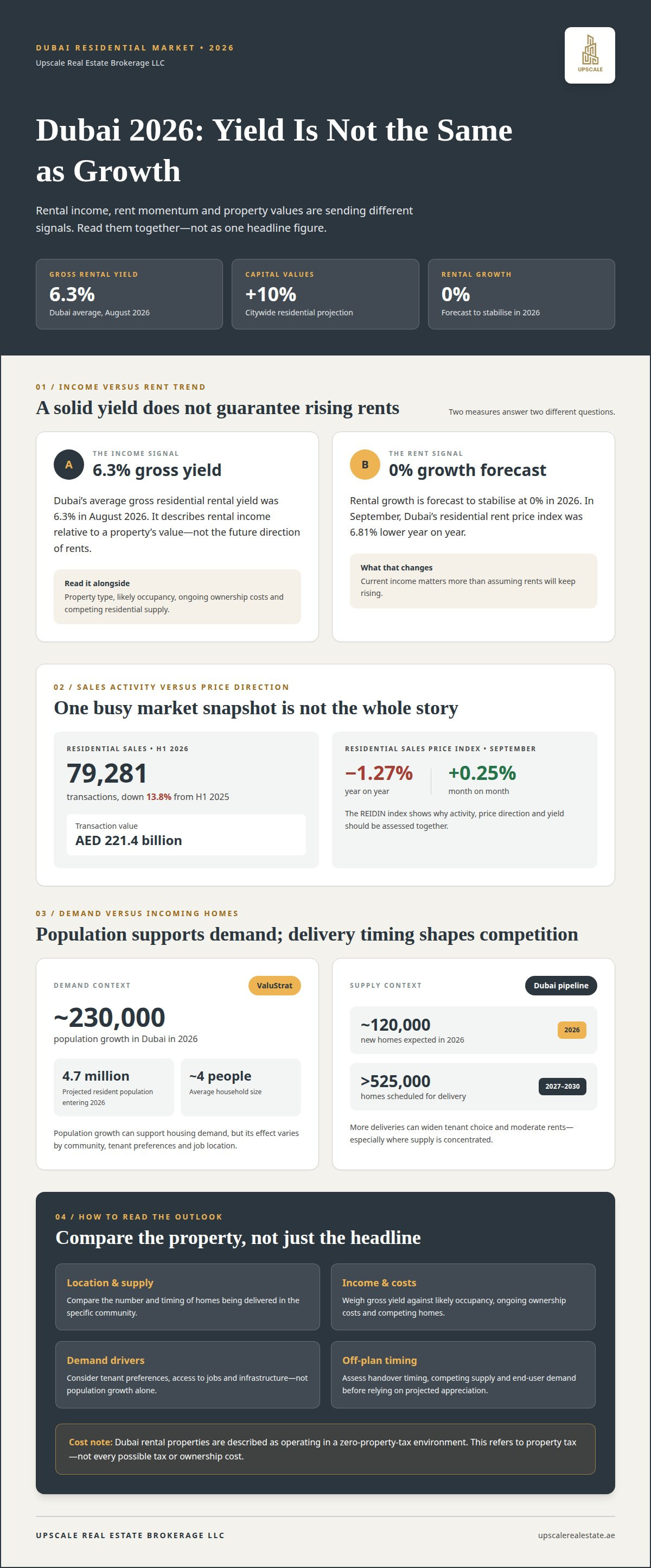
Rental yield and price growth are telling different stories in Dubai in 2026. The UAE real estate market forecast for 2026 includes an average Dubai gross residential rental yield of 6.3% as of August, while citywide residential capital values are projected to grow by 10%. Rental growth, however, is forecast to stabilise at 0%, so a solid yield doesn’t necessarily mean rents will keep rising.
That distinction matters when weighing rental income against appreciation. Population growth can support housing demand, but new homes entering the market and the timing of off-plan handovers can affect rents, buyer choice and prices differently from one community to another.
This forecast explains what the yield figures mean for investors, how population growth and incoming supply may shape Dubai’s market, and why handover timing matters when assessing off-plan property. You’ll get a grounded view of the factors behind the 2026 outlook, so you can compare income potential with price prospects rather than relying on a single headline figure.
Key Takeaways
- Assess rental income alongside rent trends and property type, rather than treating a headline yield as a complete investment measure.
- Use population growth as a demand signal, then compare it with the number and timing of homes being delivered in each community.
- Dubai recorded 79,281 residential sales in H1 2026, while transaction volumes were 13.8% lower than in H1 2025. Read activity and pricing together to gauge market momentum.
- For off-plan purchases, weigh the handover timeline, competing supply and end-user demand before relying on projected appreciation.
Are rental yields good in Dubai in 2026?
The UAE real estate market forecast for 2026 points to attractive yields but slower rental growth. Dubai’s average gross residential rental yield was 6.3% in August 2026, while its residential rent price index was 6.81% lower year on year in September. Rental growth is forecast to stabilise at 0% in 2026, making current income more important than assumptions of rising rents.
Sales activity also calls for a measured reading of investor sentiment. Dubai recorded 79,281 residential sales transactions in H1 2026, down 13.8% from H1 2025, while transaction value reached AED 221.4 billion. The REIDIN residential sales price index was 1.27% lower year on year in September, yet rose 0.25% month on month. These indicators show why investors should assess demand, price direction and yield together, rather than treating one busy quarter as proof of sustained momentum.
Supply adds pressure to that balance over the next 12-36 months. Around 120,000 new homes are expected in Dubai in 2026, and more than 525,000 homes are scheduled for delivery between 2027 and 2030. Moody’s expects more than 150,000 new homes to be built across the UAE from 2025 to 2027. More deliveries can widen tenant choice and moderate rents, especially where supply concentrates. ValuStrat reported that Dubai home prices fell 6% month on month in March 2026.
For investors, compare an apartment’s gross yield with likely occupancy, ongoing ownership costs and competing residential supply. Dubai rental properties are described as operating in a zero-property-tax environment. This refers to property tax, not every possible tax or cost. Global economic conditions can affect buyer confidence and demand, and Dubai’s average yield alone cannot predict how a specific unit will perform. The practical outlook is selective: yields remain notable, but pricing and rent growth depend on location, property type and incoming supply.
Population growth and housing demand
Dubai’s expanding resident base supports housing demand, but population growth doesn’t affect every community equally. According to ValuStrat, Dubai’s population grew by about 230,000 people in 2026. The resident population was projected to reach 4.7 million as the market entered 2026. With an average household size of approximately four people, population increases translate into demand for additional homes. Investors should compare that demand with available housing, tenant preferences and the location of new jobs.
The wider economic outlook also shapes purchasing power and rental demand. UAE GDP growth is projected at 5% in 2026, with growth projected to rebound to 8.3% in 2027 as global trade routes and supply chains stabilise. Those forecasts frame the outlook, but property performance remains local: employment access, transport links and the type of housing delivered all influence demand within individual communities.
Abu Dhabi shows why national trends need local context. CBRE reported residential prices were 21.6% higher year on year in Q2 2026, while early signs of rental stabilisation suggested the market was beginning to normalise. Cavendish Maxwell projected 15,900 home completions in Abu Dhabi in 2026. For investors, rising prices alongside rental moderation mean yields and tenant demand deserve separate attention.
Infrastructure can support housing demand by improving access to jobs and amenities. Dubai’s D33 strategic plan aims to make the city one of the world’s top four financial centres. Creek Harbour and Expo City are expected to maintain strong occupancy, supported by infrastructure improvements and job opportunities. These local drivers can help attract residents, while new deliveries influence rental growth. After two years of record-breaking rental increases, the UAE market is forecast to see a more measured pace in 2026. Rental owners can consider how property management supports their plans for tenant demand and ongoing ownership.
Final thoughts: will Dubai property prices rise or fall in 2026?
Dubai’s 2026 outlook points to growth overall, but not every segment is expected to rise. Citywide residential capital values are projected to grow by 10%, while some forecasts predict declines of up to 15% in certain segments, particularly mid-tier apartments. Abu Dhabi’s REIDIN sales price index was 11.17% higher year on year in September 2026. Ras Al Khaimah apartment prices were 4.73% lower year on year that month, showing how emirate-level trends diverge.
Supply is central to the balance between demand and price growth. A larger housing supply pipeline may give buyers more choice and bargaining power. Absorption matters as much as completions: population and job growth support demand, but concentrated deliveries can put pressure on rents and apartment values. Compare each development’s handover timing, location and competing supply before assessing its likely market position.
Global economic conditions and currency trends can also affect international buyer confidence and investment decisions. The Central Bank of the UAE raised its Base Rate by 0.25 percentage points to 3.90% from 17 September 2026. Financing costs influence mortgage affordability and buyers’ budgets; mortgage availability also affects how many purchasers can act at a given price level. These pressures can moderate demand, even where infrastructure and employment support expansion.
Office conditions offer a different signal from residential supply. Dubai and Abu Dhabi office markets recorded double-digit annual rental growth amid tight supply, while Dubai office capital values and rental rates are anticipated to increase by 15% in 2026. That strength may support business activity, but it doesn’t remove housing risks. Compare residential demand with upcoming deliveries, and weigh a community’s infrastructure against its new supply. For 2026, the clearest reading is selective growth, with outcomes varying by emirate, property type and absorption.
Off-plan investment and handover appreciation
Off-plan purchases can offer exposure to price growth before a home is completed, but the projected return depends on the project and its market. ValuStrat counted off-plan properties as 76% of Dubai residential sales in Q2 2026, showing their significant role in the property market. Some forecasts estimate that early buyers in major Dubai developments could realise 20-40% appreciation upon handover. Treat that as a forecast, not an assumed investment outcome.
Delivery volumes matter. Dubai recorded approximately 29,000 residential handovers in 2024 and approximately 42,000 in 2025, while more than 150,000 new residential units were launched during 2025. A project’s handover arrives into a market shaped by competing homes, buyer demand and tenant occupancy. If several developments complete in the same area, new residents have more choice, and landlords may face stronger competition for tenants.
Assess an investment in stages. First, compare the project’s location and infrastructure with those of established communities. Then consider whether employment, transport and amenities can sustain buyer interest and occupancy. Finally, compare the expected completion date with nearby project handovers. A sound investment case rests on end-user demand and rental potential, not just projected resale gains. The wider market can rise while an individual project underperforms its surrounding area.
At handover, compare the property’s then-current market value with your total acquisition outlay and intended holding strategy. Appreciation on paper does not equal realised proceeds; the outcome depends on the achievable sale price and costs involved. For a rental strategy, assess likely occupancy and competing supply instead of relying only on capital growth forecasts. A disciplined review of project timing, location and demand gives buyers a clearer basis for deciding whether an off-plan investment fits their objectives. Explore off-plan project options with these factors in mind.
Upscale Real Estate Brokerage: Ready Property Sales
Upscale Real Estate Brokerage LLC helps buyers compare ready properties and off-plan opportunities against their investment objectives. Ready Property Sales can suit buyers seeking an existing home, while Off-Plan Project Sales provide access to properties under development. The right fit depends on your preferred timing, income strategy and willingness to wait for handover.
For owners focused on rental income, Residential Leasing and Property Management can support the next stage after purchase. These services are relevant when assessing tenant demand or managing a residential investment over time. Discuss how your preferred property type and holding strategy fit the market factors in this forecast.
Contact Upscale Real Estate Brokerage LLC to discuss your property plans, or visit upscalerealestate.ae.
Make your next property decision with clarity
Use the UAE real estate market forecast 2026 as a framework for decisions, not a substitute for assessing a specific property. Before committing, define whether your priority is rental income, potential appreciation or a home that meets your own needs. Then compare suitable locations, property condition, expected holding period and the effect of future supply on your plans.
Upscale Real Estate Brokerage offers Ready Property Sales and Off-Plan Project Sales for buyers considering completed homes or developments under construction. Residential Leasing can support owners planning to rent out a property. The right next step depends on your investment goals and whether you plan to buy, hold or lease.
For a focused discussion of your property plans and the options that fit them, contact Upscale Real Estate Brokerage. A clear strategy can help you approach the market with greater confidence and make your next decision deliberately.
Frequently Asked Questions
Dubai real estate trends 2026: What's cooking?
Dubai’s 2026 trends point to selective price movement, with outcomes differing by property type and community. Prime homes can respond differently from mid-tier apartments as supply, buyer budgets and rental demand shift. To assess a specific listing, compare achieved prices with similar completed homes nearby, then consider local handovers and tenant interest. That gives a more useful decision frame than relying on a citywide headline.
Off-Plan: Why It Will Perform Better in 2026?
Off-plan property may suit buyers seeking staged payments and exposure to a development before completion, but it is not certain to outperform ready property. Compare the payment schedule with your cash-flow capacity, then assess construction progress, handover timing, nearby competing projects and likely end-user demand. If you want immediate rental income, a home available for occupancy may be a better fit than waiting for completion.
What can you expect further?
Market outcomes will increasingly depend on whether new homes are absorbed as they arrive. If you are planning a purchase, track a project’s completion schedule alongside nearby launches, then compare resale and rental demand for the same unit type. Buyers considering a longer hold can also monitor currency movements and global conditions, which may affect international investment appetite. Revisit your assumptions as these factors change.
Will Dubai face oversupply by 2026?
Oversupply could emerge in particular locations or apartment categories, but a large development pipeline alone does not establish a market-wide surplus. The key test is absorption: whether new homes attract residents, tenants and buyers as they are delivered. Compare clusters of completions with employment access, transport and competing properties. When similar units enter the market together, landlords may need to compete more actively on rent and property features.
How is UAE rental demand and rent growth expected to change in 2026?
Rental demand may remain supported by population and employment growth, while rent increases moderate after recent rapid rises. Prime districts may continue to see stronger rent growth, though increases could slow from double-digit gains. New homes in Jumeirah Village Circle and Al Furjan may ease rents locally. Landlords can compare occupancy prospects and competing listings in their community to set realistic expectations.
Which UAE cities and neighborhoods are forecast to see the strongest property growth in 2026?
Forecasts project price growth of six to eight percent in Jumeirah Village Circle, seven percent in Arjan and six percent in Dubai Creek Harbour. Dubai Hills Estate is forecast to gain five to seven percent, while Palm Jumeirah is forecast to gain four to six percent. Compare these outlooks with local supply, access and your investment horizon before choosing a property.