UAE retail rents rose 5.9% year on year in H1 2026, while retail vacancy tightened to 4.8%. The retail space leasing trends in the UAE in 2026 point to continued demand, but performance varies significantly by location and retail format across the Emirates.
Headline growth does not mean every shop, mall or community is moving at the same pace. For leasing and investment decisions, the difference between a high-footfall destination and a neighbourhood serving nearby residents can matter as much as the wider market direction.
This overview explains where key UAE shop leases are concentrated, how demand differs between malls and community locations, and which indicators can help assess an opportunity. It also clarifies why rent movement, lease activity and vacancy each tell a different part of the story, helping you assess a location against your commercial objectives with Upscale Real Estate Brokerage LLC.
Key Takeaways
- Use lease activity as well as rent levels to spot where retail demand is concentrated; Dubai’s Deira cluster accounts for a notable share of shop leases.
- Assess rent-free periods alongside early-termination terms to understand how lease flexibility may affect your occupancy planning.
- Distinguish mall demand from community retail demand by considering tourism exposure, resident footfall and the role of the tenant mix.
- Compare rent movements with vacancy and lease-registration trends to build a more balanced view of a location’s investment potential.
Where Is Retail Rent Concentrated Across Dubai?
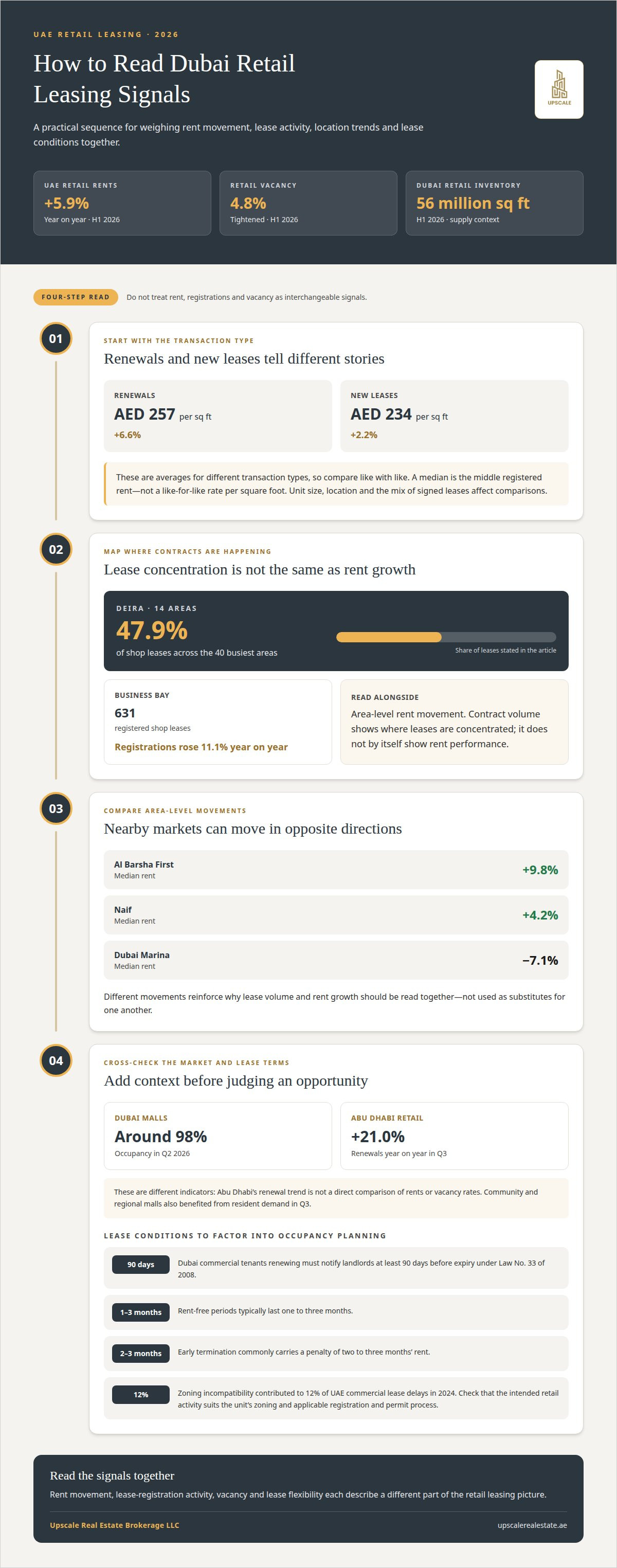
Renewals rose 6.6% to AED 257 per sq ft, while new leases increased 2.2% to AED 234. These averages describe different transaction types, so they shouldn’t be treated as interchangeable. A median is the middle registered rent, not a like-for-like rate per square foot; unit size, location and the mix of signed leases affect comparisons.
Lease activity is concentrated differently from rent levels. Deira’s 14 areas represented 47.9% of shop leases across the 40 busiest areas. Business Bay recorded 631 registered shop leases, and registrations there rose 11.1% year on year. Naif’s median rent rose 4.2%, while Al Barsha First’s increased 9.8%. Dubai Marina’s median rent fell 7.1%. These contrasting movements show why an area’s contract volume and rent growth should be read together.
Across emirates and mall types, Dubai mall occupancy was around 98% in Q2 2026; community and regional malls also benefited from resident demand in Q3. Abu Dhabi retail renewals rose 21.0% year on year in Q3, but that renewal trend isn’t a direct comparison of rents or vacancy rates.
For leasing, align the proposed retail activity with the unit’s zoning and applicable registration and permit process; zoning incompatibility contributed to 12% of UAE commercial lease delays in 2024. Dubai commercial tenants renewing must notify landlords at least 90 days before expiry under Law No. 33 of 2008. Rent-free periods typically last one to three months, often providing the necessary window for space planning and interior fit-outs by providers like Right Solution Contracting LLC, while early termination commonly carries a penalty of two to three months’ rent. These terms, alongside rent and area-level contract trends, shape occupancy costs and lease risk.
Commercial property categories and location selection
Dubai retail premises can serve restaurants, cafés, salons, boutiques, medical clinics and convenience stores, each with different location needs. A café may depend on passing foot traffic and visibility, while a convenience store may rely on regular nearby customers. A clinic or salon may need easy access and a setting suited to repeat visits. Match a unit’s visibility, accessibility and surrounding foot traffic to the business model and customer journey.
Choosing a location involves more than finding a busy address. Consider how customers reach the premises, which neighbouring businesses attract visitors, and whether the surrounding area supports the tenant’s day-to-day offer. A destination boutique may need a different setting from a convenience store serving residents. For restaurants and cafés, check whether the surrounding mix and access suit the intended customer experience. These criteria help distinguish a strong fit from a location that merely looks busy.
A practical screening process can focus on four linked questions:
- Use: Does the unit suit the intended retail category, such as a clinic, salon or café?
- Access: Can customers reach and identify the premises easily?
- Catchment: Does nearby foot traffic reflect likely customers, rather than passing volume alone?
- Lease structure: In high-footfall locations, consider whether rent also includes a share of tenant sales.
Retail formats are evolving, too. UAE retailers are adopting phygital showrooms that combine a visible brand presence with micro-fulfilment. For some tenants, this means assessing a unit for customer engagement and order handling, not just direct sales. The right choice depends on how the physical location supports the business’s wider sales model.
For a focused assessment, review Dubai retail leasing options against your intended use, access needs and customer profile before weighing individual opportunities.
Mall and community retail demand
Dubai had 56 million sq ft of retail inventory in H1 2026, providing the supply context for leasing decisions. That figure describes existing inventory, not a count of malls or mixed-use projects opening during the year. For location analysis, distinguish available retail stock from demand signals in operating destinations, including malls and community centres.
Resident demand supported UAE mall footfall in Q3 2026, when summer heat limited outdoor leisure options. Community and regional malls benefited from this local customer base and relied less on tourism, helping landlords maintain rental positions. Super-regional malls draw on a different mix of demand, including tourism and destination shopping. Dubai Mall welcomed more than 111 million visitors in 2024, illustrating the scale of footfall at a major destination, though visitor volume alone doesn’t establish a tenant’s sales potential.
Tenant mixes are changing as well. Some major UAE brands are consolidating space in super-regional malls. Landlords are responding with private-label and smaller international brands, alongside smaller-format dining and flexible food halls. For tenants, this may open opportunities in compact units and curated spaces, while reshaping the competitive mix around established retailers. Corporate leasing decisions should account for how the mall’s evolving offer fits the customer base and operating model.
Tourism can support demand in destination malls, while resident visits underpin community locations throughout the year. E-commerce also changes the role of physical retail: stores can complement online browsing through product experiences, services or convenient fulfilment. Population growth may expand a local customer base, but its value to a specific unit depends on nearby residents and accessibility. Assess the mall’s tenant mix, the balance of resident and visitor demand, and the role of physical stores in the retailer’s wider sales strategy.
Retail investment indicators to monitor
Dubai’s retail inventory stood at 56 million sq ft in H1 2026, while vacancy tightened to 4.8%. Together, these figures show a large market with limited vacant space. Vacancy offers context, not a standalone investment signal: assess it alongside tenant demand, lease activity and the specific asset’s position.
Prime locations can move differently from the wider market. Dubai Mall’s Fashion Avenue ranked as the 11th most expensive retail location globally, with rents rising 9% year on year. The contrast between a landmark destination and other districts makes submarket analysis essential. A citywide average can obscure the pricing and leasing conditions around an individual property.
Transaction measures add another layer of insight. New retail contracts in Dubai fell 7.3% year on year in Q3 2026, then rose 7.2% quarter on quarter. Renewals fell 13.4% quarter on quarter during the same period. These movements capture different leasing decisions, so track new agreements and renewals separately when assessing momentum.
Yield can help frame potential income against asset value. Dubai retail and prime asset yields were cited at 6-8% in Knight Frank’s 2026 Wealth Report. Treat that range as market context, not an estimate for every property. Compare the asset’s location, leasing profile and occupancy costs before applying yield assumptions in investment modeling. In addition, property investors aiming to secure consistent rental returns can consider rental guarantee services from Takeem. Industrial property indicators should remain separate because they reflect a different asset category.
For a focused review, compare four signals: vacancy direction, rent movement, new-contract activity and renewals. Then check whether the figures reflect the property’s submarket and tenant profile. This turns market data into more useful investment insights without relying on a single headline statistic.
Discuss your Dubai retail investment strategy using these indicators as a starting point.
Upscale Real Estate Brokerage
Upscale Real Estate Brokerage LLC helps clients make informed Dubai property decisions through Property Sales, Property Leasing, Property Management and Investment Advisory. If retail leasing indicators are shaping a wider portfolio strategy, its team can advise on ready and off-plan property opportunities, as well as property management and investment decisions. These services support ownership, leasing and ongoing asset oversight alongside the market assessment in this article.
Consider speaking with the team when weighing property options or deciding how ownership and management fit your objectives. Clarifying your priorities can help focus the next step, whether you are considering a ready property, an off-plan project, a residential lease or property management.
Contact Upscale Real Estate Brokerage LLC to discuss your property objectives.
Make Your Next Property Decision With Clarity
The retail space leasing trends in the UAE in 2026 can inform your outlook, but a sound decision also depends on your wider property objectives. Treat market signals as inputs to a strategy, then consider how location, investment horizon and asset management priorities align with your plans.
Upscale Real Estate Brokerage LLC can support related property decisions through Ready Property Sales, Off-Plan Project Sales and Residential Leasing. These services may be relevant when your next step involves acquiring a property or assessing residential options alongside your commercial interests.
For a considered discussion of your property objectives and possible next steps, contact Upscale Real Estate Brokerage LLC. A clear strategy starts with the goals you want your property decisions to serve.
Frequently Asked Questions
How Is Dubai’s Retail Property Market Performing in 2026?
Dubai’s retail market shows rent growth alongside strong occupancy, but leasing activity varies by transaction type and location. For a practical assessment, separate new leases from renewals, then compare both with vacancy and local contract activity. This helps distinguish ongoing tenant demand from rent changes affecting existing occupants. A busy district can still differ from a prime mall in tenant mix and leasing conditions.
Does the analysis include shops inside malls?
Mall demand indicators and registered shop lease activity measure different things. Mall occupancy and visitor numbers describe destination performance, while area-level lease registrations track contracts across a district. For example, a mall’s occupancy rate should not be treated as the leasing rate for every shop in the surrounding area. Use each measure to assess the relevant property format.
How much does it cost to rent a shop in Dubai?
The reported average was AED 234 per sq ft for new leases and AED 257 per sq ft for renewals. These are market benchmarks, not a quote for an individual unit. To estimate a specific shop’s base rent, apply its agreed rate to the area specified in its lease.
What are the key retail leasing trends in the UAE in 2026?
The retail space leasing trends in the UAE in 2026 include demand from both destination shoppers and local residents, alongside changing tenant formats. Some retailers use physical stores as brand showrooms and fulfilment points, while mall landlords introduce smaller-format dining and flexible food halls. For a tenant, the practical question is how the unit supports customer experience, sales channels and daily operations.
What are current retail rents per square foot in Dubai and Abu Dhabi in 2026?
For Abu Dhabi, the available market indicator is renewal activity: retail renewals rose 21.0% year on year in Q3 2026. That percentage describes contract movement, not a rent-per-square-foot figure. Keep the measures distinct when comparing emirates, and avoid treating renewal growth as a direct rental-rate comparison.
Which UAE retail locations and sectors are seeing the strongest leasing demand in 2026?
In Dubai, registered lease volume was especially high in Naif, with 5,481 contracts, followed by Al Suq Al Kabeer with 3,673 and Al Mararr with 2,827 in 2026 year to date. Business Bay recorded 631 contracts and an 11.1% annual increase. Retail formats include cafés, restaurants, salons, boutiques, clinics and convenience stores; fit depends on the location’s customers and access.