

The highest-rent commercial property isn’t always the most valuable. In the UAE, commercial property valuation methods weigh income potential, operating costs and comparable sales, while the cost approach can help assess specialised assets with limited market evidence. The right method depends on the property and the strength of the available information.
It’s easy to assume that valuing a commercial property is much like valuing a home. Both involve location and market evidence, but commercial value depends more directly on rental income, occupancy, lease terms and asset-specific risk. Residential valuations, by contrast, tend to rely more heavily on comparable sales.
This guide explains how income, costs and comparable transactions inform commercial property value, and why the assessment differs from a residential valuation. It covers how net operating income and capitalisation rates shape an income-based estimate, when the sales comparison or cost approach is useful, and why leases and intended use matter.
Key Takeaways
- Assess a leased asset through the income it can sustain, after accounting for operating costs and the risk reflected in the capitalisation rate.
- Use the cost approach when a property is specialised or comparable market evidence is limited; it considers land value and depreciated replacement cost.
- Make sales comparisons more meaningful by accounting for differences in location, size, condition, tenancy and lease terms.
- Distinguish commercial valuation from residential valuation: income, occupancy and lease structure weigh more heavily for commercial assets.
Cost Approach: When to Use It?
The cost approach estimates value from land and building costs, less depreciation. It suits specialised buildings when income or comparable sales provide limited evidence.
Cost and Replacement-Cost Valuation
Replacement-cost valuation estimates the current cost of rebuilding a property, then adds land value and accounts for depreciation. In Dubai, this approach can help assess purpose-built facilities with few comparable transactions. It can also support valuations of newly constructed buildings with limited rental history. The method focuses on what the physical asset would cost to recreate, rather than relying mainly on income or a similar sale.
These are valuation costs, not property values. The scope and complexity of the asset help determine the appropriate approach. A valuation report should state its purpose and basis clearly, so decision-makers can understand how the figure was reached.
Depreciation in the Cost Approach
Depreciation reduces replacement cost to reflect differences in a building’s condition and usefulness compared with a new equivalent. The calculation considers the cost of rebuilding, not simply the original construction cost. For example, an older building may require a greater adjustment than a newly constructed one. The land component is assessed separately, then combined with the depreciated building cost to estimate the property’s value.
This distinction matters when a specialised asset has limited market evidence. A new facility and an older one may occupy similar plots, yet their buildings differ in condition and remaining utility. A careful valuation accounts for those differences rather than treating every building as new. The Dubai Land Department is part of Dubai’s valuation framework, alongside applicable guidelines and recognised standards.
Cost per Rentable Square Foot
Cost per rentable square foot expresses a building’s assessed cost relative to the area available for rental use. It helps investors compare building-cost assumptions across commercial properties. Divide the relevant building cost by rentable area, keeping land value separate when comparing construction costs. This measure does not, by itself, establish the property’s full value.
For an informed comparison, use consistent area measurements and account for depreciation before calculating the rate. Differences in building condition, layout or rentable space can change the result, even when properties appear similar. In a cost-based valuation, this measure is one supporting indicator. Read it alongside land value and the building’s replacement cost, not as a standalone sale price.
How Is Net Operating Income Calculated for Commercial Assets?
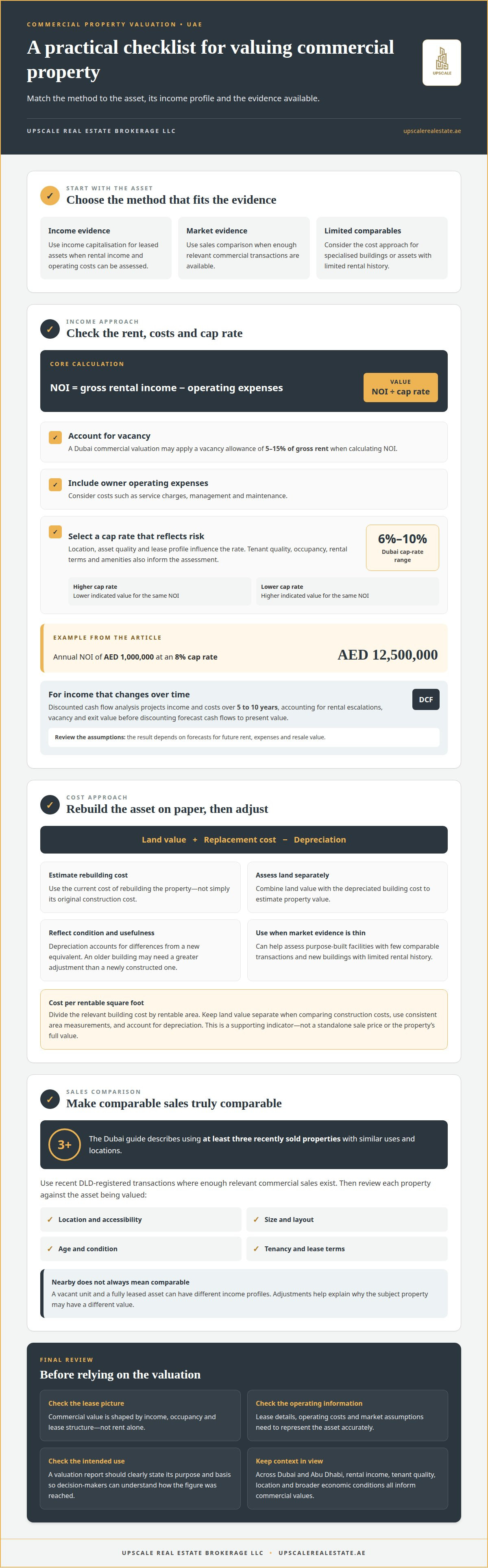
For a leased commercial asset, income capitalisation converts net operating income into an estimated property value. Net operating income, or NOI, is gross rental income less operating expenses. This method helps investors assess the income an asset generates in relation to the return reflected in its capitalisation rate.
Vacancy affects the rent available to cover expenses. A Dubai commercial valuation may apply a vacancy allowance of 5-15% of gross rent when calculating NOI. Owner expenses can include service charges, management and maintenance. The resulting NOI is divided by the capitalisation rate: at an 8% rate, annual NOI of AED 1,000,000 indicates a value of AED 12,500,000. The formula is NOI ÷ capitalisation rate.
A cap rate reflects market risk and expected return, so location, asset quality and lease profile influence the selected rate. Dubai commercial property cap rates typically range from 6% to 10%, depending on location and asset quality. Tenant quality, occupancy, rental terms and amenities also inform the assessment. A higher cap rate produces a lower indicated value for the same NOI; a lower rate produces a higher one.
For complex or large-scale assets, discounted cash flow analysis projects income and costs over 5 to 10 years. The model accounts for rental escalations, vacancy and exit value, then discounts forecast cash flows to estimate present value. Its result depends on assumptions about future rent, expenses and resale value. These projections make it useful for assets whose income changes over time, while also making the assumptions important to review.
Across Dubai and Abu Dhabi, commercial values reflect rental income, tenant quality, location and broader economic conditions. Valuation limits arise when lease information, operating costs or market assumptions fail to represent the asset accurately. For investors considering how lease profile shapes income, commercial leasing context can inform the assessment.
Sales comparison approach and comparable transactions
The sales comparison approach estimates market value by analysing similar properties sold in the same area. In Dubai, valuers use recent DLD-registered transactions and adjust for differences between each comparable property and the asset being valued. This method is most useful when enough relevant commercial sales exist to reveal meaningful pricing patterns.
A practical analysis begins by identifying comparable assets with similar uses and locations. The Dubai guide describes using at least three recently sold properties. For example, a four-floor commercial building can be compared with other four-floor buildings nearby. The analysis then considers location, accessibility, size, layout, age, condition, tenancy and lease terms. Each adjustment helps explain why the subject property may have a different value.
Dubai Land Department transaction data supports transparent valuation by giving valuers registered sales evidence. But a nearby transaction is not automatically a strong comparable. A vacant unit and a fully leased asset may have different income profiles, while lease terms can affect investor demand. Comparing like with like helps separate wider market trends from features specific to one building.
The method has limits for commercial real estate because assets can differ sharply in use, layout and tenant arrangements. A warehouse and an office building, even in the same district, may not offer useful direct comparisons. When evidence is limited, the sales comparison approach is less conclusive and may be considered alongside income or cost analysis.
For financing or acquisition decisions, comparable sales provide a market-based reference, not a guaranteed transaction price. Investors and developers evaluating capital options can look to property finance specialists such as thefederalgroup.com when structuring acquisitions and development funding. An illustrative Dubai commercial property example estimates value at AED 12,500,000, but that figure applies to the example, not every similar asset. A valuation report should explain which transactions informed the estimate and how differences affected the final assessment.
Commercial and residential valuation differences
In Dubai, commercial and residential valuations rely on different evidence. Commercial values depend heavily on income potential, occupancy, lease structures and asset-specific risk. Residential values rely more on comparable sales. That distinction matters: valuing a leased office with stable rental income requires analysis of its tenants and lease terms, not just nearby sale prices.
Commercial properties also vary by use. An office, retail unit and warehouse can have different income profiles, operating needs and buyer demand, even within the same market. Residential properties are more readily compared by location, size, layout and condition. For commercial assets, comparable transactions still provide insight, but differences in tenancy and lease terms can limit how accurately they indicate market value.
For a Dubai commercial valuation, the application for built property requires a statement of expenses for the last 3 years. The municipality map required for a valuation application must be valid for one year. A hotel valuation application also requires detailed expenses and net profits for the last 3 years from a certified accounting office.
The valuation process establishes the purpose and basis, reviews property and legal details, assesses the asset and local market, then applies an appropriate method. A commercial valuation report typically records the methodology, assumptions, limiting conditions and final opinion of value. For bank, audit or court use in Dubai, the report must state compliance with applicable UAE regulations and valuation standards. Formal valuations must be carried out by valuation firms licensed and approved by the Dubai Land Department.
The takeaway is practical: residential pricing evidence alone may not capture a commercial asset’s leases, occupancy or operating performance. An accurate assessment connects the chosen method to the property’s use and valuation purpose. For help considering a property decision in this context, discuss your real estate requirements.
Upscale Real Estate Brokerage: Commercial Leasing
Upscale Real Estate Brokerage LLC provides commercial leasing for landlords and tenants considering commercial space. A valuation can inform property decisions, while leasing is a practical next step when you’re ready to find or lease commercial premises.
Landlords can consider how leasing fits their property plans, while businesses can weigh a space’s location, layout and intended use against operational needs. Keeping these priorities clear connects valuation insights with a practical real estate decision.
If you’re exploring commercial leasing, contact Upscale Real Estate Brokerage LLC to discuss your property requirements.
Put Your Property Plans Into Motion
A valuation can inform a decision, but the next step depends on what you intend to do with the asset. If you’re assessing a purchase, lease or portfolio direction, define the decision first, then use the valuation alongside your objectives and the property’s role. Commercial property valuation methods in the UAE are most useful when they support a clear business purpose.
Upscale Real Estate Brokerage LLC supports related property decisions through Ready Property Sales, Off-Plan Project Sales and Residential Leasing. These services may be relevant when plans extend beyond commercial space to acquiring a property or arranging a home rental.
For a conversation about your next property decision, contact Upscale Real Estate Brokerage LLC. A clear next step can help you turn valuation insight into a considered plan.
Frequently Asked Questions
What Is Commercial Property Valuation?
Commercial property valuation assesses a property’s market value for a stated purpose. It applies to income-generating or business-use assets such as offices, retail units, warehouses and commercial land. The valuation considers the asset’s use and relevant market evidence. Its intended purpose, such as a financing decision or financial reporting, helps determine the appropriate basis and method.
What Cap Rates Apply to Different Commercial Asset Classes?
Indicative cap rates vary by commercial asset class. The stated ranges include 6-7.5% for Grade A offices, 7.5-9.5% for Grade B offices, 7-9% for prime retail, and 8-12% for prime logistics space. Secondary retail is listed at 8.5-11% in 2026, while mixed-use properties are listed at 7-9.5% in 2026. Asset quality and lease profile influence the applicable rate.
What Decisions Depend on Valuation Accuracy?
Accurate valuation supports financing and refinancing, acquisitions, investment decisions, financial reporting and portfolio revaluation. For example, a company updating its balance sheet needs a defensible value for its commercial assets, while a lender uses valuation evidence when considering financing. In court cases, legal disputes and business restructuring, a reliable assessment can also inform decisions. The valuation’s purpose should shape its scope and reporting.
What are the main commercial property valuation methods used in the UAE?
The main approaches are income capitalisation, sales comparison and cost. Income capitalisation suits assets where rental income is central to value. Sales comparison draws on transactions involving similar properties, while the cost approach considers land value and the depreciated cost of replacing the building. Discounted cash flow analysis can assess complex or large-scale properties by modelling projected income and value over time.
How does the income capitalization method value commercial property in the UAE?
It converts an asset’s net operating income into an indicated value using a capitalisation rate. For instance, if annual net income is AED 1,000,000 and the selected rate is 8%, dividing income by the rate gives an indicated value of AED 12,500,000. The selected rate reflects expected return and asset risk, while lease terms, tenant quality and occupancy inform the income assessment.
When is the comparable sales method used to value commercial property in the UAE?
The comparable sales method is useful when relevant transactions provide evidence for similar commercial properties. A valuer can compare assets with similar uses, then account for differences in accessibility, size, condition, tenancy and lease terms. The method is less conclusive when properties have distinct purposes or comparable sales are limited. In those cases, income or cost analysis can provide additional valuation evidence.