

A property in Sobha Hartland can look ideal on paper yet fail to fit your day-to-day needs or investment plan. Community-wide descriptions are a useful starting point, but they don’t show whether a specific building, unit, ownership structure or project status suits your decision.
It’s reasonable to be drawn to a well-planned residential community while still wanting clear evidence before committing. This 2026 guide outlines the residential mix and lifestyle considerations, then offers a practical way to assess an individual property against your priorities. It also explains why distinguishing the original community from Sobha Hartland II matters when comparing project status and investment assumptions.
You’ll find steps for reviewing rental evidence, service charges, ownership details and documents relevant to a purchase or investment decision. Rather than relying on a community-wide headline, assess the asset itself: its condition, costs, status and suitability for your intended use. With objective-led brokerage guidance and careful due diligence, you can make a more grounded decision about whether a particular Sobha Hartland property belongs in your plans.
Key Takeaways
- Compare apartments, duplexes, townhouses and villas by space, privacy, upkeep and how you plan to use the property.
- Assess Sobha Hartland at the building and unit level. The community’s reputation alone can’t establish a property’s suitability or investment performance.
- Separate gross rental yield from net yield and cash flow, and account for costs and assumptions before judging potential returns.
- Follow a due-diligence sequence that fits your situation, with distinct checks for buyers, renters and off-plan purchases.
- Define your property type, timing and priorities first so sales, leasing, management or investment advice can support a clearer decision.
What Is Sobha Hartland? Understand the Community Beyond Its Luxury Positioning
Sobha Hartland is a residential community and mixed-use development by Sobha Realty, with apartments, duplexes, townhouses and villas across different buildings and residential enclaves. Its luxury positioning describes the intended market, but it doesn’t establish the condition, completion status, outlook or value of a particular home.
Keep the scope clear, too. The original Sobha Hartland and the newer Sobha Hartland II are separate communities, with different developments and delivery timelines. A listing or conversation that uses the community name broadly may not make that distinction clear. Before comparing properties or relying on project information, confirm which development, building and unit are being discussed.
In brief: Sobha Hartland is a mixed-use residential community with several home formats, but the experience and investment case depend on the specific property.
What does the community offer residents?
The master plan includes green spaces and lagoons, while the forthcoming Sobha Mall is expected to add retail and leisure options. These are community-level features, not proof that a particular residence has direct access to them or that a facility is currently open. Plans and operating status can change, so distinguish amenities that are planned from those available to residents today.
Building-level facilities are a separate consideration. Access to a pool, gym, parking, security or other shared areas can depend on the building and its arrangements. Establish whether a feature applies to the exact property and is usable before treating it as part of your decision. A map or community brochure can help with orientation, but it can’t replace information specific to the unit and building.
Who might consider living or investing here?
Owner-occupiers can compare layouts, privacy, daily access and the spaces their household will actually use. A family may prioritise room configuration and nearby green space; a tenant may place greater weight on daily travel needs, building facilities and lease terms. These priorities can lead to different choices, even within the same community.
Investors should assess the individual asset rather than assume the community name predicts rent, occupancy or appreciation. Property type, purchase terms, ongoing costs, delivery status and intended holding period all shape the decision. A ready unit and an off-plan property also involve different timelines and considerations.
For any buyer, tenant or investor, fit comes down to the specific unit, budget and intended use or holding period. Use community descriptions as a starting point, then test each claim against the property’s actual details. That approach gives you a more grounded basis for deciding whether Sobha Hartland aligns with your plans.
Apartments, Villas, and Townhouses: How Sobha Hartland’s Property Mix Differs
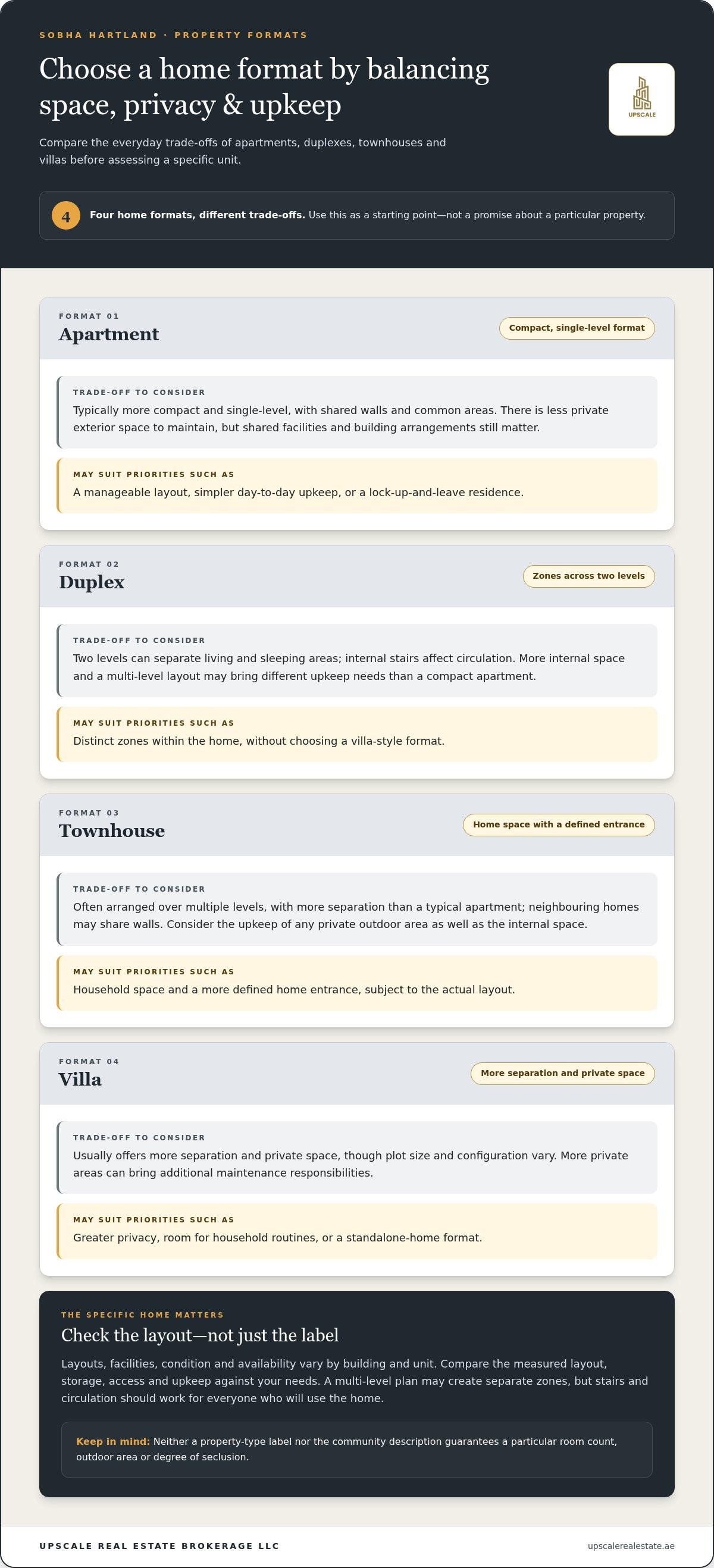
Property type shapes more than floor area. It affects how you use the space, the degree of separation from neighbours and the upkeep involved. The comparison below outlines common format-level trade-offs, not a promise about a specific home in Sobha Hartland. Layouts, facilities, condition and availability vary by building and unit, so use each row as a starting point for viewing and due diligence.
| Property type | Space and privacy | Maintenance considerations | May suit priorities such as |
|---|---|---|---|
| Apartment | Typically a more compact, single-level format, with shared walls and common areas. | Less private exterior space to maintain; shared facilities and building arrangements still matter. | A manageable layout, simpler day-to-day upkeep, or a lock-up-and-leave residence. |
| Duplex | Two levels can create separation between living and sleeping areas; internal stairs affect circulation. | More internal space and a multi-level layout may mean different upkeep needs than a compact apartment. | Buyers seeking distinct zones without choosing a villa-style format. |
| Townhouse | Often arranged over multiple levels, with more separation than a typical apartment; neighbouring homes may share walls. | Consider the upkeep of any private outdoor area as well as internal space. | Household space and a more defined home entrance, subject to the actual layout. |
| Villa | Usually offers more separation and private space, though plot size and configuration vary. | More private areas can bring additional maintenance responsibilities. | Greater privacy, room for household routines, or a standalone-home format. |
Which property type aligns with your use case?
Start with how you’ll use the home. An apartment may suit a buyer prioritising a compact format, while a duplex can offer separation across levels. Townhouses and villas may appeal to households seeking more space or privacy, but neither label guarantees a particular room count, outdoor area or degree of seclusion. Compare the measured layout, storage, access and upkeep against your needs. For example, a multi-level plan may create separate zones, but stairs and circulation should work for everyone who will use the home.
Why building-level differences matter
Even within one property type, the building’s position in the community, outlook, layout, facilities and current condition can change the experience. Completion and handover status can also differ between projects and buildings. Property directories such as Propsearch can provide building and construction categories as research prompts, but these aren’t proof of current status or availability. Verify the specific unit and its building information before making comparisons.
For investment context, Global Property Guide’s UAE property market outlook for 2026 can help frame broader questions about price trends and rental-market conditions. It can’t establish the likely performance of an individual property. A sound comparison still depends on the unit, its costs and your intended use.
Set your priorities before viewing: space, privacy, maintenance tolerance and timing. An objective-led review of property sales and investment advisory can help you compare formats against your plans without treating every home as interchangeable.
Is Sobha Hartland a Sound Investment? Assess Returns, Costs, and Risk
A prestigious community name doesn’t guarantee a strong investment. The result depends on the price paid, achievable rent, ownership costs, timing and the specific unit. Treat any headline yield or appreciation claim as a starting point for analysis, not a forecast. Compare ready and off-plan options using consistent assumptions, while accounting for differences in delivery timing, rental start date and available evidence.
Keep four measures separate. Gross rental yield is annual rent divided by the purchase price, before expenses. Net yield estimates annual rental income after relevant operating costs, divided by the investment basis. Capital appreciation is a change in the property’s value over time, separate from rent and not guaranteed. Cash flow is the income left after the expenses and payments included in your model. A property can show an appealing gross yield yet produce a different net result once costs and vacant periods are included.
How to assess rental potential without relying on headlines
Compare the asking rent with completed rental transactions for genuinely similar properties. Match the building, property type, layout, size and condition as closely as possible. Asking rent shows the landlord’s advertised target; a completed transaction provides evidence of rent agreed. Neither alone proves what your unit will achieve. Check the evidence period and whether the comparison reflects similar lease terms and furnishing status.
Model a realistic vacancy allowance instead of assuming continuous occupancy. Don’t treat market-wide or community-level yield figures as a forecast for a specific unit. Any projection should identify its source, time period, property sample and calculation method. Without those details, it’s difficult to determine whether the figure applies to your decision. Test how a lower achieved rent or longer vacancy period would affect your expected income.
Which ownership costs can change the investment picture?
Build a net-yield estimate from documented inputs, not a single advertised number. Include:
- Purchase basis: the agreed acquisition price and any transaction costs included in your calculation.
- Service charges: use current figures for the specific building and unit, rather than assuming community-wide rates apply.
- Vacancy and leasing: allow for periods without rent and the costs associated with securing or renewing a tenancy.
- Maintenance and management: account for expected upkeep and any property-management costs relevant to your holding plan.
Review current ownership documents, service-charge information and lease terms, then test how changes in rent, vacancy or maintenance affect the outcome. Net results vary by unit, tenancy and holding strategy. For owners with multiple assets, portfolio planning can help assess how one property fits alongside their other holdings. For Sobha Hartland, the disciplined approach is to assess the individual asset and its evidence, not rely on reputation or a headline return.
What to Verify Before Buying or Renting a Sobha Hartland Property
Use a structured review rather than treating a community description as evidence about a particular home. In Sobha Hartland, building, unit and project details can differ, so match important claims to current records or the specific property’s documentation. Start with your purpose, then follow the checks that apply to a ready purchase, rental or off-plan commitment.
- Define your objective. Set out whether you plan to live in the property, rent it as a tenant or hold it as an investment. Record your budget, preferred property type, timing and, for an investment, intended holding period.
- Identify the exact asset. Note the development, building, unit number, property type and whether it’s ready or off-plan. Don’t rely on a broad community label to establish a unit’s identity or status.
- Gather current evidence. Match the listing and verbal descriptions against relevant unit, building and transaction documents. Resolve missing or conflicting details before relying on them in your decision.
Checks for a ready property or rental unit
Buyers should review the unit’s condition, measured layout, ownership and sale documentation, and building-specific charges. Compare the asking terms with relevant completed transaction evidence where available, making sure the properties are genuinely comparable. For broader acquisition steps, use this ready-property purchase checklist alongside unit-specific checks.
Tenants should inspect the actual unit, confirm what is included and read the proposed tenancy terms, including rent, duration, responsibilities and any stated conditions. Buyers and renters should verify facilities, access, parking and shared-area arrangements against current building information and the unit’s specific arrangements. A community amenity list alone doesn’t establish access.
Checks for an off-plan property
Review the current project status and contractual milestones against authoritative, up-to-date records. Read the sale contract for the agreed payment schedule, obligations, delivery terms and procedures if milestones change. Check that escrow references and payment instructions align with current official project and transaction records. An old listing or forecast isn’t proof of present construction progress or a handover date.
Base your decision on the documented terms, not an assumed completion timeline. Compare what the contract states with current project information, and account for how timing could affect your intended use or investment plan. If a milestone or payment obligation is unclear, pause your assessment until you understand what the signed documents require.
Keep a record of the documents and claims you relied on, including their dates. This helps distinguish confirmed unit-level facts from estimates or promotional descriptions, and makes it easier to compare properties on consistent terms.
For an objective-led review of a purchase, rental or investment decision, discuss your Sobha Hartland property plans with Upscale Real Estate Brokerage LLC.
Plan Your Sobha Hartland Property Decision with Clear Advice
A focused brief turns property research into a practical decision. Before shortlisting homes in Sobha Hartland, define how you’ll use the property, which format you prefer, when you need it and what matters most financially. For an investment, state your intended holding period and the assumptions you want to test. For a home, prioritise the layout and daily requirements that will shape your choice.
Keep the decision grounded in current information about each property. A recommendation should relate to your stated objectives and the evidence available for the specific unit, rather than relying on broad community claims or a promised outcome.
Match the service to the property objective
Buyers can compare ready and off-plan opportunities against criteria such as intended use, timing, property type and documented terms. Landlords can consider residential leasing and property management in relation to their ongoing ownership needs. For investors, investment advisory can help organise assumptions around an individual asset and broader portfolio objectives. In each case, clear priorities make it easier to assess trade-offs without treating every property as interchangeable.
Move from research to a considered next step
Share your preferred property type, budget, intended use and timing, along with the priorities that matter most. This gives the discussion a clear basis and helps keep recommendations aligned with your objectives. Brokerage guidance can support property comparisons and transaction decisions, but it isn’t legal advice, lending, or interior design and fit-out. Keep those roles distinct as you plan.
Discuss your requirements with Upscale Real Estate Brokerage LLC, a privately owned, RERA-licensed brokerage (ORN 23084), and outline what you want your property decision to achieve.
Then move forward in a clear sequence:
- Define your objectives: record intended use, timing, budget and investment priorities.
- Shortlist specific units: compare property type, building and unit details against your criteria.
- Review the evidence: assess current documentation, costs, condition, tenancy or contractual terms, and relevant market comparisons.
- Choose a transaction path: decide whether a ready purchase, off-plan purchase or residential lease best fits your plans, and identify any ongoing management needs.
A measured process won’t remove every uncertainty, but it can make the basis for your decision clearer. The right next step is the one that fits your intended use and is supported by unit-specific information.
Take the Next Step with a Clear Property Brief
A sound property decision starts with priorities you can explain and evidence you can assess. Before acting, turn your plans into a short brief: intended use, preferred property type, timing, budget and the trade-offs you’re prepared to accept. That clarity keeps the next conversation focused on what matters to you, rather than on a broad promise about Sobha Hartland.
Upscale Real Estate Brokerage LLC is a RERA-licensed brokerage, ORN 23084, supporting clients with ready and off-plan sales, residential leasing, property management and investment advisory. The aim is to connect the right property path with your stated objectives while keeping the basis for each decision transparent.
Bring your brief and the questions you still need answered. Discuss your Sobha Hartland property objectives and take a measured next step with guidance shaped around your plans. A well-defined decision can make the process clearer and help you move forward with confidence.
Frequently Asked Questions
Is Sobha Hartland a freehold community?
Yes, Sobha Hartland is identified as a designated freehold area, where eligible buyers may acquire freehold ownership. Treat tenure as a property-level detail: review the title deed or current ownership record for the exact unit, including the registered owner and any recorded interests. The community name alone doesn’t establish the tenure attached to a particular property. For a resale, confirm that the seller’s authority and unit details align with the relevant ownership documentation.
Can overseas buyers purchase property in Sobha Hartland?
Yes, overseas buyers may acquire property in designated freehold areas such as Sobha Hartland, subject to the applicable ownership structure and transaction requirements. Available rights can include freehold ownership, usufruct or long-term lease rights of up to 99 years. These arrangements aren’t interchangeable. Before proceeding, establish which right applies to the specific property and review the ownership documents and contract terms to understand what is being transferred.
Are schools located within Sobha Hartland?
Schools are part of the community’s planned mix, but that doesn’t confirm that a particular school is operating now or that it will suit your household. Families choosing a home should check the school’s current operating status, location, admissions information and practical travel route from the unit. Distinguish a school described as part of the wider plan from one that is open and accessible to residents today.
What should buyers know about escrow when purchasing an off-plan property?
An escrow account is a designated account for handling payments connected with a development. Before transferring funds, match the payment instructions to the signed sale agreement and current official project records. Review the stated payment milestones, the named account beneficiary and the contract’s provisions for delays or changes. Don’t rely on verbal instructions or a general project description; confirm the account and payment process through authoritative records relevant to that specific development.
Can service charges differ between buildings in Sobha Hartland?
Yes, charges can vary by building and property type, and an amount quoted for one residence may not apply to another. Request the latest charge information for the exact unit and clarify the area used in the calculation, billing period and any separately stated items. For a resale, compare the available charge documentation with the unit’s records. A previous owner’s payment or an older listing may not reflect the current amount.
How can I check whether a particular Sobha Hartland property is currently available?
Check a current listing against the property’s building, unit reference, asking terms and listing date, then establish whether its status has changed. Availability can shift after a listing is published, so an old advertisement isn’t proof that a home remains on the market. Keep the exact unit details with your shortlist and use current status information before arranging decisions around a purchase or tenancy.
Does the community’s listed amenity access apply to every building?
No, a community-wide amenity description doesn’t establish access for every building or unit. Some facilities may be tied to a specific development, subject to operating arrangements or still planned rather than open. Check the building’s current information and the unit’s access terms, including any rules for shared spaces. If a facility is a deciding factor, establish its operating status and resident access before relying on it in your choice.