

A stronger UAE property portfolio may come from buying fewer, better-aligned assets rather than adding properties as quickly as possible. If you’re weighing apartments against villas, ready homes against off-plan projects, or headline rental yields against the costs that affect actual returns, start by clarifying what you want the portfolio to achieve. Learning how to build a real estate portfolio in UAE begins with a clear investment purpose, not a shortlist of properties.
A disciplined plan connects your objectives, time horizon, available capital, and tolerance for vacancy or changing conditions to practical acquisition criteria. It also distinguishes gross rent from net operating income and accounts for the costs and management demands that affect performance.
This guide sets out a practical sequence for building and reviewing a balanced portfolio. You’ll learn how to compare residential and commercial opportunities, assess ready and off-plan assets, identify concentration and financing risks, and establish an ongoing review process. The aim isn’t to predict every market change, but to make measured decisions and revisit them when conditions or your circumstances change.
Key Takeaways
- Learn how to build a real estate portfolio in UAE by translating income, growth, and liquidity goals into clear acquisition criteria.
- Use a step-by-step framework to screen properties and model rent, recurring costs, vacancy, and reserves before committing capital.
- Compare ready residential, off-plan, and commercial strategies by income timing, liquidity, operating needs, and exposure.
- Identify concentration risks across property types, tenants, completion dates, and financing before and after each acquisition.
- Establish a review process that keeps portfolio assumptions visible and connects acquisition choices with ongoing property management.
How to Build a Real Estate Portfolio in the UAE Around Clear Investment Goals
A property portfolio is a group of assets managed together to meet financial and practical objectives. Those objectives might include rental income, potential long-term appreciation, access to capital, or spreading exposure across different property types. A portfolio is more than a record of purchases: each asset should have a defined role, and the combined holdings should reflect the investor’s priorities.
That distinction is central to how to build a real estate portfolio in UAE. An apartment intended to generate rental income has different demands from an off-plan property with a longer investment horizon. A property intended for future personal use has its own requirements, too. Ownership and registration frameworks can vary by emirate. A general overview of real estate in the United Arab Emirates can provide context, but decisions should be based on the requirements that apply to the specific property and emirate.
Income, appreciation, and diversification are related but distinct aims. Rental income depends on leasing and ongoing costs. Appreciation is a potential change in value, not a guaranteed return. Diversification can reduce reliance on a single asset or income source, but it doesn’t remove market or vacancy risk. The right balance depends on what you need the portfolio to do and when.
A collection of properties becomes an investment portfolio when every asset has a defined role in a shared plan.
Set the investment objectives before selecting properties
Decide which outcome leads: current rental income, potential long-term growth, or a balance of both. Then define your holding period, how much liquidity you may need, and how much vacancy exposure you can accommodate. If a property may become a personal residence or support a future relocation, weigh suitability and timing alongside investment performance. These priorities help determine which property types, investment stages, and leasing approaches to consider.
Establish a realistic portfolio starting point
Separate the capital available for acquisition from reserves for holding costs, maintenance, and periods without rental income. Record financing assumptions without treating access to finance or future income as certain. Consider how changes in costs, leasing timing, or personal circumstances could affect your ability to hold an asset. Document the assumptions behind each decision and review them before committing.
A practical starting document can be concise. Record your priority objective, intended holding horizon, liquidity needs, vacancy tolerance, and available capital. Add the reserve you intend to retain and note assumptions that depend on financing or future rental income. If personal use is part of the plan, state when and how it could change your investment criteria.
This written brief creates a consistent basis for comparing opportunities, rather than letting a compelling feature or projected return set the strategy. Investment advisory can help connect your priorities to property decisions, while comparing ready and off-plan opportunities on the same assumptions makes trade-offs easier to see. Revisit the brief when your circumstances or objectives change. Portfolio decisions should follow the plan, not quietly redefine it.
A Step-by-Step UAE Property Portfolio Building Framework
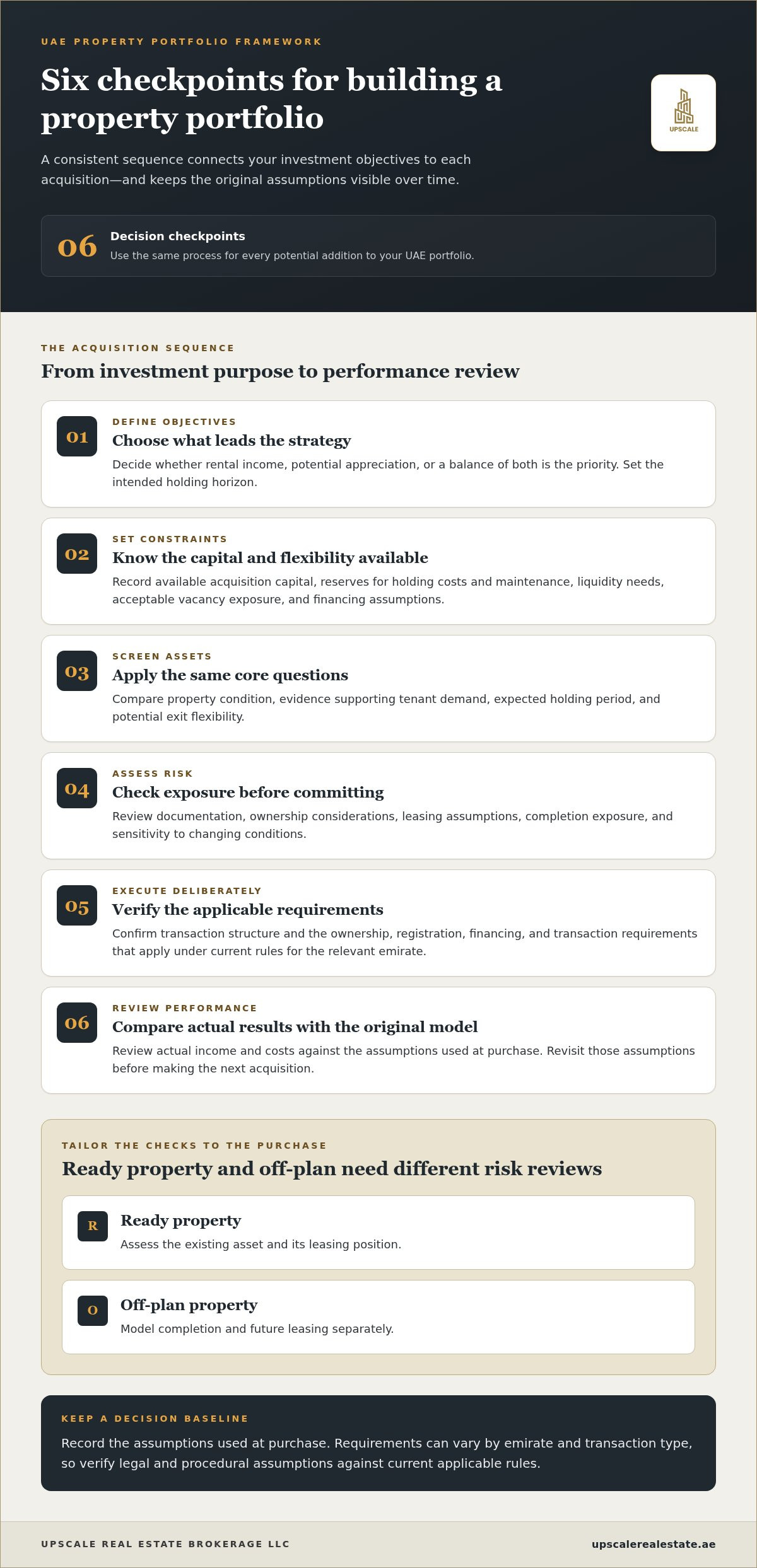
A consistent process turns investment objectives into acquisition decisions you can compare and review. Use the following sequence for each potential addition to your UAE portfolio, rather than changing your criteria to suit a particular listing.
- Define objectives. Decide whether income, potential appreciation, or a balance leads the strategy, and set a holding horizon.
- Set constraints. Establish available capital, reserves, liquidity needs, acceptable vacancy exposure, and relevant financing assumptions.
- Screen assets. Compare property condition, evidence supporting tenant demand, expected holding period, and potential exit flexibility.
- Assess risk. Review the asset’s documentation, ownership considerations, leasing assumptions, completion exposure, and sensitivity to changing conditions.
- Execute deliberately. Confirm the transaction structure and applicable ownership, registration, financing, and transaction requirements under current rules for the relevant emirate.
- Review performance. Compare actual income and costs with the original model, then revisit assumptions before making the next acquisition.
Requirements can vary by emirate and transaction type. Treat legal and procedural assumptions as items to verify against current applicable rules, not as fixed national conditions. Keep a record of the assumptions used at purchase; it provides a useful baseline for later decisions.
Screen potential acquisitions against consistent criteria
Apply the same core questions to each candidate: What is known about its condition? What supports the tenant-demand assumption? How long do you expect to hold it, and how flexible is your exit if priorities change? For ready property, assess the existing asset and leasing position. For off-plan property, model completion and future leasing separately. The screening criteria can be shared, but the risk checks should reflect the type of purchase.
For a fair comparison, use consistent assumptions for holding period, expected income, recurring costs, and reserves. Keep differences visible instead of combining ready and off-plan estimates into a single headline yield.
Model the numbers without relying on headline yield
Gross yield compares expected annual rent with the property’s purchase price, but it doesn’t show the costs or interruptions that affect operating performance. Net operating income is rental income remaining after operating expenses and vacancy allowances, before financing costs; it is not the same as gross rent. Build each property model around expected income, recurring operating costs, a vacancy allowance, and reserves for maintenance or other unplanned needs.
Include financing assumptions only when they apply to your circumstances, and separate those costs from operating performance so comparisons remain clear. Test scenarios such as lower rent, a longer vacancy, or delayed completion for an off-plan property. These are not forecasts; they show how sensitive your plan may be if assumptions change.
Investment advisory can help structure comparisons around your objectives, while property management connects acquisition planning with ongoing leasing and oversight. A considered UAE property investment advisory approach can help keep the assumptions behind each decision visible as your portfolio develops.
Compare UAE Property Strategies by Income, Growth, Liquidity, and Risk
Property type and investment stage shape how an asset may contribute to a portfolio. A ready apartment, an off-plan home, and a commercial unit differ in when income might begin, what needs managing, and how exposed the investor is to leasing or delivery delays. None is automatically the better choice. The right fit depends on documented objectives, time horizon, liquidity needs, and capacity to manage risk.
| Strategy | Income timing and exposure | Liquidity and operating needs | Diversification role |
|---|---|---|---|
| Ready residential | Potentially near-term leasing, subject to condition, tenant demand, and any existing tenancy. | Physical condition and leasing arrangements can be assessed before purchase; ongoing tenant and property oversight is required. | Can add a different unit or residential configuration, though several similar properties may still share the same risks. |
| Off-plan | Rental income generally depends on delivery, handover, and subsequent leasing; timing and execution are key exposures. | Resale options and timing may be limited by project stage and applicable terms; oversight involves tracking progress and payment commitments. | Can diversify investment timing or property exposure, but multiple projects with similar completion dates can concentrate delivery risk. |
| Commercial property | Income depends on business occupancy, lease terms, and the tenant’s ability to meet its obligations. | Business use, lease structure, and property-specific operating requirements need careful attention; vacancy may require a different leasing approach. | May diversify beyond residential tenancy, but adds exposure to business demand and commercial leasing conditions. |
Ready property and off-plan property serve different portfolio roles
Ready property lets an investor assess the asset’s current condition and near-term leasing potential. Off-plan property calls for a different review: consider delivery timing, the payment structure, project progress, and the possibility that leasing begins later than planned. Compare both using the same holding-period and income assumptions, then assess each asset’s specific risks separately. Avoid treating projected rent from an off-plan property as current income in your portfolio model.
Residential and commercial assets bring different operating considerations
Residential leasing commonly involves individual households, while commercial leasing serves business occupants and depends more directly on intended use and lease terms. Management tasks, tenant turnover, and vacancy patterns can therefore differ. A commercial property may broaden exposure beyond residential assets, but it is not automatically a hedge against residential risk. Review business-use suitability, lease obligations, and the implications of a tenant leaving before treating it as diversification.
More units do not necessarily mean less risk. Several apartments with similar tenant profiles, leasing cycles, or financing exposure can remain vulnerable to the same conditions. Consider what drives each asset’s income, when it may become available to lease, and how much of the portfolio depends on one tenant or property type. That is a more useful test of balance than counting doors. When deciding how to build a real estate portfolio in UAE, compare each opportunity by its contribution to the whole, not by unit count or headline yield alone.
Manage UAE Portfolio Risks Before and After Each Acquisition
Risk management continues after a purchase is completed. A property’s condition, documentation, tenancy, project progress, and applicable ownership rules can affect its costs, income, and ability to meet your portfolio objectives. Review these factors before committing, then track how the asset performs against the assumptions in your original plan.
Net yield can help compare income, but it cannot describe total investment risk without context on vacancy, asset condition, financing, liquidity, and delivery exposure. A portfolio may show an attractive projected yield and still be vulnerable if most income depends on one tenant, several assets are due for completion at once, or financing assumptions leave little room for disruption.
Use due diligence that matches the property and transaction
Start with the checks relevant to the asset and transaction. Review title and transaction documents through the current process that applies in the relevant emirate, and assess the property’s condition. For a tenanted home, examine lease terms, payment records, documented condition, and handover details. For off-plan property, review project documentation, delivery terms, payment commitments, and any escrow protections that apply under current rules.
Ownership, registration, and transaction requirements are not a single set of procedures for every UAE property. Keep a record of the requirements that apply to the specific emirate and transaction, and include any resulting obligations in your acquisition plan. This makes due diligence part of the investment decision, not a formality after you have already committed.
Set portfolio review triggers, not just an annual check-in
A scheduled review is useful, but material changes call for an earlier assessment. Revisit the portfolio if occupancy falls, operating expenses rise, financing conditions change, or an off-plan timeline shifts. Compare what happened with the original assumptions, update forward-looking scenarios, and document the reason for any corrective action. This creates a clear record of how decisions respond to evidence.
Track each asset consistently. A simple portfolio register can capture:
- Rent received, occupancy, lease dates, and upcoming renewals.
- Operating expenses and maintenance completed or planned.
- Financing commitments and other upcoming obligations.
- Project progress and expected delivery dates for off-plan assets.
Then assess concentration across four dimensions: asset type, tenant income, completion timing, and financing exposure. Several units may still move in step if they rely on similar tenants or face the same leasing conditions. A delay affecting multiple projects can also put pressure on reserves at once. The goal is not to eliminate exposure, but to understand where it sits and whether the portfolio can absorb a change.
For investors considering how to build a real estate portfolio in UAE, ongoing visibility matters as much as careful acquisition. Property management can support tenant operations and asset oversight as part of a structured approach to portfolio review. Learn more about portfolio risk and property management.
Turn a UAE Property Strategy into a Managed Portfolio
A considered portfolio takes shape through connected decisions: define the desired outcomes, set an allocation that reflects your priorities, compare suitable assets, complete acquisition due diligence, and plan for ongoing oversight. The work doesn’t end at purchase. Leasing performance, operating costs, tenant needs, and changing circumstances all influence whether an asset continues to serve its intended role.
Investment advisory can help structure property comparisons around consistent assumptions, making trade-offs between income timing, potential growth, and risk easier to see. This keeps decisions anchored to your strategy rather than an isolated listing or headline return. You remain responsible for weighing those choices, but a clear advisory process can make the reasoning and assumptions more visible.
Prepare a concise portfolio brief before taking action
Before comparing opportunities, write down your target outcomes, time horizon, preferred asset exposure, and liquidity requirements. Add your available capital assumptions, reserves, risk limits, and the operational support you expect to need after acquisition. Keep the brief focused enough to use, but specific enough to rule out assets that don’t fit.
Use the same brief to assess each property. Note whether an asset is intended to contribute rental income, potential appreciation, or a different form of exposure. Compare its expected holding demands and leasing needs with your capacity to manage them. This makes comparisons more consistent and reduces the chance that an appealing feature will quietly change your overall plan.
Connect acquisition decisions with long-term management
Different stages of ownership call for different forms of support. Sales guidance can inform the comparison and acquisition of ready property or off-plan projects. Leasing supports the transition to tenancy, while property management covers ongoing tenant relations and asset oversight. Investment advisory can help keep these actions connected to your portfolio objectives as your needs evolve.
Plan operational responsibilities before acquiring an asset, not after a tenant issue or vacancy emerges. Decide who will monitor lease dates, track rent received and expenses, coordinate property oversight, and report changes that may affect your assumptions. Document the relevant responsibilities and review rhythm, especially when assets have different tenancy or delivery timelines.
Over time, revisit the brief and compare actual results with the assumptions behind each acquisition. If an asset no longer supports the strategy, assess its role alongside the rest of the portfolio before making a change. This measured review helps preserve discipline without assuming that every property must be held or that every market shift requires an immediate response.
Upscale Real Estate Brokerage LLC provides investment advisory and property management to connect property decisions with ongoing oversight. Explore Upscale Real Estate Brokerage LLC’s investment advisory and property management to discuss a strategy aligned with your objectives.
Make Your Next Property Decision Part of a Clearer Plan
A portfolio strategy becomes useful when it informs the next decision, not just the first purchase. Before acting, identify which assumption needs the most attention: income timing, available reserves, leasing exposure, or how an asset fits your longer-term plans. Keeping that question visible can help you respond to changing conditions without losing sight of your objectives.
Upscale Real Estate is a RERA-licensed brokerage with ORN 23084. Its investment advisory and professional property management connect acquisition planning with ongoing asset oversight, while guidance on ready and off-plan property sales helps frame opportunities against your priorities. No approach can guarantee investment results, but clear comparisons and attentive management can support more informed decisions.
Discuss your objectives with Upscale Real Estate and explore investment advisory and property management to shape your next property decision around a practical portfolio plan.
Frequently Asked Questions
Can I build a UAE real estate portfolio with one property?
Yes, one property can be the starting point of a portfolio if you manage it against defined objectives. Learning how to build a real estate portfolio in UAE doesn’t require buying several units at once. Treat the first asset as a way to test your assumptions: track actual leasing demand, costs, and management workload, then use that experience to refine your criteria before considering another acquisition.
How much capital do I need to start a real estate portfolio in the UAE?
There’s no single capital amount that suits every investor. The required starting point depends on the property, transaction terms, applicable costs, any financing, and the reserves you need to hold. Before setting a budget, separate funds for acquisition from money reserved for vacancy, maintenance, and ongoing obligations. A model based only on the purchase price can leave too little room to manage the property responsibly.
Is it better to invest in ready or off-plan UAE property first?
Neither is automatically the better first purchase. A ready property may suit an investor who wants to assess its current condition and leasing potential, while off-plan requires comfort with delivery timing and a period before rental income may begin. Compare each against your cash-flow needs and investment horizon. For a first acquisition, also consider how much uncertainty you can absorb without relying on immediate rent.
What happens if a portfolio property remains vacant longer than expected?
A longer vacancy can reduce income while expenses and other obligations continue. Use your reserve to manage the shortfall, then review the rent assumption, property condition, presentation, and leasing approach. Compare actual enquiries and occupancy with your expectations, and update your forecast if the vacancy persists. Property management and residential leasing can support tenant operations, but no leasing timeline or outcome is guaranteed.
Can non-residents own property throughout the UAE?
No, non-resident ownership isn’t available throughout the UAE without restriction. Foreign buyers can own freehold property in designated areas, and the applicable ownership and registration framework is managed at emirate level. Before making an acquisition decision, establish which rules apply to the specific property and transaction. Don’t assume that eligibility or procedures in one emirate automatically apply elsewhere in the country.
How often should I review a UAE real estate portfolio?
Set a regular review schedule and add an additional review when a material change occurs. For example, reassess after a lease ends, an extended vacancy begins, an expense changes materially, or an off-plan delivery timeline shifts. A recurring review helps catch variances before they become embedded in your assumptions. Record the reason for any change to your plan, along with the action you take.
Should rental income or capital appreciation be the priority when building a portfolio?
Prioritise the outcome that best fits your financial needs and holding horizon. If you depend on property income, examine rent after operating costs and account for possible vacancy. If your objective is longer-term value growth, consider whether you can hold the asset without depending on near-term rent. Some investors balance both aims, but neither rental income nor appreciation is assured, so test the strategy against less favourable scenarios.