

The most appealing Emaar home may be the wrong purchase if its delivery timeline or property type doesn’t match your plans. A ready apartment and an off-plan villa serve different needs, even when both appear in a search for “emaar properties for sale dubai.”
Listings can be difficult to compare when details vary and investment claims don’t explain whether a specific unit suits your budget, timing or intended use. Start with consistent criteria, then assess each property against evidence rather than headline appeal.
This guide explains how to compare Emaar apartments, townhouses and villas by delivery stage and ownership goal. You’ll find practical criteria for personal use, rental plans and longer-term investment, along with documents and transaction details to review before proceeding. Upscale Real Estate Brokerage LLC provides guidance on ready and off-plan sales, as well as investment advisory, to help you evaluate options against your objectives.
Key Takeaways
- Compare emaar properties for sale dubai by property type, delivery stage and intended use.
- Assess apartments, villas and townhouses as distinct ownership options, not interchangeable investment choices.
- Use the same comparison criteria for each property, since a developer’s reputation alone can’t explain unit-level differences.
- Review the relevant property or project documents and transaction details before proceeding.
- Turn your priorities into a focused property brief and assess each option against your longer-term ownership goals.
Emaar Properties for Sale in Dubai: What Buyers Should Evaluate First
A useful search for emaar properties for sale dubai starts with your objectives, not a shortlist of attractive listings. Each purchase involves four decisions: how you’ll use the property, when you need it, which property type fits your needs and what you expect from ownership over time. Define these criteria before comparing properties so you can focus on relevant details rather than the builder’s name alone.
Write down your priorities before reviewing individual listings. Decide whether you need a home for yourself or a rental property, how soon you expect to occupy or lease it, and how long you plan to hold it. These answers help you identify acceptable trade-offs. A buyer looking for a home soon, for example, may prioritise current condition and occupancy timing, while an investor considering a property under development may focus on project progress and delivery information.
Is a featured property for sale right for your objective?
Separate personal-use priorities from rental and portfolio goals. If you’re buying a home, assess how the layout, size and practical features support your daily needs. If you’re buying to rent it out, consider the specific unit’s potential tenant appeal and ownership costs alongside any income assumptions. For a longer-term portfolio decision, consider how the purchase fits with your existing assets and intended holding period.
Be specific about timing. Record your preferred occupancy date and whether you can accommodate a longer wait. Investment outcomes depend on the property and changing market conditions, so a projected return is not a guarantee. Examine any yield or appreciation estimate against its assumptions, unit-specific evidence, expenses and your own circumstances.
Assess the specific property, not the brand alone. Base your decision on verified unit details, suitability and documented obligations.
What a prominent builder reputation can, and cannot, tell a buyer
The builder’s identity provides context about who is responsible for a project. For background on the company and its history, see the Emaar Properties Wikipedia page. That context can inform your research, but it doesn’t establish that a particular home suits your needs, that a listing is current or that a specific investment outcome will follow.
Distinguish verifiable information from promotional language. Check the project identity, delivery stage, unit configuration and stated specifications against current project and listing information. Claims such as “high demand” or “strong investment potential” need support specific to the unit before they can guide your decision through Upscale Real Estate Brokerage LLC.
Project status and unit details can change, so verify current information before relying on a listing. Apply the same care to the property’s condition, ownership obligations and transaction documents. In your comparison notes, identify what is confirmed, what is an assumption and how each point affects your intended use. This gives you a grounded way to compare available homes without treating builder reputation as a substitute for due diligence.
Emaar Property Types and Delivery Stages: Understand the Options
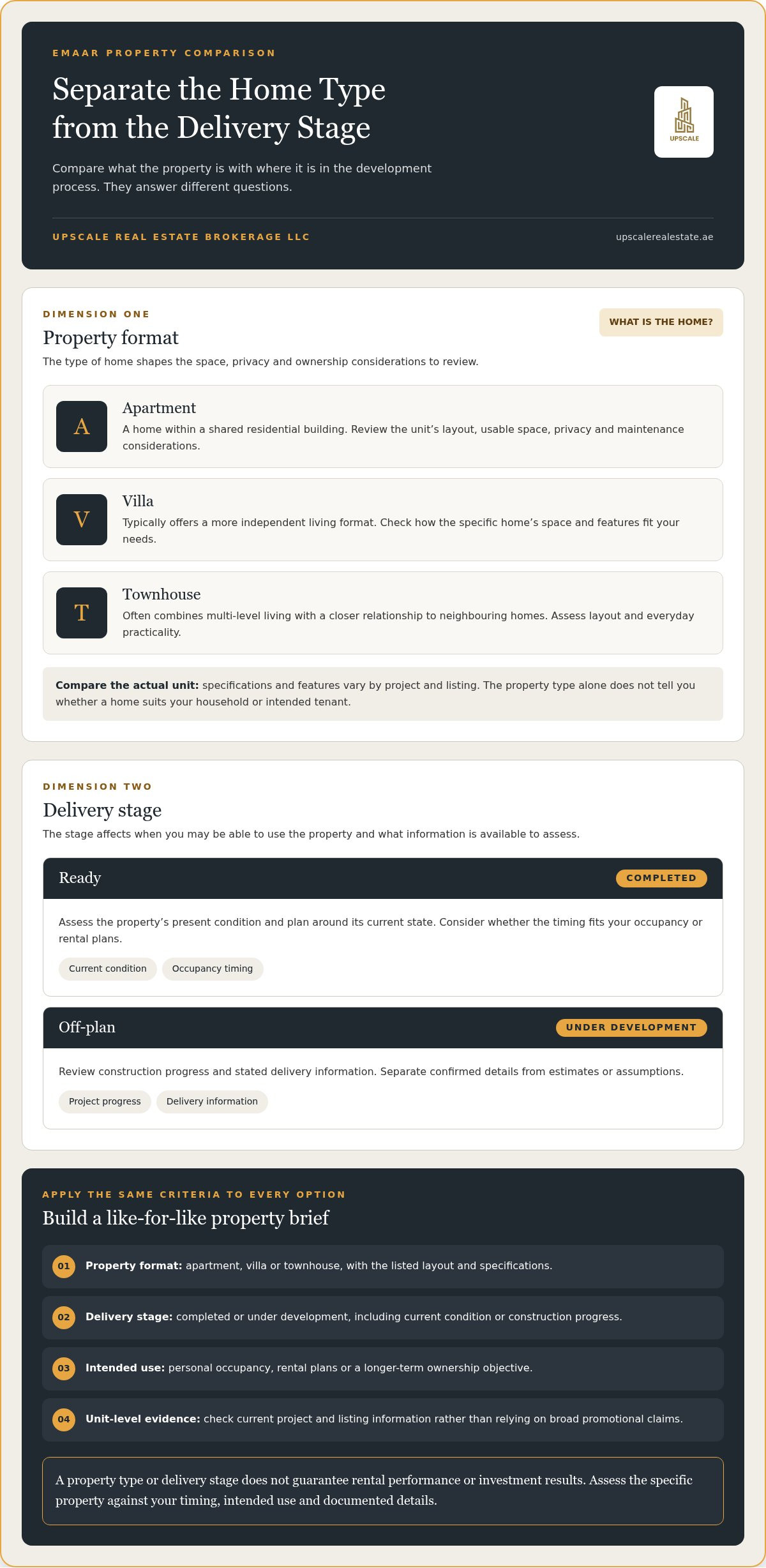
Once you’ve defined your priorities, compare the property format separately from its delivery stage. Apartment, townhouse and villa describe the type of home; ready and off-plan describe whether it is completed or still under development. Keeping these categories distinct makes a search for emaar properties for sale dubai easier to assess and prevents unlike options from being treated as equivalent.
Property type affects the space, privacy and ownership responsibilities that may suit your household. Delivery stage affects when you may be able to occupy or use the property and what construction information is available to review. Neither category guarantees rental performance or investment results.
How apartments, villas and townhouses differ as property choices
Apartments are homes within shared residential buildings. Villas typically offer a more independent living format, while townhouses often combine multi-level living with a closer relationship to neighbouring homes. These broad distinctions are a starting point, not a substitute for checking the individual unit.
Compare usable space, privacy, layout and maintenance considerations with your household’s needs. A family may prioritise room configuration and everyday practicality. A buyer planning to rent the home may focus on whether the layout suits the intended tenant. Specifications vary by project and listing, so review the unit details instead of assuming every apartment, villa or townhouse has the same features.
What ready and off-plan mean for an Emaar buyer
A ready property is completed, so you can assess its present condition and plan around its current state. An off-plan property is still under development, making construction progress and stated delivery information important parts of your review. For either option, consider how the timing fits your plans and separate confirmed details from estimates or assumptions.
For a closer comparison of these purchase routes, read this ready versus off-plan property guide. Use it to structure your comparison, then base your decision on the project and unit information for the property you’re considering.
For each option, record:
- Property format: Apartment, villa or townhouse, along with the listed layout and specifications.
- Delivery stage: Completed or under development, including the current condition or construction progress.
- Intended use: Personal occupancy, rental plans or a longer-term ownership objective.
- Timing: Your preferred move-in or use date compared with the available delivery information.
Company-level information can provide context, but it can’t establish whether a specific unit meets your criteria. The Emaar Properties Forbes profile offers a business overview. Use project and listing information to evaluate the individual property. For help organising a comparison of ready and off-plan options, Upscale Real Estate Brokerage LLC provides brokerage guidance focused on your ownership priorities.
How to Compare Emaar Properties for Sale Against Your Priorities
To compare emaar properties for sale dubai consistently, apply the same criteria to every option. A shared developer name doesn’t make two homes equivalent: layout, completion stage, intended use and supporting evidence can differ from one unit to another. Record what each listing confirms, then separate those facts from your preferences and assumptions that still need testing.
Which comparison criteria matter most to your purchase?
Start with the layout and intended occupancy. Consider who will use the home, when you expect to occupy or lease it, and how long you plan to hold it. Then account for the delivery stage and recurring ownership responsibilities, such as maintenance and property management needs. Treat preferred features as decision criteria, not proof that a home will perform well financially.
Use the table as a consistent starting point. Add one row for each property, using current listings and project documents as evidence.
| Property type | Delivery stage | Intended use | Timing to assess | Evidence to review |
|---|---|---|---|---|
| Apartment | Ready | Personal occupancy or rental | Condition and intended start date | Unit layout, specifications and current condition |
| Townhouse | Off-plan | Future home or rental asset | Construction progress and stated delivery information | Project and unit details, including listed specifications |
| Villa | Ready or off-plan | Personal use or portfolio holding | Occupancy plans or delivery timing | Current listing, project details and ownership responsibilities |
These are comparison prompts, not claims that a particular property type or delivery stage suits every buyer. Confirm details against the specific listing. Don’t infer a unit’s layout, condition or obligations from its category alone.
How to read investment claims without assuming guaranteed returns
Keep projected rental yield, realised rental income and potential appreciation separate. A projection is an estimate based on assumptions; realised income reflects actual rental performance, while appreciation refers to a change in value over time. If a figure is presented, check its source, date, calculation basis and the unit-specific inputs behind it.
Past performance and projected returns don’t guarantee future results. Base rental-yield assumptions on current, property-specific information and account for relevant ownership responsibilities. A broad figure for a property type or area cannot, by itself, establish the return for an individual unit.
For buyers weighing a purchase against wider asset allocation, the property investment portfolio guide offers broader context. Use it to consider how a potential acquisition fits your portfolio, while keeping the comparison anchored in the specific property, your intended holding period and evidence you can review.
Emaar Purchase Due Diligence: Documents and Checks Before Proceeding
A disciplined review can help reveal gaps before you move ahead with emaar properties for sale dubai. Follow a clear sequence: confirm the exact unit, compare the listing with relevant documents, understand the obligations attached to the purchase, then follow the transaction process using current guidance. Keep a record of which details are documented and which still need clarification.
What to review in a specific Emaar property listing
Start by matching the listing’s project and unit details to current project information. Check that the stated property type, layout, specifications and delivery status align with the documents available for that property. Treat photographs and marketing descriptions as a starting point, not a replacement for written unit details.
Review documents relevant to the purchase and intended use. For a completed property, these may include available ownership records, sale documentation and information about the unit’s present condition. For a property under development, review available project and unit documentation, stated delivery information, payment obligations and relevant construction updates. These are useful review points, not a universal list of mandatory documents.
Check the permitted use and any obligations described in the applicable documents. If the listing gives a project name, completion milestone or specific feature, verify the information against current records. Project status and unit details can change, so avoid relying on outdated material when making a decision.
How the purchase process differs by delivery stage
Ready and developing properties involve different evidence and milestones. For a completed home, focus on its current condition, ownership documentation and transaction details. For an off-plan property, the review may also involve project information, construction progress and documented payment and delivery terms. The applicable paperwork depends on the property and transaction, so don’t assume one checklist or timeline fits every purchase.
Before progressing, use this practical sequence:
- Confirm the unit. Match its identifying details and specifications across the listing and available project information.
- Review the documents. Distinguish records for a completed property from project and unit documents for a developing one.
- Assess obligations. Understand the relevant terms, intended use and responsibilities described in the documents.
- Check current procedures. Verify applicable land registration and regulatory processes against official, up-to-date guidance before taking transaction steps.
Procedures can change, and requirements may depend on the transaction. Don’t rely on a generic online timeline or assume a payment structure applies across projects. Official investor and regulatory guidance can provide wider context, while current official information should inform procedural decisions.
Upscale Real Estate provides brokerage and investment advisory guidance for buyers comparing ready and off-plan options. Its team can help keep your review focused on the property documents, delivery stage and ownership objectives that matter to your decision.
Plan Your Emaar Property Search with Transparent Brokerage Guidance
A focused brief turns your priorities into a practical way to assess emaar properties for sale dubai. It narrows the search without treating every listing as a match and gives you a consistent basis for comparing options as project details and availability change. Keep the brief concise, specific and tied to decisions you can explain.
Separate requirements that determine suitability from preferences you could adjust. For example, your target occupancy window may be essential, while a particular layout feature could be flexible. This distinction helps you compare actual options without losing sight of why you’re buying.
What a focused Emaar property brief should contain
Record the intended use, preferred property type, acceptable delivery timing and expected holding period. Note how the property should fit your household or wider investment plans. Then separate non-negotiables from flexible preferences, so a listing that misses a core requirement doesn’t seem suitable just because it meets secondary criteria.
- Intended use: Personal occupancy, rental ownership or a longer-term portfolio objective.
- Property format: Apartment, townhouse or villa, with the layout needs that matter to you.
- Timing: Your preferred occupancy or use date and tolerance for an off-plan delivery period.
- Decision criteria: Essential requirements, flexible preferences and the documents needed to evaluate each option.
Use the same brief for every property. If a listing misses a requirement, record the gap rather than quietly changing your criteria. This creates a clear decision trail and makes accepted trade-offs easier to identify.
How an advisory-led brokerage can support the next step
Brokerage guidance can help organise a comparison of ready and off-plan opportunities around your objectives, delivery stage and available property information. Upscale Real Estate Brokerage LLC facilitates ready and off-plan property sales and provides investment advisory. Its role is to support an informed purchase process, not to act as Emaar or the project developer.
For an investment-focused purchase, put assumptions in context. Projected yield and potential appreciation depend on the individual property, relevant costs and market conditions. They are factors to analyse, not promised outcomes. A transparent discussion distinguishes documented unit and project details from estimates, then connects the decision to your holding period and wider plans.
Before taking the next step, bring your brief and comparison notes together. They give you a practical basis for weighing priorities, reviewing the information available for a property and identifying where further due diligence is needed. The goal is clarity, not pressure to select a listing before reviewing the evidence.
Make Your Next Property Decision with Clarity
Turn your research into a short, written decision brief. Set out what the property must achieve, what evidence you still need and which trade-offs you’re prepared to accept. This gives you a clear basis for assessing emaar properties for sale dubai as current project and unit information evolves, without letting an appealing listing rush your decision.
Upscale Real Estate Brokerage LLC is a RERA-licensed brokerage identified with ORN 23084. Its property management service can also support owners planning beyond the purchase itself. Keep your objectives at the centre of the discussion, and treat investment assumptions as matters for careful, property-specific review.
Frequently Asked Questions
How much do Emaar properties for sale in Dubai cost?
There’s no single price for emaar properties for sale dubai. Values vary by property type, project, unit size, condition, delivery stage and current market conditions. Compare similar homes using recent, unit-specific information rather than relying on a broad starting figure. Budget separately for purchase-related expenses, and confirm applicable charges for your transaction using current official guidance before committing.
Can foreign buyers purchase Emaar property in Dubai?
Foreign buyers can purchase property where ownership is permitted under applicable rules, but eligibility depends on the property and its ownership status. Before proceeding, establish whether the specific unit supports the ownership structure you intend to use, and verify requirements through current official guidance. Don’t assume that one buyer’s eligibility or one property’s status automatically applies to another.
Are Emaar properties a good investment?
They may suit some investors, but the developer’s name alone can’t establish whether an individual property is a sound investment. Assess the unit’s purchase terms, expected rental demand, recurring ownership responsibilities and your planned holding period. Compare any projected income with realistic expenses and current market evidence. Your objectives and risk tolerance matter, and neither rental income nor future appreciation is assured.
Can I rent out an Emaar property after buying it?
In general, an owner may rent out a completed residential property, subject to the applicable ownership documents, community terms and current rules. Review restrictions on permitted use and leasing, and understand any landlord responsibilities before relying on rent as part of your financial plan. For an off-plan property, establish whether leasing is possible at the relevant stage and what conditions apply after handover.
Can an off-plan Emaar property be resold before completion?
Possibly, but resale before completion isn’t automatic. The signed sale agreement may set conditions for transfer, and the applicable registration process can depend on current rules and the project’s status. Review the contract’s resale and transfer provisions, including any stated developer conditions, before treating an early resale as part of your exit strategy. Confirm the current process through official guidance before taking action.
How can I check whether an Emaar property listing is accurate?
Compare the listing with current project and unit documents, including the property identifier, stated layout, specifications and delivery status. Check when the listing was updated, and treat promotional images or broad investment claims as unverified until supported by property-specific information. Confirm that the project and unit details match current records, then resolve inconsistencies before paying a deposit or signing transaction documents.
Discuss your Emaar property priorities with Upscale Real Estate to compare ready and off-plan options against your objectives and take the next step with a clear framework.