

Could the property that looks strongest in a listing become the weaker investment once vacancy, ownership costs and timing are factored in? When comparing al furjan east property, headline prices and advertised yields alone can hide the details that matter to your decision.
That uncertainty is understandable. A ready property and an off-plan purchase involve different timelines, risks and income considerations, and listings may not present costs on a like-for-like basis. A consistent investment framework helps you compare those differences before narrowing your shortlist.
This guide explains how to define your objectives, compare property types and assess potential income alongside operating and acquisition costs. It also covers key due diligence priorities and the steps involved in progressing a purchase, so you can make a measured decision based on your timeline and risk tolerance. Upscale Real Estate Brokerage LLC is a RERA-licensed brokerage offering investment advisory, with a focus on transparent comparisons and buyers’ objectives. The aim is to help you understand which opportunity may fit your plans.
Key Takeaways
- Set your investment objective, time horizon and risk tolerance before comparing properties in al furjan east.
- Compare ready and off-plan options against your timeline, payment structure and the evidence available for each property.
- Use gross yield as an initial indicator, then account for vacancy and operating costs to assess potential net income.
- Follow an ordered due diligence checklist and match property claims with records and contractual documents before making an offer.
- Rank shortlisted properties using the same criteria for objective fit, evidence quality, costs, risks and timing.
Al Furjan East Property: Define Your Buying or Investment Objective
A property search can lead to very different decisions. One buyer may want a home that suits daily life; another may focus on rental income, potential appreciation or adding an asset to a wider portfolio. Before comparing listings, define what success means for you. The right choice depends on how well the property’s features, your time horizon and your risk tolerance align with your objective.
Set the brief before comparing listings
Start by identifying your main priority: personal use, rental income, capital growth or portfolio diversification. Then record your preferred property type, intended holding period and how involved you want to be in ongoing ownership. A buyer who needs a home soon may value usability and timing more than projected resale flexibility. An investor may give greater weight to rental demand, ongoing costs and how readily the property could be sold later.
Separate essential requirements from preferences. A suitable layout or a target purchase timeline may be essential, while a particular view or extra amenity may be desirable but not decisive. This distinction keeps attractive listing details from distracting you from the criteria that determine whether a property fits your plan.
For general background on the area’s development and built environment, consult the Al Furjan Wikipedia page. Treat it as context, not a substitute for assessing a specific property and its documentation.
Choose evidence that answers the real question
For a home you intend to occupy, assess the layout, how the space supports your needs, ongoing ownership obligations and whether the property’s timing matches your plans. For an investment, focus on evidence relevant to income and exit options: comparable achievable rents, realistic vacancy assumptions, operating expenses and factors that may affect resale flexibility.
Advertised performance is an assumption to test, not a guaranteed outcome. Find out what a rent estimate is based on, whether it allows for periods without a tenant, and which costs it includes. A headline figure that excludes vacancy or recurring expenses may not reflect the income you ultimately retain.
Write a concise investment thesis before shortlisting. For example: “I’m seeking a property for long-term rental income, with costs and expected vacancy included in my assessment, and a holding period that allows time for the plan to work.” Adjust the wording to your own objective, then apply it consistently to each option. If a listing’s strongest features don’t support that thesis, it may not belong on your shortlist.
Compare Ready and Off-Plan Property Against Your Timeline
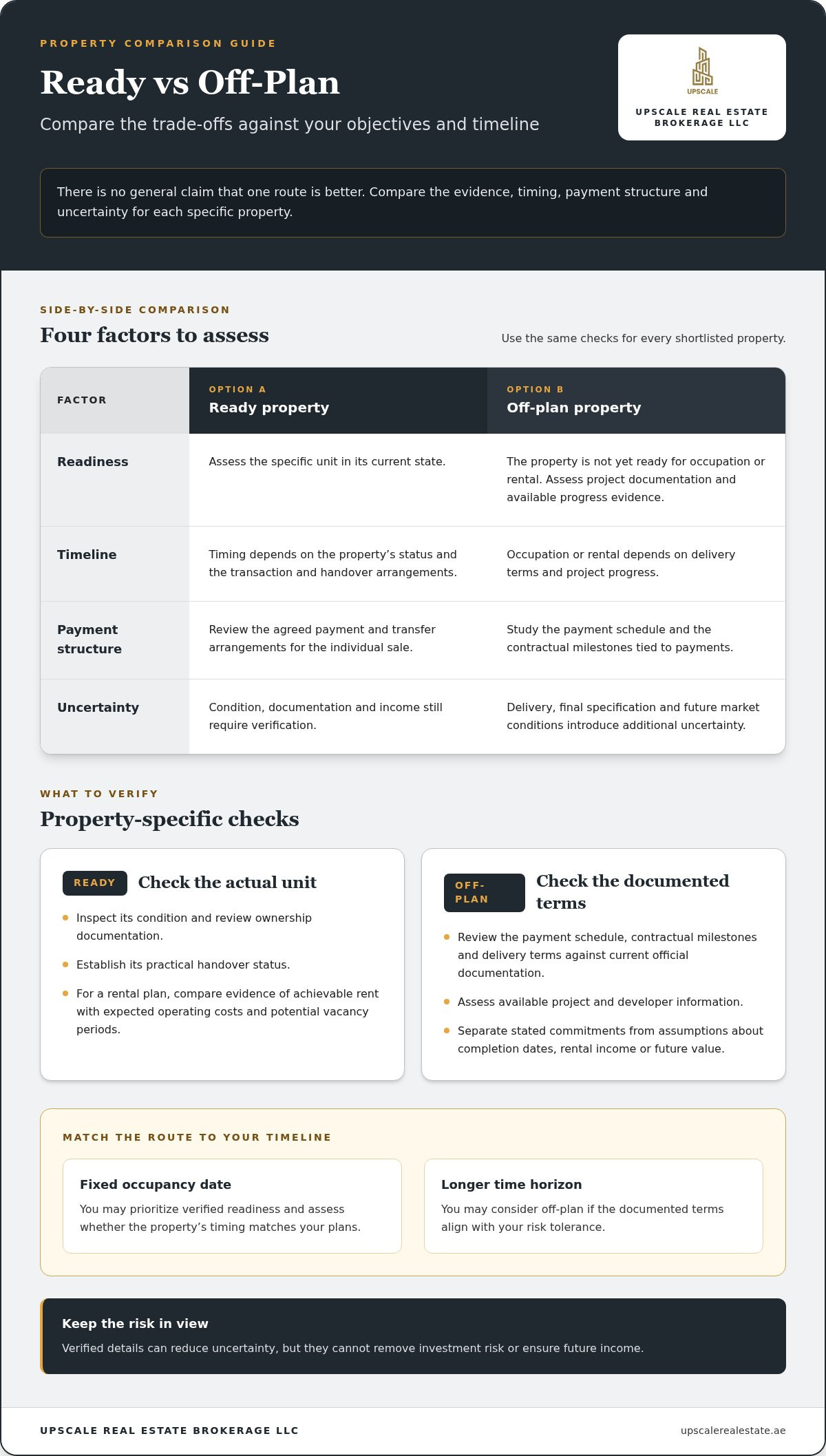
The choice between a ready property and an off-plan purchase is best judged against your objectives and timeline, not a general claim that one route is better. A ready property may offer clearer information about its current condition and potential rental income. Off-plan may suit a buyer whose plans allow for a future handover, provided the contractual terms and delivery risks are understood.
| Factor | Ready property | Off-plan property |
|---|---|---|
| Readiness | You can assess the specific unit in its current state. | The property is not yet ready for occupation or rental. Assess project documentation and available progress evidence. |
| Timeline | Timing depends on the property’s status and the transaction and handover arrangements. | Occupation or rental depends on delivery terms and project progress. |
| Payment structure | Review the agreed payment and transfer arrangements for the individual sale. | Study the payment schedule and the contractual milestones tied to payments. |
| Uncertainty | Condition, documentation and income still require verification. | Delivery, final specification and future market conditions introduce additional uncertainty. |
For a broader framework, read this guide to comparing off-plan and ready property. Market context can also inform your assumptions, but it doesn’t replace property-level analysis. The residential market trends resource provides data to consider alongside your own evidence.
When a ready property may fit better
If you need to use or lease the property within a nearer timeframe, inspect the actual unit and its condition, review ownership documentation, and establish its practical handover status. For a rental plan, compare evidence of achievable rent with expected operating costs and potential vacancy periods. Verified details can reduce uncertainty, but they can’t remove investment risk or ensure future income.
What to assess before choosing off-plan
Review the payment schedule, contractual milestones and delivery terms against current official documentation. Assess available project and developer information, and distinguish stated commitments from assumptions about completion dates, rental income or future value. For a focused overview of completed assets, see this ready property sales guide.
Use your brief to decide which trade-offs are acceptable. A buyer with a fixed occupancy date may prioritize verified readiness; one with a longer horizon may consider off-plan if the documented terms align with their risk tolerance. For a structured comparison of ready and off-plan options, explore property advisory resources.
Test the Investment Case: Income, Costs, and Risk
A rental estimate is useful only when its assumptions are visible. Compare each shortlisted property using the same method, and distinguish advertised rent from income supported by relevant rental evidence. A headline yield is a starting point for analysis, not a promised return.
Build a transparent rental-yield estimate
Gross rental yield is annual rent divided by the property’s purchase price, expressed as a percentage. Calculate it as: annual rent ÷ purchase price × 100. To estimate net yield, subtract relevant operating expenses and an allowance for possible vacancy from expected rental income, then divide the remaining income by the purchase price. State clearly which costs are included so comparisons remain consistent.
Use rental comparables that match the property type and note the period they cover. Record whether each figure is an asking rent, an agreed rent or another form of evidence. Don’t treat an advertised figure as achievable income without support. Include ownership and operating expenses only when verified for the specific asset, such as applicable service charges, maintenance and property management costs.
| Model input | Assumption to record | Evidence to use | Unresolved variable |
|---|---|---|---|
| Purchase price | Price used in the yield calculation | Property-specific sale documentation | Any costs excluded from the yield calculation |
| Annual rent | Expected rent for the relevant period | Comparable rental evidence for the same property type | Difference between advertised and achievable rent |
| Vacancy | Clearly stated allowance or scenario | Evidence relevant to the property and rental plan | Actual time between tenancies |
| Operating expenses | Only verified costs included in the model | Asset-specific records and applicable service information | Future maintenance or management needs |
Stress-test the assumptions before proceeding
Run a vacancy scenario by reducing the rent collected in your model, then recalculate net yield. The point isn’t to predict exactly how long a property may sit empty. It’s to see whether the investment still fits your income needs and risk tolerance if rent is interrupted.
Test the effect of maintenance, service charges and management needs using documented figures where available. Consider resale constraints too: a property that suits a narrow group of buyers may offer less flexibility when you want to exit. Keep unresolved variables visible rather than filling gaps with optimistic estimates.
For a broader framework covering multiple assets, read the property portfolio management guide. A consistent model makes it easier to compare opportunities and identify which assumptions need further evidence before you proceed.
Complete Property Due Diligence Before Making an Offer
Before making an offer, turn listing details and investment assumptions into a documented review. The key is to distinguish information supported by records or contract terms from statements that still need evidence. Work through the checks in order, and note how any missing detail could affect your decision.
Verify the asset and its financial assumptions
- 1. Confirm the property identity. Match the unit type, location reference, size and identifying details in the listing against available property records and sale documents.
- 2. Check condition and included features. Inspect the actual unit where possible. Compare its condition, fixtures and any stated inclusions with supporting records or written terms, rather than relying only on listing photographs or descriptions.
- 3. Establish its current status. Clarify whether the property is occupied, vacant, under construction or otherwise subject to a handover arrangement. For an off-plan purchase, review project-specific documentation and contractual delivery terms.
- 4. Reconcile the financial case. Compare expected rent with relevant rental evidence, and check ownership expenses against available statements or other asset-specific documentation. Keep assumptions about vacancy, maintenance and management visible in your calculations.
- 5. Record information gaps. List each unanswered question, the evidence needed to resolve it and its potential effect on your offer, expected income or timeline. If a material point remains unclear, account for that uncertainty before committing.
Review transaction documents and obligations
Next, read the applicable ownership, sale and payment documents carefully. Confirm that the property details, agreed terms, payment timing, responsibilities and stated conditions are consistent across the documents. Keep a written record of discrepancies and seek clarification through the transaction process before relying on an assumption.
Procedural requirements can depend on the transaction and current rules. Verify applicable steps and documentation against current official guidance from the relevant land and property authorities before treating any process description as a rule. Don’t rely on an outdated checklist or informal explanation when official guidance is available.
Due diligence helps you make a better-informed decision; it can’t guarantee rental income, capital growth, a particular handover outcome or future resale demand. The aim is to understand what the evidence supports, what remains uncertain and whether the remaining risk fits your objectives.
Use this review to prepare focused questions and clarify your priorities before progressing. Discuss your property criteria with Upscale Real Estate.
Turn Your Shortlist into a Property Decision
A shortlist becomes useful when every option is assessed against the same priorities. When comparing al furjan east property, avoid letting a standout feature or headline figure outweigh essential requirements. A simple scorecard can make trade-offs visible and help you decide which option merits further review.
Use a consistent shortlist scorecard
Rate each property against your stated objectives, using the same scale and evidence standard for every option. Record facts separately from estimates and unresolved questions. Remove any property that fails an essential requirement before weighing secondary benefits.
- Objective fit: Does the property support personal use, rental income, potential growth or diversification as intended?
- Evidence quality: Which key details are supported by records or documents, and which remain estimates or claims?
- Costs: Are the purchase and ongoing ownership expenses understood well enough to assess the budget and potential income?
- Risk: What uncertainties remain around condition, vacancy, delivery, management or resale, and are they acceptable?
- Timeline: Does the property’s readiness or expected delivery align with your plans?
Use the same rating scale across the shortlist, and add a short note explaining each score. A property with appealing secondary features should not outrank one that better meets your core requirements if its evidence is weaker or its unresolved risks are less acceptable.
Plan the next step around your ownership objective
For an acquisition, identify the remaining evidence and documents needed before you progress. Tie outstanding questions to specific decision points, such as confirming a property detail, reconciling an assumption or understanding a contractual obligation. This makes the next step clear without treating an estimate as a verified fact.
If you plan to rent out the property, consider how leasing and ongoing property management fit your ownership strategy. The right approach may depend on how involved you want to be and how you intend to manage the asset over time. Include these practical needs in your comparison rather than treating them as afterthoughts.
Upscale Real Estate offers ready and off-plan property sales and investment advisory to support a considered comparison based on your objectives, timeline, risk tolerance and available documentation. An advisory discussion can help clarify trade-offs and identify what evidence you need before moving forward.
Explore property advisory with Upscale Real Estate.
Make Your Next Property Decision with Clarity
A sound decision about al furjan east starts with your objectives, not the appeal of a listing. Set your priorities and timeline first, then compare ready and off-plan options against the same criteria. Test rental assumptions against relevant costs and possible vacancy, and treat missing documentation as a decision factor rather than filling gaps with optimism.
Due diligence can help clarify what the available evidence supports, but it can’t guarantee future income or resale performance. Identify which shortlisted property best fits your plans and what information you need before proceeding.
Upscale Real Estate Brokerage LLC is a RERA-licensed brokerage, ORN 23084, supporting buyers with ready property sales, off-plan sales and investment advisory. Residential leasing can also inform rental planning. For a considered discussion focused on your objectives and property comparisons, explore property advisory with Upscale Real Estate.
Bring your objectives, timeline and shortlist to Upscale Real Estate Brokerage LLC to discuss your property options and next steps.
Frequently Asked Questions
Is a property associated with Al Furjan East suitable for investment?
It may suit your investment plan if the specific property, expected income, costs and risk profile align with your objectives. Assess relevant rental evidence, likely vacancy, ongoing ownership expenses, resale flexibility and your intended holding period. Evaluate each asset on its own merits rather than relying on location appeal or advertised returns. No projected yield or appreciation should be treated as guaranteed.
How do I compare ready and off-plan properties?
Compare each option against your timeline, payment terms, evidence quality and tolerance for uncertainty. A ready property can be assessed in its current condition, with its actual unit details and status reviewed. For off-plan, examine project information, contractual milestones, payment schedules and delivery terms. Neither route is automatically better. The right fit depends on your ownership objective and whether the documented risks and timing work for your plans.
What documents should I review before buying a property?
Review available ownership and property identification records, the sale agreement or other applicable transaction documents, and the payment terms. Match the unit type, size, condition and included features against supporting records and written contractual details. For an investment, also examine documented rental evidence and applicable ownership expenses. Requirements may vary by transaction, so verify current procedural steps through relevant official sources before relying on them.
How do I calculate rental yield on a property?
Calculate gross rental yield by dividing expected annual rent by the purchase price, then multiplying by 100 to express it as a percentage. This gives an initial comparison, not a guaranteed return. For a more realistic net-yield estimate, account for relevant operating expenses and possible vacancy. Base rent assumptions on comparable evidence, identify the period and property type, and distinguish advertised rent from rent you can reasonably support.
What costs should I consider when assessing a property investment?
Consider the purchase and transaction expenses applicable to the specific sale, as well as recurring ownership costs. These may include service charges, maintenance, property management and periods without rental income. Check which costs apply to the asset using available documentation, and record whether each figure is verified or estimated. Include the same cost categories for every shortlisted property so you can compare potential net income consistently.
Can a real estate broker help me compare property investments?
Yes. A broker can help structure a comparison around your objectives, timeline and risk tolerance, and distinguish documented property details from estimates that need further review. Upscale Real Estate Brokerage LLC is a RERA-licensed brokerage, ORN 23084, offering ready and off-plan property sales and investment advisory. Its residential leasing and property management services can also inform planning for rental ownership and ongoing asset needs.