

Could a home that looks like a strong investment prove unsuitable for the way you plan to live? When searching for dubai land residences, the right decision depends on more than listing photos or projected rent. The unit type, intended use, ownership costs and verified transaction details all shape whether a property fits your plans.
It can be difficult to compare listings when specifications and property status vary, and rental performance depends on the individual home and the assumptions behind any estimate. Before deciding, establish exactly what is being sold, who is selling it and what ongoing costs may apply.
This guide explains how to compare homes for personal use or investment, assess potential rental performance and review the property and transaction details that matter. It also shows how sales guidance and investment advisory can help you weigh a property against your goals, using clear criteria and documented information.
Key Takeaways
- Establish whether “dubai land residences” identifies a specific development or is being used as a broader listing label.
- Start with your intended use, then assess each home’s layout, condition, privacy and everyday practicality.
- Compare apartments, villas and townhouses against your space needs, maintenance priorities and investment objectives.
- Review ownership documents, seller authority, unit details, service charges and transaction requirements before proceeding.
- Use transparent sales guidance and investment analysis to compare suitable options with your personal or portfolio goals.
What Does Dubai Land Residences Mean for a Property Buyer?
As a property search phrase, dubai land residences may refer to a named development, a broader area or a location label used in a listing. Those meanings are not interchangeable. A listing tagged with an area name does not, by itself, establish which project or building contains the property. Before comparing homes, identify the specific asset and check the source of its location description.
A general geographic overview can provide background, but it cannot verify a particular property. Confirm the official project name, boundaries, developer and property category against reliable documentation before treating them as facts. Any project detail that is not supported by records should remain an open question, not be assumed to describe the home.
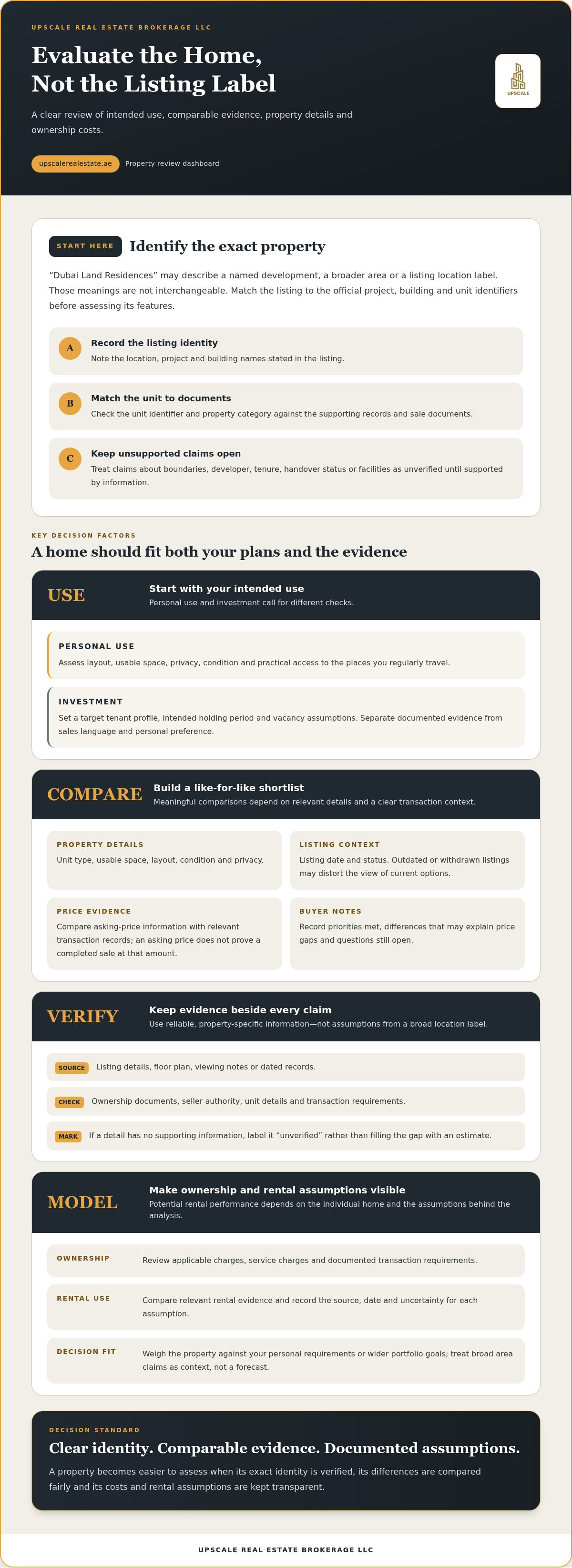
First, match the listing to the official project, building and unit identifiers before assessing its location or features. This gives you a consistent basis for comparing options and helps prevent a broad marketing label from being mistaken for the identity of the property.
How to identify the exact Dubai Land Residences property
Compare the listing title with the project or building name and the unit identifier shown in the relevant property records and sale documents. Confirm that the details refer to the same property rather than assuming similar wording proves a match. Listings can use overlapping location terms while referring to different buildings, developments or unit types.
Keep a short verification record as you review each option:
- Write down the location, project and building names stated in the listing.
- Match the unit identifier and property category to the supporting documents.
- Record claims about boundaries, developer, tenure, handover status or facilities as unverified until you find supporting information.
This distinction matters for both ready and off-plan sales. An area name can help you find listings, but it does not identify the specific asset being offered.
Which buyer goals can these residences serve?
For an owner-occupier, the main question is whether the particular home supports everyday needs. Consider the room arrangement, usable space, privacy, condition and practical access to the places you regularly travel. Assess facilities and community features using information about the specific property rather than inferring them from a location label.
An investor should assess the home against a different set of objectives: intended holding period, ownership obligations, potential rental use and fit with the wider portfolio. Rental demand and returns depend on evidence for the specific property and the assumptions used in the analysis. Treat broad area claims as context, not as a forecast.
Compare apartments, villas or townhouses only when the listing and property details establish that category. The right format depends on your intended use, space requirements and tolerance for ongoing responsibilities, not on a search phrase alone. Clear identification makes it possible to assess the property on its own merits.
How to Evaluate a Dubai Land Residences Home Before Buying
A disciplined review turns a promising listing into a decision you can explain. When evaluating a home in dubai land residences, focus on the specific unit rather than relying on broad area claims. Work through your intended use, comparable options, supporting documents and ownership costs in sequence. Keep the evidence for each step together so your assumptions remain visible.
Match the home to your intended use
Start by defining what the property needs to do for you. Personal-use buyers can rank layout, usable space, privacy, condition and access to everyday destinations. Investment buyers should identify a target tenant profile, expected holding period and vacancy assumptions, then separate documented evidence from sales language and personal preference.
For example, a floor plan may show room dimensions, while “ideal for families” is a marketing description to compare with your own requirements. A projected rent is also an assumption until supported by relevant rental evidence. Record which details are measurable, which are subjective and which need clarification.
Build a comparable shortlist
Compare like with like wherever possible: the same property category, similar usable space and condition, and a clear transaction context. Record each listing’s date and status. A withdrawn or outdated listing can distort your view of current options, and an asking price does not prove that a sale was completed at that amount.
Comparable evidence helps show which differences are meaningful, rather than allowing unlike listings to create a misleading impression of value.
Use this working template for each option. Add a note or source beside every entry, and mark a field “unverified” rather than filling it with an estimate:
- Criterion: unit type, usable area, layout, condition, privacy, listing date and status. Evidence: listing details, floor plan, viewing notes or dated records. Buyer notes: priorities met and open questions.
- Criterion: asking price and comparable context. Evidence: current listing information and relevant transaction records. Buyer notes: differences that may explain the gap.
- Criterion: ownership and investment assumptions. Evidence: documented transaction requirements, applicable charges, service charges and rental comparables. Buyer notes: source, date and uncertainty for each assumption.
Verify, model, then decide
Before progressing, match the unit details to its supporting documents and establish the transaction requirements that apply to the purchase. The land department investor overview provides transaction context. Use current official information to identify the requirements for the specific property and transaction.
Model total ownership costs, not just the asking price. Include applicable transaction charges and recurring obligations such as service charges and maintenance. For an investment, test rental assumptions against possible vacancy and ownership costs instead of treating gross rent as net performance. For personal use, weigh the costs against the home’s practical suitability. A grounded decision follows when the documents, comparisons and financial model support your priorities. Upscale Real Estate Brokerage LLC provides property sales and investment advisory to help buyers assess ready and off-plan options against their objectives.
Dubai Land Residences: Compare Unit Types and Investment Fit
Choosing a property format is a practical decision, not a status decision. An apartment may suit a buyer seeking a home in a shared building, while a villa or townhouse may suit someone looking for a different balance of space, privacy and maintenance responsibility. These are general distinctions, not claims about every property described as dubai land residences. Compare a format only when current property details establish that it applies to the listings you are reviewing.
Apartment, villa, or townhouse: which format fits?
Homes in shared buildings can involve common areas and building-level services, so review applicable service charges and what they cover. More independent home formats may offer a different balance of privacy and space, while bringing different upkeep responsibilities. The actual arrangement varies by property. Match floor plans, condition and documented obligations to your household’s needs rather than assuming one type is inherently better.
Use this comparison as a framework. Fill it with verified listings and property-specific information:
| Format | Practical considerations | Evidence to compare |
|---|---|---|
| Apartment | Shared building spaces; review privacy, usable layout and recurring building charges. | Unit plan, condition, service-charge details and building obligations. |
| Villa | Assess space, privacy and the responsibilities tied to maintaining the home. | Property details, condition and documented maintenance obligations. |
| Townhouse | Consider how the layout and shared or private elements suit daily routines. | Unit plan, boundaries, condition and any applicable community obligations. |
Assess investment potential without relying on headline yield
A rental estimate alone does not show whether an acquisition fits your investment objectives. Start with the purchase basis, then model potential gross rent separately from vacancy, operating costs, service charges and other ongoing ownership expenses. Use rental evidence relevant to the specific property and label assumptions clearly. A guide to ready property sales can help frame the asset review.
Holding period matters too. A buyer planning a longer hold may assess costs and rental assumptions differently from someone with a shorter investment horizon. Treat appreciation as uncertain, not as a guaranteed outcome. For a wider view of how a property may sit alongside other assets, consider a portfolio management strategy when assessing portfolio fit.
A sound comparison keeps facts, assumptions and preferences separate. Record the source and date for each figure, and do not compare unlike formats as though they have identical costs or rental prospects. This supports a clearer assessment of whether the home suits personal use, investment or neither. Upscale Real Estate Brokerage LLC provides investment advisory to help investors assess property against portfolio objectives and stated assumptions.
What to Verify Before Buying in Dubai Land Residences
A listing can make a property look straightforward, but the purchase decision depends on whether the seller, unit, condition, ownership record and transaction details align. For any home described as being in dubai land residences, make the checks below property-specific. Supporting records and requirements can differ depending on whether the home is ready or off-plan and on the circumstances of the sale.
A listing claim describes what is being offered; verified purchase evidence shows what the property and transaction support. Keep copies of the records you review and note unresolved points before making a commitment. Check project, regulatory and transaction details against current authoritative information rather than assuming one general rule applies to every purchase.
Documents and transaction details to review
Start by matching the marketed property to its unit identifier and ownership documentation. Establish the seller’s authority to transact and compare names and property details across the relevant records. For a ready property, review the available title or ownership documents and the transaction information relevant to the sale. A listing description alone does not establish ownership or authority.
Requirements may vary according to property status and transaction circumstances. Use current land department information to understand the steps and documents that apply to the specific case, rather than relying on an old checklist as universal guidance. As you review the file, check that the key details are consistent:
- Seller and authority: records showing who is selling and their authority to proceed.
- Property identity: project or building name, unit identifier and property category across the listing and supporting documents.
- Condition and inclusions: viewing notes or inspection records, plus a clear record of what is included in the sale.
- Transaction requirements: current steps and supporting documents relevant to the property and circumstances.
For an off-plan purchase, review the project’s current status and contractual documents in detail. Compare the agreed unit description with the sales contract, and understand the payment milestones and stated handover information. Record important dates and obligations as written. Verbal assurances and promotional language are not substitutes for contract terms.
Ownership costs and ongoing obligations
Look beyond the purchase amount. Review current records for applicable service charges, community rules and other documented obligations tied to the unit. Check what charges cover where that information is available, and distinguish recurring expenses from one-time transaction costs. A general estimate should not stand in for the costs of a specific home.
Condition also affects the ownership picture. Note visible maintenance needs, included items and any commitments documented in the sale materials. For an investment model, include relevant maintenance and property management assumptions alongside recurring costs. Keep each assumption separate from confirmed charges so a change in vacancy or upkeep expectations is not mistaken for a verified figure.
A clear review helps identify gaps before they become costly surprises. Upscale Real Estate Brokerage LLC supports buyers with property sales and can bring listing details, transaction information and intended use into a transparent assessment.
Buying Dubai Land Residences with Clear, Professional Guidance
A property decision should reflect your needs, not the momentum of a sales conversation. For buyers considering dubai land residences, professional guidance can bring your intended use, preferred format, purchase criteria and investment assumptions into one structured review. The aim is to compare suitable options transparently, understand relevant transaction steps and make a decision that aligns with your objectives.
Upscale Real Estate Brokerage LLC provides sales for ready and off-plan properties, alongside investment advisory. As a RERA-licensed brokerage with ORN 23084, the firm can organise a property review around your criteria and explain transaction information clearly. Property-specific documents still need to support your decision, and a review does not assure a particular listing, unit or return.
What tailored purchase support should help you decide
A useful discussion starts with your intended use, decision timeline and preferred property format. For personal use, clarify the practical requirements a home must meet. For investment, identify portfolio objectives, acceptable assumptions and constraints. These priorities create a consistent basis for comparing options instead of allowing promotional descriptions to set the agenda.
Relevant options can then be organised against documented criteria, such as property type, stated specifications, condition and available transaction details. A clear review separates confirmed information from assumptions and open questions. It also explains the purchase sequence and the records or obligations relevant to each option, without presenting general guidance as a rule for every transaction.
- Purpose: State whether the home is for personal use, investment or another defined objective.
- Preferences: Note property format, essential features and practical priorities.
- Constraints: Set out timing, ownership considerations and investment assumptions.
- Open questions: Identify information to clarify before comparing options or progressing.
Plan your next step as a buyer or investor
Write down your priorities before reviewing specific property options. A short brief helps keep discussions focused: what the home needs to do, which compromises are acceptable and which financial or practical assumptions matter most. Investors can note how a prospective asset should fit their wider portfolio, so the property is assessed in context rather than on a headline claim alone.
Use the review to examine suitability, documentation and purchase objectives in a calm, structured way. Investment advisory can help frame an asset against portfolio goals and explicit assumptions, while sales guidance can support comparison and transaction understanding. Base your decision on the details of the specific property and current transaction information, not on an expectation of guaranteed returns or special access.
If you are considering a purchase, prepare your criteria and preferred property type before reviewing options. A focused discussion can help organise the questions that matter as you assess your choices.
Turn Your Property Priorities into a Clear Next Step
A confident purchase begins with a clear sense of what would make a home the right choice for you. Before taking the next step on dubai land residences, define your decision threshold: which features are essential, what trade-offs are acceptable and what evidence would give you confidence to proceed. That brief can keep your search focused as individual opportunities and circumstances change.
If you are weighing personal use against investment, bring both perspectives into the discussion. A property that works on paper still needs to fit your plans, comfort with ownership responsibilities and longer-term objectives. Professional guidance can provide a structured conversation to help you consider those priorities without pressure to make an immediate decision.
Upscale Real Estate Brokerage LLC provides property sales and investment advisory to support buyers assessing homes against their intended use and objectives. Discuss your Dubai Land Residences purchase criteria with Upscale Real Estate Brokerage LLC to plan your next step.
Frequently Asked Questions
What does Dubai Land Residences refer to?
Dubai Land Residences may refer to a specific residential development or be used as a broad listing label, so the phrase alone does not identify a home. If a listing headline and supporting documents use different project or building names, pause before treating them as the same property. Note the exact project, building and unit identifiers, then compare those details with current records before evaluating the listing.
Is Dubai Land Residences suitable for property investment?
It may suit an investor if the specific property’s acquisition basis, expected income, ownership costs and holding period align with their objectives. Consider how the purchase could affect portfolio concentration and whether you could manage a period without rental income. Compare the property with alternatives using consistent assumptions rather than relying on a headline yield. Future appreciation is uncertain, so it should not be the only reason to proceed.
Can international buyers purchase property in Dubai Land Residences?
Whether an international buyer can purchase depends on the specific property’s ownership status and the current requirements for the buyer and transaction. Do not infer eligibility from a listing label or assume every unit has the same tenure. Review the property’s title information and current official guidance for applicable procedures. Record any questions about ownership structure or buyer documentation and resolve them before committing.
How do I check whether a Dubai Land Residences listing is accurate?
Check that the listing’s factual claims align with current supporting records, not just its headline or photographs. Pay particular attention to discrepancies in stated area, floor plan, unit reference, furnishing or included items. Save a dated copy of the listing and note which details are supported and which remain unclear. If the advertised status changes, update your comparison rather than relying on an older snapshot.
What costs should I consider when buying a home in Dubai Land Residences?
Plan for the purchase amount, applicable transaction charges and recurring expenses tied to the property. Depending on the home, your ownership plan may also need to account for maintenance, service charges, management and periods without rental income. Separate one-time payments from ongoing costs, then consider when each would fall due. Use current documents for the specific unit, since a general estimate may not reflect its actual obligations.
How can I compare two homes in Dubai Land Residences fairly?
Use the same comparison basis for both homes. For example, do not compare a recently maintained unit with one needing work without recording the difference, or treat different area measurements as equivalent. Note each listing’s status and date, then separate asking-price information from documented transaction evidence. For investment comparisons, apply the same rent, vacancy and expense assumptions to both so the result reflects the properties rather than inconsistent modelling.
Should I consider ready or off-plan property in Dubai Land Residences?
Choose the status that best fits your intended timing, risk tolerance and cash-flow plan. A ready home may allow you to assess its present condition, while an off-plan purchase involves reviewing delivery information and contractual commitments before the home is complete. Consider how a change in your plans or timing would affect your decision. Compare both options against the same objectives and review the specific documents before proceeding.