

Headline rent is not the same as investment return. When calculating ROI on rental property UAE investors need to account for cash going out as well as rent coming in. A strong headline yield can look less compelling once vacancy, operating expenses and purchase costs are included.
Expected rent is a useful starting point, but a sound comparison needs a fuller view. Transaction procedures and costs can vary across emirates, and rental yield, ROI and cash-on-cash return measure different things. Treating them as interchangeable can make two properties appear more alike than they are.
This guide sets out a practical UAE-focused framework for calculating gross yield, net rental return and cash-on-cash performance. It explains how to organize income, account for recurring and upfront costs, and identify assumptions that can change the result, including vacancy and financing. Use it to compare opportunities consistently and decide whether a property merits closer investigation, not as a promise of a particular outcome.
Key Takeaways
- Distinguish rental yield, overall ROI and cash-on-cash return so each figure answers a different investment question.
- For calculating ROI on rental property UAE, organize purchase costs, rent, recurring expenses, financing and vacancy in a transparent model.
- Use clearly labelled formulas and documented inputs to make calculations easier to verify and update.
- Compare properties on the same basis, including calculation periods, expense categories and financing assumptions.
- Test alternative assumptions and weigh the results against your objectives, liquidity needs, risk tolerance and holding period.
Rental property ROI in the UAE: why headline yield is only the starting point
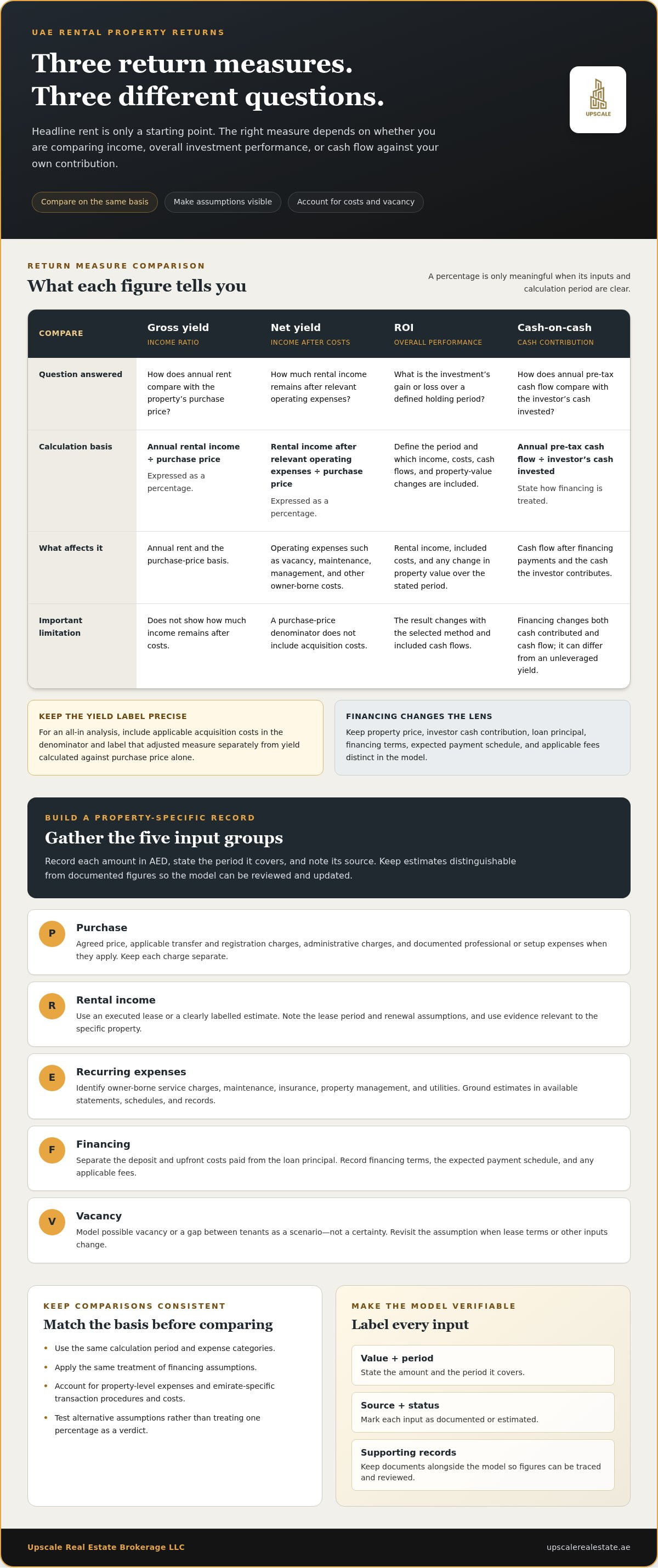
Rental yield measures rental income against a property’s price or cost. Return on investment (ROI) assesses gain or loss over a defined period, potentially including rental income and a change in property value. Cash-on-cash return focuses on cash income relative to the investor’s cash contribution, so it is sensitive to financing.
An advertised gross yield can help screen opportunities, but it leaves out costs that affect what an owner retains. Vacancy, maintenance, management and other operating expenses reduce rental income, while acquisition costs increase the amount invested. A reliable comparison also depends on the property, lease terms, financing structure and emirate-specific inputs. The same rent and purchase price can produce different results under different assumptions.
Gross rental yield versus net rental yield
Gross rental yield is annual rental income divided by the property’s purchase price, expressed as a percentage. It offers a quick comparison of rental income with property price, provided the rent period and price basis are consistent. It does not show how much income remains after costs.
Net rental yield uses rental income after relevant operating expenses, divided by the purchase price. Net rental yield is the annual rental income left after relevant operating expenses, expressed as a percentage of the property’s purchase price. For an all-in analysis, include applicable acquisition costs in the denominator as well. Label that adjusted measure separately from a yield calculated against purchase price alone, since it reflects more of the cash required to acquire and operate the property.
ROI, yield, and cash-on-cash return answer different questions
Yield is an income ratio. It shows how rental income compares with a property’s price or cost, but does not capture the wider performance of an investment. ROI can assess total gain or loss over a stated holding period, taking account of income and any change in property value. The result depends on which costs and cash flows are included, so define the method before comparing figures. This explanation of Return on Investment (ROI) in real estate also highlights why the calculation basis matters.
Cash-on-cash return compares annual pre-tax cash flow with the investor’s cash invested. Because a loan changes both the cash contributed and the cash flow remaining after financing payments, this measure can differ from an unleveraged yield. State whether financing is included and use the same treatment for each property you compare.
For calculating ROI on rental property UAE, keep assumptions visible rather than treating a single percentage as a verdict. Emirate-specific transaction procedures and property-level expenses affect the inputs, while lease terms, vacancy assumptions and management costs shape operating income. Property management and investment advisory can support a grounded review of assumptions and ongoing income and expenses. The aim is a transparent comparison aligned with the investor’s objectives, not a promised return.
Gather the UAE rental property figures needed for a reliable calculation
Before calculating ROI on rental property UAE investors should build a property-specific record of expected cash flows. Organize the figures into five groups: purchase, income, recurring expenses, financing and vacancy. Record each amount in AED, state the period it covers and note its source. This makes estimates easy to review when a lease, service charge or financing assumption changes.
Record acquisition costs and the investor's actual cash contribution
Start with the agreed purchase price, then list applicable transfer, registration and administrative charges for the transaction. Add professional or setup expenses only when they apply and are documented. Keep each charge separate rather than folding it into the purchase price. This lets you compare a price-based yield with an all-in analysis.
For a financed purchase, distinguish the deposit and upfront costs paid from the loan principal. The property’s total price and the investor’s cash contribution are different figures. Record the financing terms separately, including the expected payment schedule and any fees that apply to the transaction.
Estimate rent, vacancy and recurring operating expenses
Base annual rent on evidence relevant to the specific property, such as an executed lease or a clearly labelled estimate. Note the lease period and renewal assumptions. Model possible vacancy or a gap between tenants as a scenario, not a certainty. Then identify owner-borne costs, including service charges, maintenance, insurance, property management and utilities the owner is responsible for.
Recurring expenses differ by property and emirate, so avoid applying one generic figure across every opportunity. Use available statements, schedules and records to ground each input. A maintenance checklist can help organize repair and upkeep items that may otherwise be missed, especially when estimating expenses over the intended holding period.
Build a source-labelled checklist before calculating
Use a simple table or worksheet. Give each input a value, period, source and status, such as “documented” or “estimate.” This distinction matters: a signed lease is evidence of contracted rent, while an assumed future renewal is a projection. Keep supporting documents alongside the model so another reviewer can trace the figures.
- Purchase: agreed price and applicable transaction, registration and setup charges.
- Income: contracted or estimated rent, lease dates and renewal assumptions.
- Expenses: service charges, maintenance, insurance, management and owner-paid utilities.
- Financing: cash deposit, upfront costs, loan amount and payment assumptions.
- Vacancy: the scenario used for any unoccupied period or leasing gap.
Procedures and charges can vary with the emirate, property and transaction details. Use current, property-specific documentation and authoritative schedules rather than relying on a figure remembered from another purchase. For context on public-sector property data efforts, the Emirates News Agency reported on the UAE Ministry of Finance's real estate initiatives. Your calculation still needs inputs tied to the individual property.
Once the figures are assembled, investment advisory can help structure assumptions and compare opportunities against your objectives. Learn about investment advisory as part of a considered assessment.
How to calculate rental yield and ROI step by step
Use one consistent period and cost basis throughout the calculation. For annual measures, compare annual rent with annual expenses. For an all-in yield, include documented acquisition costs in the denominator. Keep operating performance separate from financing and eventual sale proceeds so each result answers a clear question.
Calculate gross yield and net rental yield
First define the inputs: R is annual rent, P is the agreed purchase price, E is annual operating expenses, and A is the acquisition basis, meaning purchase price plus acquisition costs included in your analysis. If you account for vacancy, use rent after the assumed vacancy deduction and label the adjustment.
- Calculate gross yield. Divide annual rent by the purchase price, then multiply by 100: Gross yield = (R ÷ P) × 100.
- Calculate net rental yield. Subtract annual operating expenses from annual rent, divide by the chosen acquisition basis, then multiply by 100: Net rental yield = ((R − E) ÷ A) × 100.
Net rental yield is annual rent after operating expenses, divided by the stated acquisition basis, and requires rent, expense and acquisition-cost inputs measured on a consistent basis. Keep the basis explicit: using purchase price alone gives a different result from including acquisition costs. Do not divide annual rent by a monthly expense figure or combine a partial-year lease with a full year of costs.
Calculate cash-on-cash return and broader holding-period ROI
Next define C as annual cash flow after operating expenses and scheduled debt payments, I as the investor’s initial cash invested, and T as the stated holding period. Initial cash invested may include the deposit and upfront acquisition costs paid by the investor, but not the loan principal as though it were cash contributed.
- Calculate cash-on-cash return. Divide annual cash flow by initial cash invested and multiply by 100: Cash-on-cash return = (C ÷ I) × 100. State whether the figure is before or after tax.
- Track financing separately. Record operating costs, mortgage interest and principal repayment as distinct items. Interest is a financing expense; principal repayment reduces the outstanding loan balance. If cash flow is calculated after the full mortgage payment, do not subtract principal again as an operating cost.
- Calculate holding-period ROI. Add net rental cash flows over the holding period to net sale proceeds, subtract initial cash invested, then divide by initial cash invested: ROI = ((cumulative net rental cash flows + net sale proceeds − I) ÷ I) × 100.
For net sale proceeds, account for relevant sale costs and any remaining loan balance. State whether the ending property value is a projection or a realized sale price. Avoid counting acquisition costs twice if they are already included in initial cash invested. A transparent model makes calculating ROI on rental property UAE opportunities easier to compare without presenting projections as certain outcomes.
Compare UAE rental investments by testing assumptions, not just yields
A comparison is meaningful only when each property is assessed on the same basis. Use the same calculation period, expense categories and financing treatment, and distinguish documented figures from estimates. Otherwise, a difference in results may reflect a modelling choice rather than a stronger investment case.
A higher gross yield can produce a weaker net return when operating costs, vacancy or financing reduce the income retained by the owner. Compare the full set of measures, not just the headline percentage.
| Measure | Candidate A | Candidate B |
|---|---|---|
| Gross yield | Enter calculated annual gross yield | Enter calculated annual gross yield |
| Net yield | Enter net yield using the same cost basis | Enter net yield using the same cost basis |
| Annual cash flow | Enter cash flow after consistently treated financing | Enter cash flow after consistently treated financing |
| Key assumptions | Rent, vacancy, expenses, financing | Rent, vacancy, expenses, financing |
Populate both columns with property-specific inputs. If one calculation includes acquisition costs while the other does not, or one deducts debt payments while the other excludes them, revise the model before drawing a conclusion.
Run sensitivity checks on rent, vacancy and expenses
Model a base case, a cautious case and a stronger case. Change one assumption at a time first, then test combined changes. Lower rent or a longer vacancy period reduces collected income; higher maintenance or service charges reduce net operating income. Do not assign probabilities without a defensible basis. Track which changes move the result most, then focus your verification on those inputs.
For example, compare the same property using lease-supported rent in the base case, a lower rent estimate in the cautious case and a stronger rent assumption only where evidence supports it. Apply the same approach to vacancy and expenses. Property management records can help owners monitor actual income, costs and tenant-related operations, improving the quality of future assumptions.
Compare ready and off-plan opportunities on a consistent basis
A ready property may have current rent or lease evidence to assess, while an off-plan property’s rental income is projected and may not begin until delivery and leasing. Reflect delivery timing in the holding period, and label projected income separately from income already received. Do not compare a full year of rent from an occupied property with an off-plan projection that assumes immediate availability.
When comparing ready and off-plan properties, make the timing, evidence and cash flows explicit. Calculating ROI on rental property UAE investments is most useful when the comparison accounts for these differences, not just projected yield.
For an objective-led review of property assumptions and comparisons, see investment advisory.
Turn your UAE rental ROI calculation into an investment decision
A return figure is useful only when it helps answer a decision that matters to you. Treat the calculation as a structured assessment, not a verdict: verify the inputs, understand how the result changes under different assumptions, then consider whether the property fits your objectives. When calculating ROI on rental property UAE investors should weigh the result alongside liquidity, risk tolerance, holding period and diversification.
- Validate the inputs. Reconcile rent, expenses, acquisition costs and financing assumptions with property-specific records. Mark projections clearly.
- Compare scenarios. Review cautious, base and stronger cases to see which assumptions most influence cash flow and return.
- Assess your objectives. Consider whether the expected income profile, capital commitment and holding period suit your needs and risk tolerance.
- Choose a next step. Investigate further, revise assumptions, compare another opportunity or decide that the property does not fit your current plan.
ROI is one input among several. A property can show an appealing modelled return while requiring more capital than you want to commit or offering less liquidity than your circumstances allow. Consider how a single asset fits alongside your other investments, and do not treat an assumed value change as a realized gain.
Set a return benchmark that reflects your objectives
Define your intended holding period, income needs and tolerance for changes in rent, occupancy or expenses before comparing properties. Then measure each opportunity against your own benchmark, using consistent assumptions rather than an unsupported market average. A real estate portfolio management strategy can add context by considering how an asset may fit with broader portfolio goals.
Use verified inputs and ongoing management to maintain visibility
After acquisition, compare forecasts with actual lease records, invoices, occupancy and management performance. Note differences and update the model so future decisions reflect observed costs and income as well as projections. Property management can support the monitoring of expenses and tenant-related operations, while investment advisory can help review assumptions and compare opportunities against your objectives.
Review the calculation periodically and whenever a material input changes, such as a lease, financing arrangement or recurring expense. Keep the original assumptions alongside updated figures so you can see what changed and why. This creates a practical record for deciding whether to hold, adjust expectations or explore another opportunity.
For a property-specific review grounded in verified inputs and your investment objectives, discuss your UAE property investment objectives with Upscale Real Estate Brokerage LLC.
Move from a return estimate to a considered next step
A rental ROI model is most useful when it leads to a decision you can explain and revisit. Treat calculating ROI on rental property UAE as part of a wider investment plan, with assumptions tied to your objectives and updated as actual performance becomes clearer. The next step may be to investigate a property further, refine your criteria or pause until an opportunity better fits your plans.
Upscale Real Estate Brokerage LLC brings investment advisory and property management perspectives to rental investment decisions, alongside residential and commercial leasing across the UAE. This can help connect property selection, leasing considerations and ongoing oversight to your investment priorities.
Discuss your UAE property investment objectives with Upscale and take your next step with greater clarity.
Frequently Asked Questions
Can rental property ROI be calculated without a mortgage?
Yes. An unleveraged calculation shows how the property performs without loan payments affecting the result. Use the acquisition basis, rental income and operating expenses to calculate net rental yield or a holding-period return. If you later assess a financed purchase, create a separate scenario that includes the investor’s actual cash contribution and financing costs. This keeps calculating ROI on rental property UAE opportunities transparent and prevents unlike scenarios from being treated as equivalent.
How should mortgage payments be treated when calculating rental property ROI?
Separate interest from principal and identify whether you’re calculating property-level return or cash-on-cash return. Interest is a financing expense, while principal repayment reduces the outstanding balance and affects cash flow and equity. If annual cash flow already deducts the full mortgage payment, do not subtract principal again as an operating expense. Use the investor’s actual cash contribution in a cash-on-cash calculation, and label the financing assumptions clearly.
Should capital appreciation be included in rental property ROI?
It can be included in a holding-period ROI, provided you distinguish an estimated future value from proceeds realized through a sale. Rental yield focuses on income relative to a price or acquisition basis, so it does not capture a change in property value by itself. For a sale-based analysis, specify the holding period and account for sale costs and any loan balance. Keep projected appreciation as an assumption, not a completed gain.
How do vacancy periods affect rental property ROI?
Vacancy reduces rent collected and may leave the owner covering costs while the property is unoccupied. Model it explicitly: compare expected rent under the planned lease schedule with a cautious case that includes a gap before a new tenant moves in. Use property-specific evidence where available, and keep lost rent separate from expenses. Otherwise, the same vacancy impact could be deducted twice and make the result look weaker than intended.
Which recurring expenses should I include in a UAE rental property calculation?
Include expenses that apply to the property and ownership arrangement, such as service charges, maintenance, insurance, property management, leasing costs and owner-paid utilities. Review lease terms and property documents to identify who is responsible for each item. Use current, property-specific records rather than carrying costs over from another asset. Charges and responsibilities can differ by emirate, property and lease, so keep each assumption traceable.
Is gross rental yield the same as ROI?
No. Gross rental yield compares annual rent with a property price or value before operating expenses are deducted. ROI can assess a broader result over a stated period, including costs and, depending on the method, financing cash flows or sale proceeds. Two quoted percentages may use different expense or financing assumptions. Name the measure and state its inputs before using it to compare properties or investment scenarios.
Can I use projected rent to calculate ROI for an off-plan property?
Yes, as a scenario, but projected rent is not income already earned. Label the rent estimate, state when you assume the property will be delivered and begin generating income, and account for the pre-rental period in the holding-period model. Test alternative start dates or rent assumptions without presenting them as certain. Compare the projection with a currently rented property only after aligning timing, cost categories and financing treatment.