

What if adding a second or third property increases concentration rather than reducing it? A portfolio can hold several units yet remain exposed to the same tenant profile, property type, delivery timeline or source of rental income. That’s why diversifying a UAE property portfolio requires more than counting assets.
It’s understandable to consider another purchase when too much capital depends on one property or income stream. But diversification should balance income, liquidity, ownership timelines and exposure without creating management demands that outweigh the benefit. This guide offers a practical framework to identify concentration and exposure gaps, then compare ready and off-plan opportunities using consistent criteria.
You’ll assess residential and commercial property, rental income and potential appreciation, ownership timelines, risk and day-to-day management needs. Sales, leasing, property management and investment advisory can each play a role across the ownership lifecycle. The aim is to turn these factors into a realistic acquisition and management plan, with clear next steps that align with your objectives and capacity. Whether you’re reviewing an established portfolio or planning your next purchase, a measured approach can bring greater visibility and reduce reliance on a single strategy.
Key Takeaways
- Assess concentration across asset type, ownership stage, income source and operating intensity to identify where your portfolio may be exposed.
- Approach diversifying a UAE property portfolio as a balance of income, liquidity, timelines and management demands, not simply a matter of adding properties.
- Compare ready and off-plan opportunities, alongside residential and commercial strategies, using consistent criteria rather than broad assumptions about risk or returns.
- Use a documented portfolio audit to identify gaps, set priorities and make decisions based on clear assumptions rather than market headlines.
- Turn portfolio objectives into an acquisition and management plan that accounts for practical constraints and each property’s ownership stage.
Why Diversifying a UAE Property Portfolio Starts with Concentration Risk
Several property titles can create the appearance of a broad portfolio. Yet if every asset depends on the same tenant segment, rental model or stage of development, the underlying exposure may still be narrow. A change affecting that shared factor could influence multiple properties at once. Start by examining what your assets have in common, not simply how many you own.
Property portfolio diversification means spreading investment exposure across assets with different income, ownership-stage and operating characteristics, in line with your objectives and capacity. This is the practical application of Diversification in finance: balancing reliance on particular sources of risk rather than assuming that more holdings automatically mean less risk.
What does a diversified UAE property portfolio mean?
The number of properties is only a starting point. An investor with several similar apartments, all ready and dependent on long-term residential tenants, may have more units but still share the same vacancy and income exposures. By contrast, a portfolio combining residential and commercial property may differ across tenant demand and leasing arrangements, though those differences bring their own considerations.
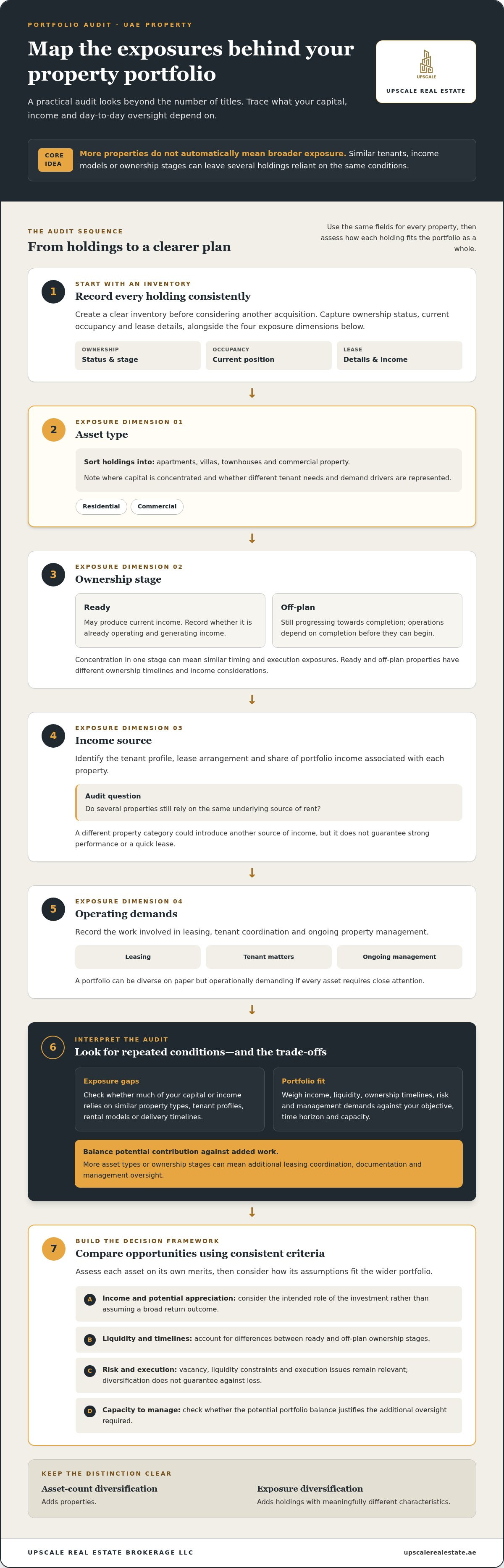
Review each holding across four dimensions:
- Asset type: Apartments, villas, townhouses or commercial property.
- Lifecycle: Ready property that may produce current income, compared with off-plan property that is still progressing towards completion.
- Income model: Tenant type, lease arrangement and source of rental receipts.
- Operating demands: The oversight required for leasing, tenant matters and ongoing property management.
These dimensions help reveal whether holdings behave differently or rely on similar conditions. Suitability depends on your investment objective, time horizon, liquidity needs and capacity to manage the portfolio. A strategy designed around current rental income may not fit an investor with a longer horizon or limited appetite for active oversight.
Does diversification reduce risk or add complexity?
Diversification may reduce dependence on one property, tenant profile or income source. For example, if all your rental income comes from one type of residential asset, adding a different property category could introduce another source of income. That does not mean the new asset will perform well, lease quickly or be easy to sell. Diversification can balance exposure, but it does not guarantee against loss.
Market movements, vacancy, liquidity constraints and execution issues remain relevant. Ready and off-plan properties, for instance, have different ownership timelines and income considerations. A varied portfolio can therefore contain risks at different stages rather than remove risk altogether. Assess each asset on its own merits and consider how its assumptions fit the wider portfolio.
There is also a practical trade-off. More asset types or ownership stages can require additional leasing coordination, documentation and management oversight. Before adding an asset, consider whether its potential contribution to portfolio balance justifies the extra work. A clear view of both financial exposure and operating capacity is the first step towards diversification that is purposeful, rather than merely more complicated.
Build a UAE Property Portfolio Around Four Exposure Dimensions
Before considering another acquisition, create a clear inventory of current holdings. Record each property’s type, ownership stage, income source and operating demands, then look for repeated characteristics. This shifts the question from “How many properties do I own?” to “Which conditions influence most of my capital and income?”
Asset-count diversification adds properties; exposure diversification adds holdings with meaningfully different characteristics. For investors diversifying a UAE property portfolio, the distinction matters: several assets may still depend on similar tenants, leasing conditions or delivery timelines.
- Asset type: Separate residential holdings, such as apartments, villas or townhouses, from commercial property. Note where capital is concentrated and whether different tenant needs and demand drivers are represented.
- Ownership stage: Mark each asset as ready or off-plan, and record whether it is producing income or depends on completion before operations can begin. Concentration in one stage can mean similar timing and execution exposures.
- Income source: Identify the tenant profile, lease arrangement and share of portfolio income associated with each property. Several properties may still rely on the same underlying source of rent.
- Operating intensity: Record the work involved in leasing, tenant coordination and ongoing management. A portfolio can be diverse on paper but operationally demanding if every asset requires close attention.
Use the same fields for every holding. A simple spreadsheet can include ownership status, current occupancy, lease details, income contribution, key dates and management tasks. Keep verified facts separate from assumptions, and flag missing information rather than filling gaps with estimates. This baseline makes potential portfolio gaps easier to distinguish from new acquisition ideas.
Balance residential and commercial property exposure
Residential and commercial leasing can involve different tenant profiles, lease structures and management requirements. Residential income may depend on household demand and individual tenancy events; commercial occupancy can be shaped by business needs and the terms of a particular lease. These are broad distinctions, not return predictions. Analyse demand for each asset separately, since the factors affecting one segment may not affect another in the same way.
For example, an investor with several residential units could assess whether a commercial asset aligns with their objectives, available capital and management capacity. The point isn’t to add commercial property automatically. It’s to determine whether its income drivers and operating needs would genuinely broaden exposure.
Review ready and off-plan ownership stages
A ready property offers visibility into its current condition, occupancy and operating requirements, although future income and leasing outcomes are never assured. Off-plan property involves a different timeline, with completion and delivery milestones affecting when ownership can move into active operation. Compare both stages against your intended holding period, liquidity needs and capacity to manage delivery-related dependencies.
Once the inventory reveals a possible gap, investment advisory can help connect that finding to your objectives and practical constraints. A considered portfolio investment advisory discussion can help frame the next acquisition around the exposure it is intended to change, as well as the oversight it will require.
Compare UAE Property Strategies with a Consistent Decision Framework
Once you’ve identified a portfolio gap, compare possible acquisitions against the same criteria. This prevents a compelling income estimate or appreciation forecast from overshadowing important differences in timing, liquidity and management effort. No property category is universally superior or inherently lower risk. The right fit depends on your objectives, assumptions and capacity to hold and operate the asset.
| Strategy | Objective | Income profile | Liquidity | Timeline | Management effort |
|---|---|---|---|---|---|
| Ready residential | Assess potential for current rental income or a long-term hold. | Review occupancy, lease terms, operating costs and renewal assumptions. | Resale timing depends on the asset and market conditions. | Existing condition and occupancy can be assessed before purchase. | Consider leasing, tenant coordination and ongoing property oversight. |
| Off-plan residential | Consider an ownership stage tied to future completion. | Income generally depends on delivery and subsequent leasing; model timing cautiously. | Exit options and timing depend on relevant terms and market conditions. | Account for construction, completion and leasing milestones. | Track progress and prepare for the transition to ownership and operation. |
| Commercial property | Evaluate exposure to business tenants and commercial leasing. | Assess lease structure, tenant profile, occupancy and operating costs. | Resale timing depends on asset characteristics and market conditions. | Align lease status and acquisition timing with the intended holding period. | Allow for lease administration, tenant relations and property oversight. |
Compare income profile, liquidity, and ownership timeline
Use documented assumptions for each option. Estimate income from lease terms and realistic occupancy scenarios, then account for operating costs before comparing net income. Keep rental income analysis separate from capital appreciation: projected price growth is uncertain, not guaranteed income. A ready property may offer more immediate visibility into its condition and occupancy, while an off-plan purchase depends on delivery and later leasing. Neither makes resale liquidity certain, so match the expected holding period to the asset’s timeline and your ability to retain it if plans change.
Include management capacity in the comparison
Estimate the work required for leasing, maintenance coordination, tenant relations and financial reporting, not just the effort involved in acquisition. Several properties with different leases or timelines may demand more oversight than one straightforward holding. Consider whether professional property management fits your portfolio’s scale and available time. Plan how responsibilities will be monitored and how operational records will inform future decisions.
For additional acquisition context, compare ready property sales with off-plan opportunities using the same criteria. When diversifying a UAE property portfolio, score each option against those criteria and note where evidence is limited. An investment advisory discussion can help connect your comparisons to your objectives and practical constraints.
How to Audit and Rebalance a UAE Property Portfolio
A useful portfolio review ends with a decision, not just a list of holdings. Work from documented information, test where income and workload are concentrated, then decide whether to hold, adjust or add an asset. Headlines and unverified appreciation forecasts can prompt questions, but they shouldn’t replace evidence about your properties, obligations and investment horizon.
Create a portfolio inventory and identify concentration
Build one record for each holding, including asset type, ownership stage, lease status, operating costs and intended holding period. Map each property’s contribution to income and the time or coordination it requires. Label information as confirmed, estimated or awaiting review. For example, distinguish rent supported by a current lease from an occupancy assumption used in a projection. This makes gaps visible before they shape a decision.
- Set your objectives. Clarify whether your priority is rental income, potential appreciation, long-term ownership or a balance. Note your time horizon, liquidity needs and tolerance for operational demands.
- Review concentration. Group holdings by property type, ownership stage, tenant and income source. Identify whether one factor accounts for a large share of your income or requires much of your oversight.
- Test the assumptions. Compare actual lease and cost records with estimates. Document the basis for occupancy, future income and resale assumptions, and mark uncertain forecasts clearly.
- Assess implications before changing exposure. Consider transaction and ownership costs, financing arrangements and compliance requirements. UAE procedures can vary by transaction; verify current ownership, registration and off-plan requirements for the relevant jurisdiction before proceeding.
- Choose an action and schedule follow-up. Decide whether to hold, sell, adjust leasing or pursue an acquisition. Record why the action addresses a specific gap, then set a review point to compare actual outcomes with your assumptions.
Set allocation guardrails and review triggers
Guardrails help keep future decisions aligned with your goals. Define acceptable exposure ranges for property types, income sources or ownership stages based on your circumstances, rather than copying a model allocation. Set review triggers that matter to your holdings, such as a lease ending or changing, an off-plan delivery update, a material shift in operating costs or a change in your liquidity needs.
Rebalancing doesn’t have to mean selling or buying immediately. If restructuring would be impractical, gradual changes may be more suitable: direct the next acquisition towards an identified gap, review leasing decisions as agreements come up for renewal, or update plans as delivery milestones progress. Keep a record of the rationale and revisit it when a trigger occurs. This creates a measured process for diversifying a UAE property portfolio without letting market headlines dictate the pace.
For a portfolio review grounded in your objectives and practical constraints, discuss your investment advisory needs.
Turn a Diversified UAE Property Strategy into an Acquisition and Management Plan
A portfolio review becomes useful when it changes how you assess the next opportunity. Convert the gaps you’ve identified into a written acquisition brief before viewing properties or comparing proposals. That brief keeps decisions anchored to objectives and practical constraints, rather than letting a persuasive forecast or a single attractive feature set the direction.
Prepare a disciplined acquisition brief
Start with the outcome you want the acquisition to support: income, a different asset exposure, a particular ownership timeline or another portfolio objective. Record liquidity needs, intended holding period and the management workload you can accommodate. Then list the property characteristics that matter, without assuming that residential, commercial, ready or off-plan property is automatically the right answer.
- Objectives and constraints: Define the role the asset should play, the capital you can commit, your time horizon and any liquidity requirements.
- Evaluation criteria: Set consistent measures for income assumptions, occupancy, operating costs, ownership stage, potential resale considerations and oversight needs.
- Evidence and assumptions: Keep documented facts, such as current lease details, separate from estimates about future occupancy or appreciation. Mark uncertainty clearly.
Use the same brief to compare shortlisted opportunities. If an option doesn’t address the portfolio gap or fits only under optimistic assumptions, pause and revisit the rationale. Investment advisory can help align acquisition criteria with your wider objectives; brokerage across ready and off-plan sales can support the property search and transaction process. Keep the decision grounded in a transparent comparison, not pressure to act quickly.
Connect acquisition decisions with ongoing management
Ownership begins a new operating phase. Before acquiring, map how leasing, tenant relations, maintenance oversight and performance review will be handled, and who will coordinate each responsibility. Consider the difference between the effort needed to establish a tenancy and the recurring attention required to manage an occupied property. This helps you assess the full commitment, not only the acquisition itself.
Residential or commercial leasing can support the income plan at different ownership stages, while property management can help coordinate ongoing responsibilities. Clear roles and records may reduce operational friction, but they can’t guarantee occupancy, income or appreciation. Include a review process that tracks actual leasing and operating outcomes against your original assumptions, then update the acquisition brief as circumstances change.
A considered approach to diversifying a UAE property portfolio links each purchase to a defined purpose and a workable ownership plan. If you’re ready to turn your portfolio objectives into practical evaluation criteria, discuss a UAE property portfolio strategy with Upscale Real Estate Brokerage LLC’s advisory team.
Make Your Next Portfolio Decision with Greater Clarity
A portfolio strategy doesn’t need to change all at once. A well-defined next step might be to gather current lease and operating records, clarify the role of each holding, or set criteria for a future acquisition. Use that work to keep decisions grounded in your objectives and capacity, then review the plan as your circumstances and properties change. This measured process can make diversifying a UAE property portfolio more deliberate and manageable.
Upscale Real Estate is a RERA-licensed brokerage, ORN 23084, supporting property sales, leasing, management and investment advisory. These services can help investors consider decisions across different stages of ownership, from acquisition and leasing to ongoing management, with choices aligned to portfolio objectives.
Discuss your UAE property portfolio strategy with Upscale Real Estate and identify a practical next step for your investment goals.
Frequently Asked Questions
How many properties do you need to diversify a UAE property portfolio?
There’s no fixed number; diversification depends on how holdings differ, not the count alone. For example, several properties with lease renewals falling around the same time could expose an investor to a cluster of vacancies or renegotiations. Review how each asset contributes to income and when key commitments arise. The appropriate portfolio size also depends on available capital, liquidity needs, objectives and the attention each property requires.
Is off-plan property a good way to diversify a UAE portfolio?
It can add a different ownership-stage exposure, but whether it suits your portfolio depends on its timeline and your capacity to manage uncertainty. Before committing, map expected project milestones against your intended holding period and consider how a delay could affect your plans. Review contractual documents and applicable requirements for the transaction. Compare the opportunity with ready property using the same assumptions, rather than relying on projected completion or future income alone.
Can residential and commercial property balance each other in a portfolio?
They can introduce different tenant and leasing exposures, but owning both doesn’t automatically balance a portfolio. Consider whether lease expiries could cluster, whether income relies on a small number of tenants and how each asset might respond to weaker demand. For instance, test a scenario in which both property types experience longer vacancy periods. Compare the resulting effect on income and oversight needs with your objectives before deciding whether the combination is suitable.
How often should I review a UAE property portfolio?
Choose a review schedule that fits your holdings, then reassess sooner when a material change affects your plans. A lease renewal, revised operating costs or an updated delivery milestone may alter an asset’s role. During each review, compare actual receipts and expenses with the assumptions used in your decision, and record what changed. This creates a useful decision history and helps distinguish a lasting portfolio shift from a short-lived market headline.
Does diversifying a property portfolio guarantee lower risk or higher returns?
No. Diversification can lessen dependence on a single asset or income source, but it can’t prevent losses or guarantee stronger returns. A portfolio with several different properties may still face vacancies, resale delays, unexpected costs or execution challenges. Consider testing how your finances would respond to a missed rental payment or a longer-than-planned sale. Use those scenarios to assess resilience while evaluating each acquisition on its own evidence and suitability.
What information should I gather before diversifying my property holdings?
Gather records that show both the financial position and practical demands of each holding. Alongside property type, lease status and costs, collect relevant ownership documents, current tenancy or lease records, payment history and upcoming obligations. Note which figures are confirmed and which depend on estimates. Add your own liquidity requirements and available time for oversight. This working file helps make comparisons more consistent and gives an adviser a clearer basis for discussing next steps.