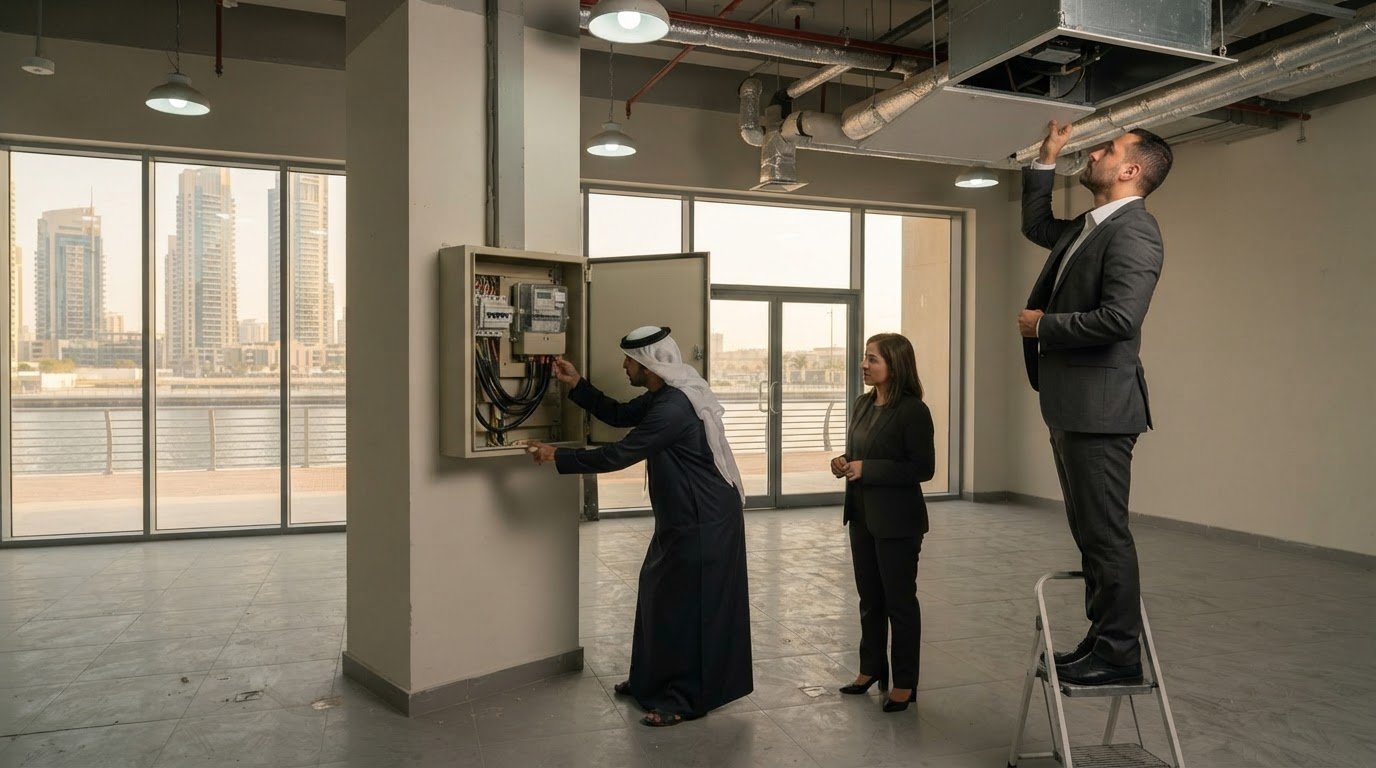

A Dubai property management licence is generally required when a company manages property for others. An individual renting out their own home can register the tenancy in Ejari without a property-management licence. Dubai’s Law No. (26) of 2007 and its amendment, Law No. (33) of 2008, regulate the landlord-tenant relationship, according to the Government of Dubai. These distinctions are central to understanding property management laws in UAE.
Licensing is a sensible place to start, but property management laws in UAE also affect rent collection, VAT and how tenancy disputes are handled. This guide explains when a Dubai property-management licence is required, how rules apply to rent and management fees, and where landlords and tenants can take unresolved rental disputes. It also places Dubai’s requirements in the wider UAE context, where federal rules sit alongside emirate-specific procedures. The key is to distinguish an owner’s obligations from those of a business managing property on the owner’s behalf.
Key Takeaways
- Distinguish managing a property for others from renting out your own home to understand when Dubai licensing requirements apply.
- Separate rent collection from management fees, and understand how VAT treatment can affect property-management charges.
- Know where Dubai landlords and tenants can turn when they cannot resolve a rental dispute directly.
- Account for both federal rules and emirate-specific procedures when assessing real estate compliance across the UAE.
Do You Need a Property Management License in Dubai?
Whether you need a licence depends on whose property you manage. An individual can rent out their own home and register the tenancy through Ejari without a property-management licence. A company managing property for others must hold a valid RERA licence, and staff who directly handle tenants, leases or rent collection must be RERA certified. RERA operates within the Dubai Land Department and regulates real estate brokers and activities.
Dubai’s Department of Land has 21 licensed real estate activities. The activity a business conducts matters: property-management supervision does not allow a company to lease property or collect rent in its own name. Licensing therefore turns on the actual service performed, not just a business’s description. Dubai’s Law No. (26) of 2007 and its amendment, Law No. (33) of 2008, regulate the landlord-tenant relationship, according to Government of Dubai.
Dubai tenancy law applies to leased real property, including vacant and agricultural land, but excludes hotel establishments and hotel rooms. Dubai lease agreements are registered through Ejari, which records tenancy contracts, renewals and notices. In Abu Dhabi, landlords register lease contracts through Tawtheeq. Lease agreements must be registered with the relevant authority in each emirate.
Ending a tenancy depends on the reason and the notice process. For sale, the landlord’s own use, or major renovations, the landlord must give 12 months’ written notice by registered mail or through a notary public. For unpaid rent, a landlord may seek eviction before the lease expires if rent remains unpaid for 30 days after a notice to pay is served. These are distinct grounds, so the notice should identify the applicable basis.
Rent increases have their own timing and limits. Dubai Land Department says landlords must notify tenants of an increase at least 90 days before contract renewal. Local Law No. 43 of 2013 governs increases, which are assessed against area averages using the RERA increase calculator. Tenants also pay housing fees calculated at 5% of yearly rental charges, collected through monthly electricity and water bills.
Operational compliance, rent collection and VAT
In Dubai, rental operations involve contractual payment terms, deposit records, service charges and tax treatment. Each affects the owner’s accounting and the tenant’s rights.
Rent Collection and Payment
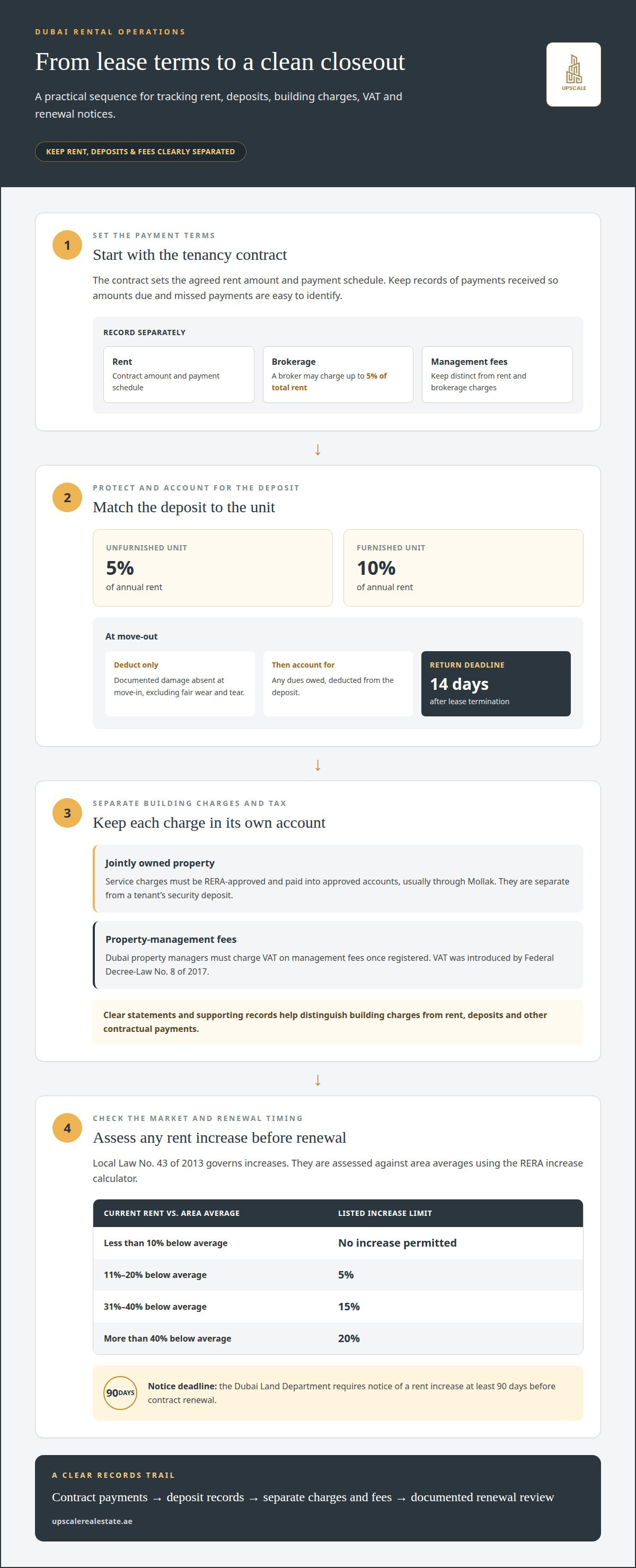
Rent collection means receiving and recording payments according to the tenancy contract. The contract sets the agreed amount and payment schedule, so clear records help owners track what is due and identify missed payments. To mitigate the risk of tenant payment delays and safeguard cash flow, property investors can also consider rental guarantee solutions like Takeem. A broker may charge a commission of up to 5% of the total rent. Keep that brokerage charge distinct from rent and property-management fees in the transaction records.
Deposits and Service Charges
A security deposit protects against eligible amounts due at the end of a tenancy. In Dubai, deposits are typically 5% of annual rent for unfurnished units and 10% for furnished units. At move-out, deductions are limited to documented damage absent at move-in, excluding fair wear and tear. The landlord must return the deposit within 14 days after lease termination, after deducting any dues.
For jointly owned property, service charges must be RERA-approved and paid into approved accounts, usually through Mollak. These charges are separate from a tenant’s security deposit. Clear statements and supporting records help owners distinguish building charges from rent, deposits and other contractual payments.
Rent Increases and Renewal Notices
Rent increases are assessed against the area’s average market rate under Local Law No. 43 of 2013. No increase is permitted when current rent is less than 10% below that average. The listed limits include a 5% increase when rent is 11%-20% below average, 15% when it is 31%-40% below, and 20% when it is more than 40% below. The Dubai Land Department requires notice at least 90 days before renewal.
VAT is another operational consideration: Federal Decree-Law No. 8 of 2017 introduced VAT, and Dubai property managers must charge VAT on management fees once registered. Owners reviewing their property management arrangements can consider how payment records, deposits and fee accounting fit together.
Complaints and rental dispute resolution
Dubai provides a dedicated route for landlord-tenant disputes that cannot be resolved directly. The forum matters: rental claims should go through the relevant authority rather than being treated as ordinary management complaints.
Rental Dispute Authorities
Dubai Decree No. (26) of 2013 established the Rental Disputes Settlement Centre, commonly called the Rental Disputes Centre. It generally handles tenancy disputes landlords and tenants cannot resolve between themselves. A tenant or landlord can bring a claim without requiring a lawyer. This gives both parties a formal channel for matters such as disagreements over lease obligations, rent, or the end of a tenancy.
Dispute Resolution and Enforcement
Start by identifying the issue and gathering relevant documents, such as the tenancy contract, payment records, notices and written communications. These help establish the rental relationship and the steps already taken to resolve the disagreement. The Rental Disputes Centre is the Dubai route for unresolved tenancy claims. Do not assume arbitration automatically replaces it: the contract and applicable rules determine the appropriate process.
Keep communications factual and dated. A landlord disputing unpaid rent, for example, should preserve the payment history and notice to pay. A tenant raising a maintenance or deposit concern should retain the relevant contract terms and correspondence. Organized evidence helps clarify what each party agreed to and what remains contested.
There is no single penalty for every unlicensed property-management activity or rental-law breach in the UAE. Consequences depend on the licensing activity and the specific tenancy issue. A rental claim at the Dubai centre does not replace the requirement to hold any business licence that applies.
For an investor, a complaint can affect rental income and the relationship with tenants. Keep property-management communications and records for at least five years. Clear records help establish what happened if a disagreement reaches the Rental Disputes Centre. Direct resolution may still be possible when both parties agree on a practical outcome.
Federal real estate laws and compliance
UAE real estate compliance combines federal legal principles with emirate-level registration and tenancy procedures. Start by identifying the property’s location and the transaction involved.
Federal Real Estate Compliance
The UAE Civil Code provides a federal framework for civil and commercial transactions, including real estate matters. It came into force on 1 June 2026, replacing Federal Law No. 5 of 1985. The Code also provides for usufruct, a right to use, enjoy, and occupy another person’s property for a fixed term not exceeding 99 years. These principles help define rights and obligations beyond day-to-day residential management.
Registration is a separate compliance step. In the UAE, lease registration is compulsory to connect water, electricity, gas and telecommunications services. It therefore matters to practical occupancy as well as the legal record. Owners and managers should distinguish this federal framework from the emirate authority responsible for recording a specific tenancy or property right.
Differences Across Emirates
Property-management rules differ by emirate because lease registration and local procedures use different authorities and systems. Dubai uses Ejari, Abu Dhabi uses Tawtheeq, and Sharjah registers lease contracts with Sharjah Municipality. The appropriate process depends on the property’s location, even where federal legal principles also apply.
For a residential property in Dubai, Dubai Land Department procedures and RERA oversight are part of the local regulatory structure. Abu Dhabi’s real estate register records title and property rights under Law No. 3 of 2005, together with its 2008 executive regulation. In Sharjah, lease registration goes through the municipality. Other emirates also require registration with the relevant local authority.
If you own property in multiple emirates, treat each location as a separate compliance file. Record the applicable registration system, local authority, tenancy documents and transaction type. This helps avoid assuming that Dubai procedures automatically apply in Abu Dhabi or Sharjah.
For a property-specific review of management requirements, discuss your property management needs with a team familiar with Dubai’s real estate framework.
Upscale Real Estate Brokerage: Property Management
Upscale Real Estate Brokerage LLC offers property management for owners seeking professional oversight of their UAE property. This can be a practical next step when coordinating rental responsibilities alongside tenancy and compliance requirements feels complex, or when an owner prefers support with ongoing property matters.
Its residential leasing service also supports owners preparing a home for tenancy. If you are considering a change in your portfolio, the company handles ready property sales and off-plan project sales. Choose the service that matches your priority: managing a property, leasing a residence or completing a property transaction.
Contact Upscale Real Estate Brokerage LLC to discuss your property requirements.
Make Your Next Property Decision With Clarity
Compliance is not a one-time task. It shapes how an owner plans rental operations, evaluates responsibilities and makes future portfolio decisions. A clear approach helps keep day-to-day management aligned with the property’s role in your wider investment strategy.
Upscale Real Estate Brokerage LLC supports owners with property management, residential leasing, ready property sales and off-plan project sales. The right next step depends on whether you plan to retain a property, lease it or consider another investment direction. Discuss your objective with the team to focus on the service that fits your plans.
Use your understanding of property management laws in UAE as a foundation for making informed decisions about your property. Contact Upscale Real Estate Brokerage LLC to discuss your requirements and take a considered next step.
Frequently Asked Questions
What laws govern real estate transactions?
Real estate transactions fall under federal civil law and emirate-specific registration rules. The UAE Civil Code came into force on 1 June 2026, replacing Federal Law No. 5 of 1985. In Dubai, Law No. 7 of 2006, amended by Law No. 7 of 2019, concerns real property registration. Off-plan sales are addressed by Dubai Law No. 13 of 2008, while Abu Dhabi’s real estate statute is Law No. 3 of 2015, amended by Law No. 2 of 2025.
Who regulates the real estate market in Dubai?
The Dubai Land Department oversees real estate rights and transactions, while the Real Estate Regulatory Agency operates within the department. RERA regulates brokers, developers, and real estate activities. For example, a brokerage transaction and a property-rights registration involve regulatory oversight and transaction records. Rental disputes have a separate route through Dubai’s Rental Disputes Centre, established by Decree No. (26) of 2013.
Can I do property management without the AED 5 million guarantee?
A company providing third-party property leasing and management requires a د.إ 5 million bank guarantee for the Dubai licence described for that activity. A supervision-only management service does not allow the company to lease or collect rent in its own name. An individual renting out their own home can manage it and register the tenancy in Ejari without a property-management licence.
How is a security deposit protected in Dubai?
Protecting a deposit depends on recording the property’s condition and documenting any proposed deductions. Move-in photographs and an inspection report, for example, can help distinguish pre-existing marks from damage that occurs during the tenancy. Deductions are limited to documented damage that was absent at move-in, excluding fair wear and tear. After the lease ends, the landlord returns the remaining deposit after accounting for any dues.
Which UAE federal laws regulate property management and landlord-tenant relationships?
The federal framework includes the UAE Civil Code for civil and commercial transactions and Federal Decree-Law No. 8 of 2017, which introduced VAT. The property management laws in UAE also include emirate-level tenancy rules rather than one uniform set of landlord-tenant provisions. In Dubai, Law No. (26) of 2007, amended by Law No. (33) of 2008, governs that relationship.
What licenses and registrations must property managers obtain in the UAE?
Requirements depend on the emirate and the activity performed. In Dubai, a company managing property for others must hold a valid RERA licence, and staff who directly handle tenants, leases or rent collection must be RERA certified. Tenancy registration also varies: Dubai uses Ejari, Abu Dhabi uses Tawtheeq, and Sharjah registers lease contracts with Sharjah Municipality. Renting out your own home is different from managing property for others.