A lower entry price can mean a longer wait and less certainty than buying a completed home. The risks of buying off-plan property in UAE include construction delays, market fluctuations and being unable to inspect the finished property before purchase. Because you buy before or during construction, assess the developer, payment schedule and contract terms as carefully as the property itself.
It’s understandable to weigh the appeal of a new home against the commitment of paying for a property that is not ready. The key question is not simply off-plan or ready: it is whether the timing, payment obligations and risks fit your plans.
This guide explains how to review a developer’s track record, match instalments to your cash flow and understand the contract provisions for delays or cancellation. It also compares off-plan and ready homes, including the trade-off between waiting for completion and inspecting a property before buying. Use it as a practical framework for making a considered decision in the UAE market.
Key Takeaways
- Review the developer’s track record and project progress to spot warning signs before committing.
- Map each instalment and added purchase cost against your cash flow, including what becomes due at handover.
- Read the contract’s completion, delay and cancellation terms so you understand the steps available if plans change.
- Compare waiting for a new build with the ability to inspect and use a ready home, based on your investment goals and timing.
What happens if a developer delays or cancels a project?
A delay can affect the handover date, payment plan and investment assumptions. In Dubai, review the Sale and Purchase Agreement (SPA), construction progress and escrow arrangements to understand your position.
-
Review the Sale and Purchase Agreement
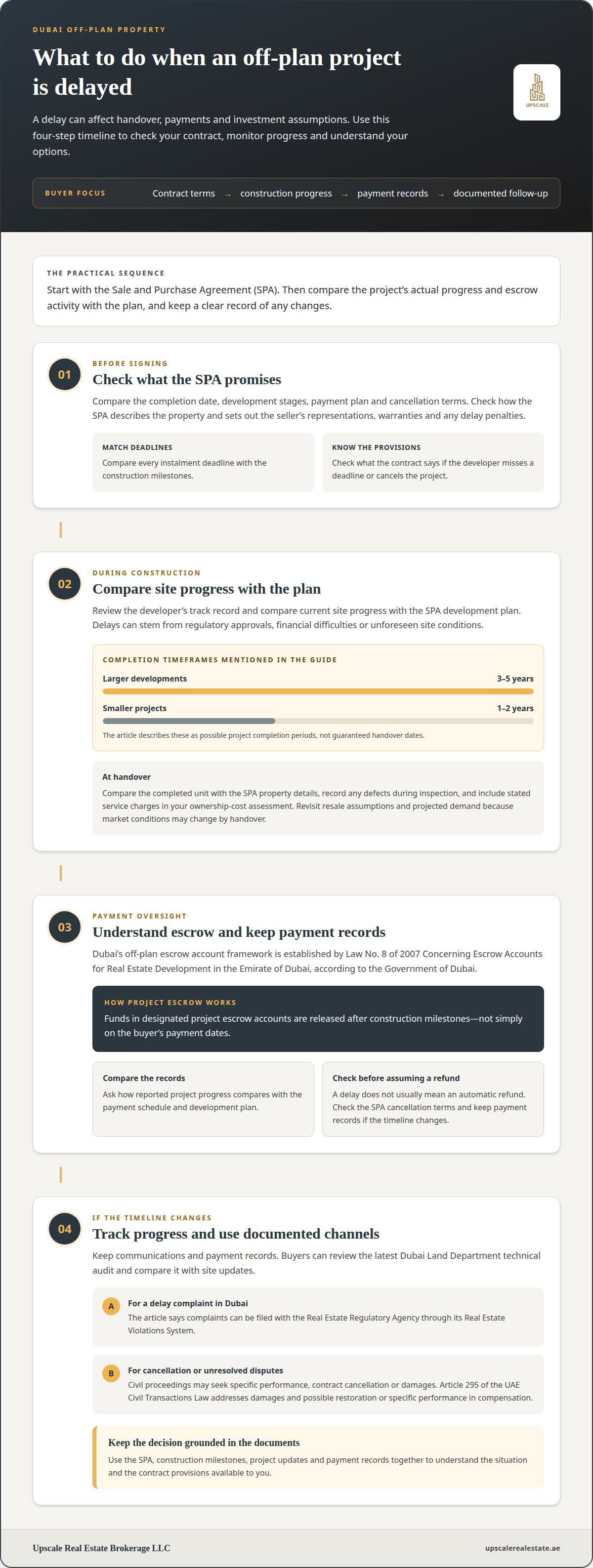
Before signing, compare the SPA’s completion date, development stages, payment plan and cancellation terms. Check how it describes the property and sets out the seller’s representations, warranties and any delay penalties. These provisions clarify what the developer must deliver and what remedies the contract provides.
Review these provisions before signing, and compare every instalment deadline with the construction milestones. The SPA should also explain what happens if the developer misses a deadline or cancels the project.
-
Assess Construction-Delay Risks
Review the developer’s track record and compare current site progress with the SPA’s development plan. Dubai projects can face delays from regulatory approvals, financial difficulties or unforeseen site conditions. Larger developments could take 3-5 years to complete, while smaller projects may take 1-2 years.
At handover, compare the completed unit with the property details in the SPA and record any defects during inspection. Review the stated service charges and include them in your ownership-cost assessment. A delay can also change market conditions by handover, affecting resale assumptions and projected demand.
- Understand where payments go. Dubai’s off-plan escrow account framework is established by Law No. 8 of 2007 Concerning Escrow Accounts for Real Estate Development in the Emirate of Dubai, according to Government of Dubai. Funds in designated project escrow accounts are released after construction milestones, rather than simply on the buyer’s payment dates.
Ask how reported project progress compares with the payment schedule and development plan. A delay does not usually mean an automatic refund. Check the SPA’s cancellation terms and keep records of payments if the timeline changes.
- Track official progress and communicate through documented channels. Buyers can review the latest Dubai Land Department technical audit and compare it with site updates. In Dubai, delay complaints can be filed with the Real Estate Regulatory Agency through its Real Estate Violations System.
For cancellation or unresolved delay disputes, civil proceedings may seek specific performance, contract cancellation or damages. Article 295 of the UAE Civil Transactions Law addresses damages and possible restoration or specific performance in compensation. Separately, according to Federal Authority for Identity, Citizenship, Customs & Port Security, off-plan property valued at AED 2,000,000 or above may qualify for the UAE’s 10-year renewable Golden Visa.
How can I verify the developer’s reputation?
Use Dubai Land Department records and the project’s registration trail to verify the developer, then assess costs and transfer restrictions before committing.
- Confirm the developer’s regulatory standing and review its track record. Dubai developers must be registered with the Dubai Land Department and hold a real estate developer licence from the Real Estate Regulatory Agency. Match the developer’s name against the project documents, then review completed projects and progress on active developments. Compare delivery records with the stated plan rather than relying only on marketing claims. Also consider whether demand in the relevant market supports your intended resale or rental strategy.
- Check registration details and deadlines. Dubai off-plan properties are registered through Oqood, the interim registration system. The sale contract must be registered through Oqood within 90 days of signing the Sale and Purchase Agreement. Keep the registration evidence with your contract and payment records. At handover, the Dubai Land Department registers the completed property and issues the title deed when it is ready for possession.
- Build a complete cost sheet before signing. Dubai property registration costs 4% of the property’s value. The stated Oqood fee is AED 3,000, with an AED 10 knowledge fee; a developer self-registration fee of AED 1,000 applies for provisional sale registration through the Oqood portal. At handover, the stated title deed and map fees are AED 250 each. Mortgage registration is 0.25% of the loan amount plus AED 290.
- Check exit conditions alongside those costs. Buyers may be able to sell before completion, but transfer depends on the developer’s policies and market demand. Some projects require a minimum payment threshold before resale. Ask what the SPA requires, calculate how much you would have paid by then, and consider whether construction delays could narrow your exit options. To compare available off-plan project options, assess the payment and transfer terms alongside the developer’s record.
To reduce purchase risks, verify registration, review project delivery records, calculate every fee and read transfer conditions before signing. Selling before completion is subject to the project’s resale rules and market demand.
Payment plans and buyer cash-flow commitments
Match each payment date to available capital, not just the purchase price. Before committing to a UAE property investment, compare instalments with income, reserves and costs due at completion.
- Separate booking funds from later instalments. In Dubai, booking amounts are often 5% to 10% of the property price, while construction-linked plans may require an initial deposit of 10% to 20%. These are plan-dependent examples, not amounts to combine automatically. Record the exact deposit, due date and subsequent instalment triggers in your cash-flow model.
- Map construction-linked payments against the project schedule. Common structures include 60/40 or 70/30 splits, with instalments spread across construction and a final payment due at completion. Keep the handover amount available separately.
- Test monthly plans against your regular commitments. Some plans require monthly payments of 1% of the property value for 50 to 70 months. Calculate the full monthly obligation alongside rent, existing debt and other investments. A steady instalment can aid budgeting, but it still requires liquidity throughout the payment period and may overlap with other property costs.
- Assess post-handover terms as a separate commitment. Some plans may spread the remaining payment over 2 to 5 years after completion. Compare the schedule with expected income and service charges, and identify any large final instalment. Flexible payment plans change timing, not the total amount owed; model whether your capital remains available if income or market demand changes.
Before signing, list every amount, trigger and due date in the payment plan. Test the schedule against a delayed handover and a period of reduced income, and set aside a reserve for completion costs. Choose a plan that fits your cash flow, not just its label.
Off-plan versus ready property
Compare timing, the ability to inspect and income potential before choosing. The key trade-off in the UAE is paying during construction or buying a completed home.
- Set your required purchase timeline. Off-plan homes are bought before or during construction and may take a few years to develop. Smaller Dubai projects may take 1-2 years, while larger developments could take 3-5 years. A ready property avoids that construction wait, making it more suitable when you need a home or rental asset sooner.
- Compare the full price with comparable completed homes. Dubai off-plan properties are typically priced 10-20% below comparable ready properties. Treat that difference as a potential entry-price advantage, not a guaranteed gain. Market fluctuations, changes in demand and government policy can affect values before handover, while an off-plan property may appreciate during construction. The risks of buying off-plan property in UAE include changes that could alter your expected resale value.
- Consider what you can inspect. With a ready property, you can view the actual unit, its condition and the surrounding community before the transaction. An off-plan home cannot be inspected in its finished state beforehand. Compare plans and specifications with your priorities, and factor in delivery timing. These are practical risks of buying off-plan property in UAE if your decision depends on seeing the completed home.
- Compare potential rental income with the expected handover date. An off-plan property generates no rental income before completion, so you must fund payments without rent from that asset. A completed property may support a rental strategy sooner, depending on its condition and readiness. For either option, plan around realistic income timing, ownership costs and available capital.
- Match regulatory protections to the property stage. Dubai’s off-plan market is regulated by the Dubai Land Department and the Real Estate Regulatory Agency; project payments use a designated escrow account framework. A ready purchase offers a completed asset, while off-plan buyers remain exposed to delivery timing and market changes. Choose off-plan for a longer horizon and potential entry-price advantage; choose ready when inspection and earlier use matter more. Explore ready property options to compare completed homes against your criteria.
Upscale Real Estate Brokerage LLC: Ready Property Sales
Upscale Real Estate Brokerage LLC offers Ready Property Sales for buyers who want to inspect a completed home before purchasing. If the construction timeline suits your plans, its Off-Plan Project Sales offer another option to weigh against your preferred timing, cash flow and investment goals.
For owners planning to rent a completed property, Residential Leasing can support the next stage of ownership. These services are relevant after you have weighed delivery uncertainty against the ability to use or lease a ready home. The choice depends on whether immediate occupancy, rental timing or a future handover matters most to your plans.
To discuss ready property options or off-plan projects, contact Upscale Real Estate Brokerage LLC.
Make your next property decision with clarity
Start by matching the property to your priorities, rather than choosing simply because a launch or listing looks appealing. Set out your intended holding period, need for rental income, preferred access to the home and capacity to keep capital committed. These priorities will help you identify which trade-offs need the closest attention.
The risks of buying off-plan property in the UAE are easier to assess when you compare each opportunity with your personal priorities. Treat the purchase as part of a broader investment strategy, and be prepared to revisit your assumptions if your objectives or circumstances change. A clear plan can make a complex purchase more deliberate.
Upscale Real Estate Brokerage LLC offers Ready Property Sales, Off-Plan Project Sales and Residential Leasing to support different property goals. Discuss your property options with Upscale Real Estate Brokerage LLC and take the next step with a clearer sense of direction.
Frequently Asked Questions
What is an off-plan property in UAE?
An off-plan property is purchased before or while construction is underway, rather than as a completed home. The buyer commits based on the project and unit details in the sale contract, then takes possession after completion and handover. For example, someone might agree to buy an apartment while its building is still under construction, before the finished unit can be inspected.
What are the risks associated with buying off plan projects?
Key risks include construction delays, changes in property values and being unable to inspect the completed unit before buying. You may also receive no rental income before handover while payments continue under the agreed schedule. Reselling before completion can depend on developer rules and market demand, making an exit less straightforward than selling a ready home.
How Do Escrow Accounts Protect Your Money?
Dubai’s escrow framework channels off-plan project funds into a designated account, with releases tied to construction milestones. Law No. 8 of 2007 Concerning Escrow Accounts for Real Estate Development in the Emirate of Dubai establishes this framework, and RERA oversees it. The mechanism controls project-fund release; it does not itself ensure on-time completion or remove property-value fluctuations.
What Is Oqood Registration?
Oqood registration records an off-plan sale in Dubai’s interim real property register before a completed property can receive its final title deed. Dubai Law No. (13) of 2008 regulates that interim register. The process connects the buyer’s sale contract with the project record, so retain registration evidence with the signed agreement and payment documents for later reference.
What are the available legal remedies if an off-plan project undergoes undue delay?
Buyers can file a development-delay complaint with RERA through its Real Estate Violations System, or bring civil proceedings seeking specific performance, contract cancellation or damages. Article 22 of Dubai Executive Council Resolution No. (6) of 2010 sets out circumstances involving developer negligence or omitted obligations. Article 295 of the UAE Civil Transactions Law addresses damages and possible restoration or specific performance in compensation.
What exactly is an "Oqood" certificate?
An Oqood certificate is evidence that an off-plan sale has been recorded in Dubai’s interim property register. It relates to the transaction before completion and is distinct from the final title deed issued when a property is completed and ready for possession. Keep the certificate with the sale agreement and payment records so the project registration can be referenced alongside your purchase documents.