

What if the property that looks most attractive in a listing comes with the least suitable day-to-day costs? A search for modern residential developments across the UAE may surface appealing amenities, asking prices and future development plans, but those details don’t automatically show whether a community will fit your routine or budget.
It’s reasonable to want a clear view before you buy or rent. Area guides can leave out practical trade-offs, while market figures and development announcements need context. A confident decision starts with separating verified information from projections and comparing each property against the same criteria.
This guide from Upscale Real Estate Brokerage LLC offers a practical framework for assessing lifestyle fit, access, ongoing costs and investment assumptions. You’ll learn how to compare property options, identify records to review and assess claims about future infrastructure before relying on them. The aim is a more transparent decision process, whether you’re choosing a home or evaluating an investment.
Key Takeaways
- Assess the residential community as well as the individual property, starting with whether you plan to live there, rent, or invest.
- Use a consistent checklist to verify access, essential services, amenities and development claims, including details related to مرحلة المدينة الدولية ٢.
- Compare options by intended use, price basis, recurring costs and evidence source. Treat rental yield calculations as assumptions, not promises.
- Keep community research separate from property condition checks so your due diligence covers both the setting and the unit.
- Clarify your objectives, verify the evidence and compare total costs before narrowing your options. Upscale Real Estate Brokerage LLC is a RERA-licensed brokerage with ORN 23084.
How to assess a residential community beyond its property listings
Start with your purpose. Are you choosing a home for your household, a rental property for personal use, or an asset to assess as an investment? Your answer changes what matters most. A household may prioritise access to essential services, while a tenant may focus on their commute and recurring housing costs. An investor needs to examine demand evidence and expenses alongside potential income.
A residential community is the setting around a property, including access, services, public spaces and development context. It’s a separate layer of research, not a substitute for inspecting the unit, reviewing its documents or understanding its costs. Listings describe features, but your decision also depends on whether those features support your routine and whether the property itself meets your requirements.
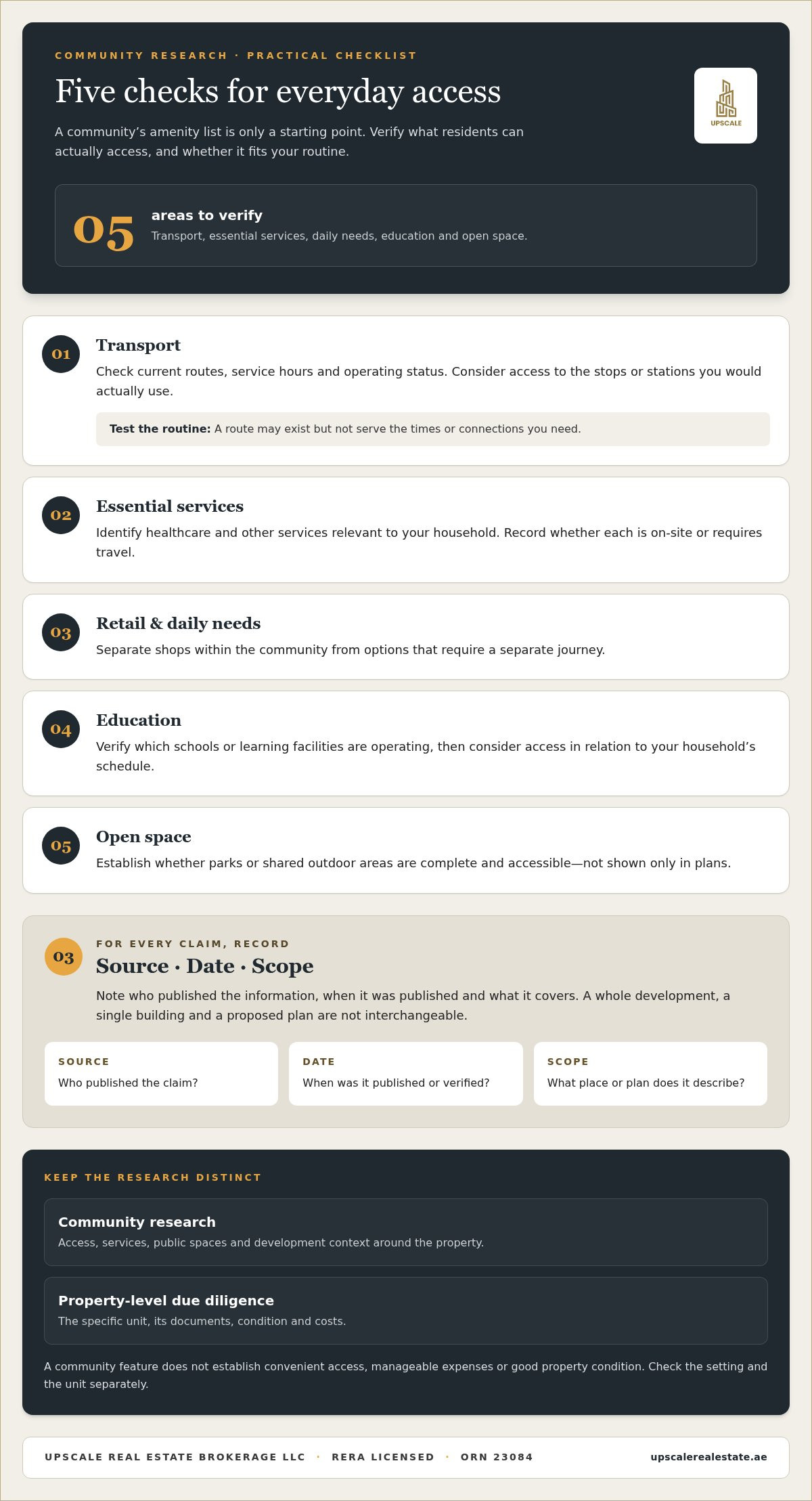
Community research considers how the surrounding setting may affect daily life and property decisions. Property-level due diligence focuses on the specific unit. Keep these questions distinct. A park or retail option may be appealing, but its presence doesn’t establish convenient access, manageable expenses or good property condition. For background on development phases and general characteristics, the International City development overview can provide context. Treat it as orientation, not proof of current conditions or a specific property’s suitability.
Which questions reveal whether a community fits your priorities?
Write down your requirements before browsing listings. Rank daily convenience, household needs, privacy and access, then divide them into essentials and desirable extras. Consider your expected routine: where household members need to travel, which services they use regularly, and what level of activity or privacy feels comfortable. For a search involving مرحلة المدينة الدولية ٢, apply the same questions you’d use for any option rather than assuming one community suits every buyer or renter.
Suitability is personal, not a universal ranking. A feature-rich environment may still be a poor fit if it doesn’t support your regular schedule. A quieter setting may meet your needs even if it has fewer amenities nearby. Record why each item matters so you can compare options against your priorities, not a general “best area” label.
How should readers interpret an area guide?
For each claim, note who published it, when it was published and what it covers. A guide might describe an entire development, one building or a proposed plan. These scopes aren’t interchangeable. Separate what you can verify today from projections, future proposals and promotional language. If a claim has no date or source, treat it as a lead for further research, not an established fact.
Apply the same care to listings. Available properties show what is being marketed at that moment; they don’t prove sustained tenant demand, completed transactions or investment performance. Compare claims with dated records and documents relevant to the property and its setting. This makes it easier to compare options without mistaking attractive descriptions for evidence.
What to verify about access, amenities, and future development
An amenity list is useful only if it reflects what residents can access in practice. For a search involving مرحلة المدينة الدولية ٢, as with any residential community, separate facilities within the development from services that require travel. Then assess whether each one supports your routine instead of treating its mention in a guide or listing as proof of convenience.
Use a simple checklist and record the source and date for each finding:
- Transport: Check current routes, service hours and operating status, as well as access to the stops or stations you would actually use.
- Essential services: Identify healthcare and other services relevant to your household. Note whether they are on-site or require travel.
- Retail and daily needs: Distinguish shops within the community from options that require a separate journey.
- Education: Verify which schools or learning facilities are operating, then consider access in relation to your household’s schedule.
- Open space: Establish whether parks or shared outdoor areas are complete and accessible, rather than shown only in plans.
This evidence-led approach has a useful parallel in the Community Health Assessment Framework, which organizes community research around conditions, resources and needs. Apply the same principle to property decisions: identify the claim, its source, its date and what it means for your requirements.
How can readers test transport and everyday access claims?
Check current route maps and operating information through reliable transport sources, then consider the journey from the property to your regular destinations. A route may exist but not serve the times or connections your routine requires. Review access during the periods that matter to you. Don’t rely on journey-time estimates unless they are dated, documented and relevant to your travel conditions.
Convenience depends on your routine. A household with school and work trips may assess access differently from someone who travels occasionally or works from home. Base your assessment on your likely schedule, not a general claim that a community is “well connected.”
How should future projects and masterplans be assessed?
Label each infrastructure claim by status: proposed, approved, active or completed. These terms describe different stages, so don’t treat a plan or announcement as an operating facility. Record the original source and publication date, then look for a current update before factoring the claim into your comparison.
Future plans are not the same as facilities residents can use today. A development proposal may change or take time to deliver, and projected connectivity or amenities don’t guarantee property value growth. Assess the property on its current merits first, then treat future plans as a separate, uncertain factor. For investment decisions, transparent property investment advice can help structure comparisons around your objectives without presenting projections as guaranteed outcomes.
How to compare property options, costs, and investment assumptions
A fair comparison uses the same measures for every option. Whether you’re assessing an apartment, villa or townhouse in مرحلة المدينة الدولية ٢, separate the asking price from the full cost of ownership and distinguish documented facts from estimates. Record the date and source for each figure because listings and cost information can change.
Use a comparison table to keep your decision grounded. Fill it with verified details rather than broad claims or unsupported market averages.
| Property type | Intended use | Price basis | Recurring costs | Evidence source |
|---|---|---|---|---|
| Apartment | Owner-occupied, rented, or investment | Current asking price or documented transaction price; label which | Applicable service charges, maintenance, management, and other expenses | Dated listing, transaction record, cost documents |
| Villa | Owner-occupied, rented, or investment | State whether the figure is an asking price or a recorded sale | Property-specific recurring expenses and management arrangements | Dated listing, transaction record, cost documents |
| Townhouse | Owner-occupied, rented, or investment | Use a consistent price basis across options | Applicable charges, upkeep, and any management costs | Dated listing, transaction record, cost documents |
Which recurring costs belong in a fair comparison?
Include service charges, maintenance, property management and any other expenses that apply to the specific unit and ownership arrangement. Don’t assume two properties have identical costs just because they share a property type. Review relevant records and label each figure as confirmed, estimated or unknown. Making assumptions visible helps you see how changes in costs could affect your budget or investment analysis.
For a broader asset-level view, compare the ready-property investment framework with the off-plan versus ready comparison. These perspectives can help you assess different purchase stages without treating them as interchangeable.
How do gross yield and net yield differ?
Gross yield = annual rent ÷ purchase price × 100. This is a preliminary ratio, not a profit forecast. Label the rent figure as an assumption or use documented rental evidence, and identify the price basis. Keep the period and currency consistent across comparisons.
Net yield considers income after relevant expenses. Account for costs such as service charges, maintenance, management arrangements and a clearly stated vacancy assumption. Applicable deductions vary by property, so don’t present a gross figure as net performance. If a cost or rent assumption is unknown, label it as unknown rather than filling the gap with an unsupported average. This creates a more transparent comparison, but doesn’t guarantee future income or returns.
Compare options only after aligning their intended use, price basis, recurring expenses and evidence quality. This helps reveal which assumptions drive the result and which property merits closer review.
A due-diligence checklist for evaluating a property decision
A disciplined review keeps community research separate from checks on the individual unit. This distinction matters whether you’re considering a home, a rental or an investment in مرحلة المدينة الدولية ٢. A convenient setting can’t establish that a property is in suitable condition, and a well-presented unit doesn’t prove that claims about its surroundings are accurate.
Follow the steps in order. Keep notes and supporting documents together so each decision rests on evidence, not memory.
- Define your objectives. Write down whether you plan to live in the property, rent it or assess it as an investment. Record essential requirements, budget limits and the factors that would rule out an option.
- Verify community claims. Check current access, services and facilities against dated sources. Keep this research at the community level; don’t use an area guide to infer the condition or legal status of a specific unit.
- Inspect the property. Assess the unit itself, including visible condition, fixtures and any issues that could affect use or upkeep. Record your observations and distinguish what you saw from information provided by someone else.
- Review costs and documents. Gather relevant transaction or tenancy paperwork and identify recurring expenses, payment obligations and included services. Mark assumptions that still need supporting evidence.
- Compare the options. Apply the same criteria to each property and note what is confirmed, estimated or unresolved. If the property is part of a wider investment portfolio, portfolio management guidance can help you assess how the asset fits alongside your other holdings.
What should buyers and renters review before proceeding?
Buyers can organize applicable title and transaction documents alongside inspection records, cost information and relevant property details. Renters should read the tenancy terms, payment obligations, condition records and descriptions of included services. Document requirements depend on transaction type and applicable rules, so seek appropriate professional guidance where needed. Keep community-level research separate from unit-specific records so you don’t mistake one for evidence of the other.
How can readers keep assumptions and evidence organized?
Create a worksheet with columns for source, date, verified fact, estimate and open question. Label asking-price figures clearly; they are not the same as completed transaction prices. Note whenever a projection, rental figure or cost relies on an assumption. Review the worksheet when your circumstances change or new information becomes available, and update the comparison rather than carrying forward outdated inputs.
Once your objectives and evidence are organized, use professional property advisory to structure a transparent comparison around your requirements and next steps.
Plan your next step with transparent real estate advice
A sound decision follows a clear sequence: clarify your objective, verify the evidence, compare total costs, then identify the options that fit. For a search related to مرحلة المدينة الدولية ٢, use the same discipline as for any property decision. The area name can help define your search, but your priorities, documented property details and cost assumptions should determine which options merit closer attention.
Upscale Real Estate Brokerage LLC is a RERA-licensed brokerage with ORN 23084. Its property sales, residential leasing, property management and investment advisory services support different objectives. A buyer may compare ready and off-plan options; a renter may narrow down homes according to household needs; an owner may consider how management arrangements fit an investment plan. The right discussion depends on your purpose, not a preset recommendation.
What can a tailored property discussion help clarify?
Bring a practical brief: intended use, budget framework, essential requirements, preferred property type and non-negotiable considerations. A structured search can then focus on options that align with your criteria. Transparent comparisons make trade-offs easier to assess, including differences in property condition, recurring costs, access and the evidence behind a price or rental assumption.
Not every option will satisfy every preference. Ranking essentials separately from desirable features helps keep your shortlist focused without overlooking meaningful compromises. Recommendations should reflect your objectives and the available information, giving you a clear basis for deciding what to explore further.
How can property management fit into an investment plan?
Property management is an operational consideration, not a guarantee of rental income, occupancy or appreciation. Before acquisition, consider how tenant relations, property operations, maintenance coordination and recurring expenses fit with the owner’s responsibilities and wider portfolio objectives. These factors can affect the assumptions used to compare an investment, so account for them alongside purchase criteria and potential income rather than treating management as an afterthought.
For owners assessing one property alongside other holdings, investment advisory can help frame the asset against stated goals, while property management addresses its ongoing operation. Neither removes the need to review evidence or recognize uncertainty. Keep projected performance separate from confirmed costs and decisions that depend on future conditions.
Once you’ve clarified your objectives and comparison criteria, discuss property management and investment advisory in relation to your property plans. A focused conversation can help organize the questions and trade-offs that matter to your decision, without assuming a particular option or outcome in advance.
Move from research to a decision you can stand behind
Your next step doesn’t need to be a commitment. Turn your priorities into a short decision brief: what the property must support, which trade-offs you can accept and what evidence you still need. This gives each viewing or discussion a clear purpose and helps prevent attractive features from distracting you from your core requirements.
If you’re considering مرحلة المدينة الدولية ٢, apply the same standard to every option: separate what’s verified today from what depends on estimates or future change. Revisit your comparison when new documents or circumstances emerge. A decision grounded in current evidence is more useful than one built around assumptions that no longer fit.
Upscale Real Estate Brokerage LLC is a RERA-licensed brokerage, ORN 23084. Its sales, leasing, property management and investment advisory services can support different property objectives. Discuss your property objectives with Upscale Real Estate and take a considered next step based on your priorities.
With a clear brief and a transparent process, you can move forward with greater confidence and keep control of the decision.
Frequently Asked Questions
How do I decide whether a residential community suits my needs?
Test the community against the routines and constraints that shape your decision, not its overall reputation or amenity count. If household members leave at different times, for example, consider whether the available access options work for each schedule. For a search involving مرحلة المدينة الدولية ٢, write down which features would make daily life workable and which would simply be convenient. A clear priority list helps distinguish a genuine fit from an attractive first impression.
What should I check before renting a property?
Before agreeing to rent, understand what the tenancy paperwork says about payment timing, maintenance responsibilities, included services and the property’s recorded condition. Compare the condition record with what you observe during a viewing, and document any differences before proceeding. Check practical details such as access arrangements and which utilities or services are included in the agreement. If a point affects your obligations, rely on the written terms rather than an informal description.
How do I compare two properties fairly?
Use information collected on the same basis and, where possible, around the same date. Distinguish each property’s internal area measurement from any broader area figure in its listing, and record whether the price is advertised or linked to a completed transaction. Note major differences in condition or included services separately rather than blending them into a single score. This makes the comparison easier to revisit if a listing changes or new evidence appears.
What is the difference between gross yield and net yield?
Gross yield compares annual rental income with the purchase price before property expenses; net yield considers income after relevant expenses. The distinction matters because a gross figure can look stronger when costs or unoccupied periods are left out. For a useful comparison, state whether rent is actual or estimated, identify which expenses are deducted and explain the vacancy assumption. Treat the result as a model based on those inputs, not a promise of future income.
Can planned transport or infrastructure increase a property’s value?
It may influence how some buyers assess a property, but any change in value is uncertain and depends on more than a plan. Base your core assessment on conditions and access that exist today. You can then consider a separate scenario in which a proposed project is delivered, clearly labelling it as conditional. This prevents an uncompleted project from carrying the same weight as an operating service when you assess affordability or investment risk.
What documents should I review before buying a property?
Review documents that identify the property, establish relevant ownership or transaction details, describe its condition and explain applicable costs and obligations. Check that names, unit references, dates and figures are consistent across the records you receive. Note missing items or inconsistencies, and seek appropriate professional guidance on points that affect your transaction. Requirements vary by property and transaction type, so a listing or verbal explanation alone isn’t a substitute for document review.
Is a property with more amenities always the better investment?
No. An amenity count doesn’t show whether tenants or residents value those features, whether they’re available to use or how related expenses affect ownership costs. Consider who is likely to use the property: a feature may matter to one household and add little value for another. Compare each option’s operating assumptions and supporting evidence, and assess whether its features support your objective enough to justify their place in the decision.