

What if the home that looks perfect online is the wrong fit for your family’s everyday life? When buying a family home in the UAE, photographs and headline features can’t show how well a layout supports your routines, whether the purchase fits your finances, or what information you’ll need to review.
Start with your household’s priorities, then compare each property against them, from room use and storage to ongoing responsibilities and paperwork. The right choice might be a ready apartment, villa, or townhouse, or an off-plan home that fits your family’s plans and timing.
This guide offers a practical framework for assessing family suitability, comparing property types and purchase options, and preparing for the decisions and documentation involved. You’ll also find a step-by-step way to move from shortlisting to viewing with clearer questions. Upscale Real Estate Brokerage LLC is a RERA-licensed brokerage, registration number ORN 23084, offering guidance on ready and off-plan residential property sales and working with DLD-verified listings.
Key Takeaways
- Start buying a family home in Dubai with a clear brief for bedroom use, privacy, accessibility, and work-from-home needs.
- Assess how a property functions in person, from the entrance and circulation to shared spaces, private rooms, and storage.
- Compare apartments, townhouses, and villas against your household’s priorities, the property’s condition, and the individual listing.
- Move from shortlist to purchase methodically, using each viewing and document review to strengthen your decision.
- Upscale Real Estate supports ready and off-plan home comparisons with DLD-verified listings. It is RERA-licensed, registration number ORN 23084.
Buying a Family Home: Define What Your Household Actually Needs
A family home needs to work on ordinary weekdays, not just look appealing during a viewing. It should support the way your household cooks, rests, studies, works, and spends time together, while remaining practical if your needs change. Before browsing, turn those routines into clear property criteria. That makes buying a family home in Dubai a considered search, rather than a contest between attractive listing features.
Family-home suitability is the match between a household’s needs and the way a property functions in daily life. Keep that test in view when comparing options. A striking finish or extra feature may be welcome, but it shouldn’t outweigh a layout that lacks privacy, usable shared space, or room for essential belongings.
How to build a family-home brief before browsing
Start with your household as it is today, then note realistic changes you expect over time. Consider who needs a bedroom, whether rooms will serve more than one purpose, and whether anyone needs step-free access or quieter surroundings. Separate requirements that apply to every property from preferences about property type. This keeps an appealing listing from shifting your priorities without a good reason.
- Household and bedrooms: Record who will live in the home and how each bedroom needs to function, including any shared or flexible use.
- Storage and shared space: List what needs to be stored and which shared rooms need enough usable space for everyday activities.
- Privacy and accessibility: Note where separation or easier movement through the home matters to household members.
- Work and future needs: Decide whether work or study requires a quiet room, and which likely changes could affect the brief.
Write down preferred property types separately. An apartment, townhouse, or villa may each be worth considering if it meets your core requirements. Preferences can guide the search, but they shouldn’t be mistaken for needs.
Which daily routines should shape the search?
Map a typical day from morning to evening. Think about how work, errands, rest, and recreation shape when rooms are busy and when quiet matters. Consider whether the kitchen is mainly for preparing meals or also a place to gather, how often your family uses outdoor space, and whether living areas need to support both shared time and independent activities.
- Convenience: Consider how the layout supports regular departures, arrivals, and everyday tasks.
- Flexibility: Look for rooms that can serve changing purposes without disrupting essential routines.
- Comfort: Decide where your household needs privacy, quiet, or room to spend time together.
Use these priorities to compare homes consistently. As you prepare to move from household criteria to the purchase process, understanding the Real Estate Regulatory Agency (RERA) can provide context on the property-sector framework. Keep the focus on fit: a home should support your routines now and remain workable as your family’s plans evolve.
How to Assess a Family Property Beyond Its Photos and Floor Plan
Photos can show finishes and room labels, but they can’t tell you how the home feels to move through with children, groceries, or a busy morning routine. At a viewing, follow the same sequence each time: start at the entrance, then trace how people move through the property before assessing the rooms themselves.
A floor plan is useful only when you test its spaces against the routines your household will actually follow. A room marked “bedroom,” for example, may not comfortably fit the bed, storage, and movement space your family needs. Look at proportions and function, not labels alone.
What to inspect during a family-home viewing
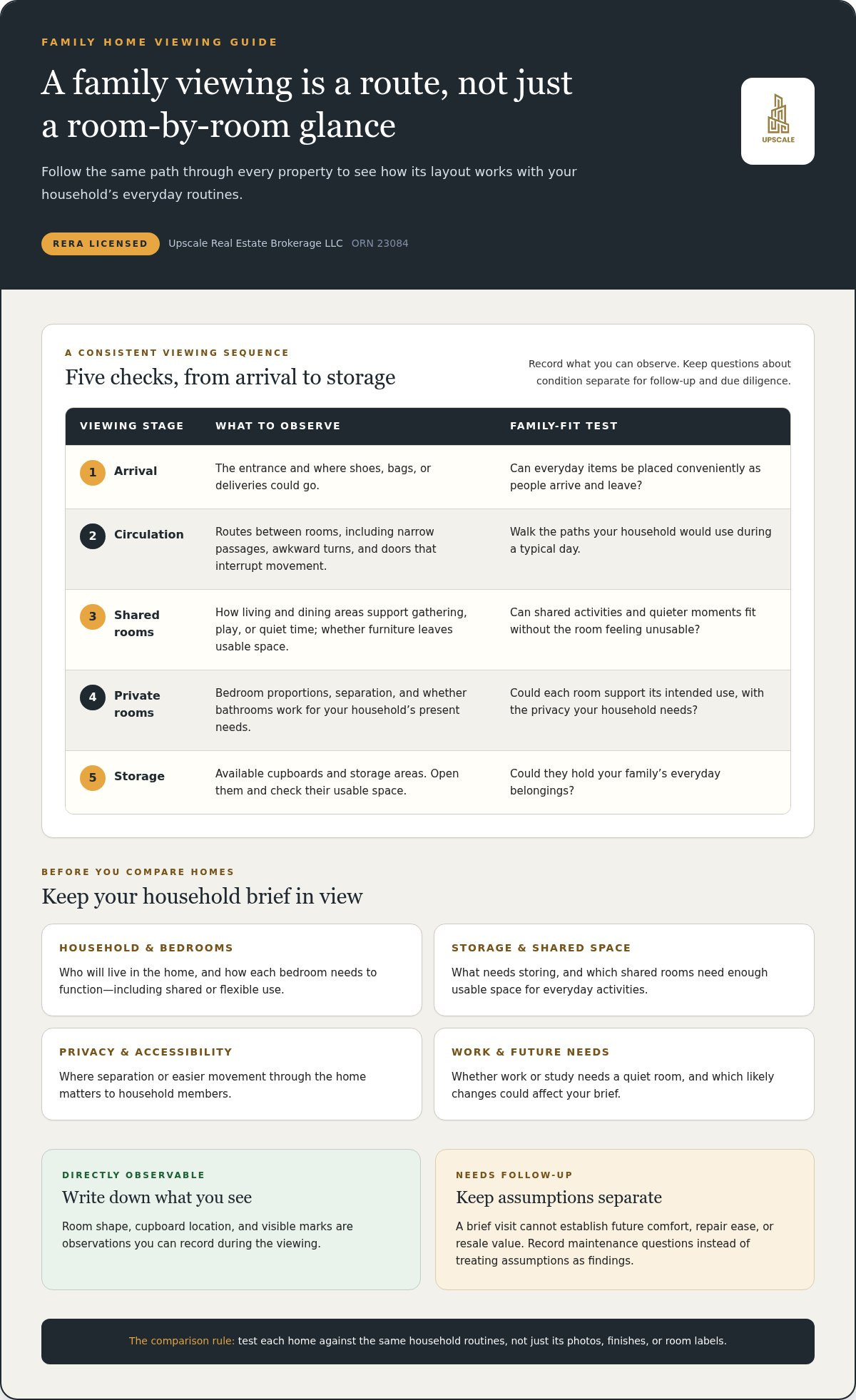
Use this order to keep the viewing focused and comparable. Take notes on what you can directly observe, and record questions about condition separately for follow-up and due diligence.
- Arrival: Notice the entrance and where everyday items such as shoes, bags, or deliveries could go.
- Circulation: Walk the routes between rooms. Look for narrow passages, awkward turns, or doors that interrupt movement.
- Shared rooms: Consider how the living and dining areas work for gathering, play, or quiet time. Check whether furniture placement leaves usable space.
- Private rooms: Assess bedroom proportions, separation, and whether the bathrooms work for your household’s present needs.
- Storage: Open available cupboards and inspect storage areas. Note whether they can hold your family’s everyday belongings.
Separate visible facts from predictions. You can observe a room’s shape, a cupboard’s location, or a mark on a wall. A brief visit can’t establish that a home will always feel comfortable, that a repair will be straightforward, or that a feature will improve resale value. Write down maintenance questions instead of treating assumptions as findings.
How to test whether the layout can adapt
Think through realistic changes, such as a child needing a study area, a guest staying over, or a family member needing more privacy. Identify spaces that could serve those purposes as they are. Don’t assume alterations will be simple or inexpensive; first assess the flexibility the existing layout already provides.
- Could a quiet corner support study or focused work without taking over the main living area?
- Can a room accommodate guests or caregiving while preserving privacy for others?
- Would changing routines make a shared area feel crowded or disrupt its main use?
After each viewing, compare your notes with the same household brief. Separate confirmed features from questions that need documentation or further review. This helps keep polished staging, attractive finishes, or a memorable first impression from outweighing practical fit. For a considered shortlist, explore ready and off-plan residential property options alongside the needs you’ve identified.
Apartment, Townhouse, or Villa: Compare Family-Home Trade-Offs
No property type is automatically the right choice for a family. An apartment, townhouse, or villa may fit, depending on your household brief, the individual listing, and the property’s condition. Compare how each home supports your routines rather than relying on assumptions about what a type usually offers. This is especially useful when buying a family home in Dubai, where listings can vary in layout and usable space.
Use this table as a starting point, then test each point against the actual property:
| Property type | Space | Privacy | Upkeep | Household flexibility |
|---|---|---|---|---|
| Apartment | Assess room proportions and how efficiently the layout uses available space. | Check bedroom placement and how sound or activity may carry between shared and private rooms. | Review the condition and responsibilities specific to the property. | Consider whether rooms can serve changing needs without disrupting shared areas. |
| Townhouse | Examine how space is distributed across levels and whether it suits daily movement. | Look at the separation between living areas and bedrooms within the home. | Understand the practical tasks associated with this individual property. | Assess whether the layout supports different activities and household routines over time. |
| Villa | Check which rooms and spaces are genuinely usable for your household. | Consider how the home’s layout separates family, guest, and quiet spaces. | Review the property’s condition and the responsibilities that come with its specific features. | Evaluate whether the available rooms can adapt to work, study, guests, or caregiving. |
These are prompts, not guarantees. A well-laid-out apartment may work better for one household than a larger home with awkward circulation. Privacy and flexibility depend on the floor plan and condition, not simply the listing category.
When an apartment may fit a family’s priorities
An apartment can suit a family if its layout gives everyday activities enough room to coexist. During a viewing, check whether the shared living area can accommodate your household’s usual routines and whether bedrooms remain private when the home is active. Look closely at storage and circulation too. A room count alone won’t show whether belongings have a practical place or whether people can move through the home comfortably.
How townhouses and villas differ in day-to-day use
Townhouses and villas can differ in how they arrange shared rooms, private areas, and movement through the home, but the individual listing matters more than the label. Consider whether stairs fit your household’s needs, how far bedrooms are from shared spaces, and whether outdoor or additional areas will be used. These features may add flexibility, but they can also involve responsibilities to understand for that specific property. Don’t assume every home of a type has the same layout or upkeep needs.
Compare your strongest candidates against the same criteria, and keep property suitability separate from purchase timing. If you’re weighing that decision too, this ready-versus-off-plan property comparison can help frame the difference between a completed home and an off-plan purchase.
A Family Buyer’s Step-by-Step Path from Shortlist to Purchase
A structured process helps turn a promising listing into a decision grounded in household fit and documented information. When buying a family home in Dubai, move through each stage deliberately. Keep your notes, questions, and supporting documents together so you can see what’s known, what needs review, and why a property remains on your shortlist.
- Define the brief. Record your household’s essential needs, preferred property types, and financial readiness. This creates a consistent basis for judging listings instead of changing priorities whenever an appealing option appears.
- Build a shortlist. Compare listing information against the brief. Note which homes appear to meet your requirements and which details need confirmation. Treat photographs and descriptions as starting points, not substitutes for an in-person assessment.
- View the properties. Use the same viewing approach for each candidate. Observe how the home functions, then record strengths, drawbacks, and questions while details are fresh.
- Compare the evidence. Review your notes side by side. Separate observable features and documented listing details from impressions, assumptions, or unresolved points.
- Review documents. Organise the property and transaction information for careful review. Check the ownership, financing, and transaction requirements relevant to your purchase using current authoritative information.
- Proceed with clarity. Move forward when the property fits your household brief, outstanding questions have been addressed, and your financial position supports the decision.
How to create and compare a family-home shortlist
Use a simple comparison record for every candidate: household-fit strengths, trade-offs, listing details, and open questions. After a viewing, distinguish what you directly observed from what needs further review. For example, a room’s layout is visible, but whether it suits a future use depends on your needs and the information available.
Consistent notes make trade-offs easier to judge. A home that misses one preference may still meet all essential requirements, while a polished presentation shouldn’t obscure an unresolved issue. The Dubai Land Department overview offers related context on the named property authority.
What to review before moving ahead
Gather the listing materials and transaction documents in one place. Note which facts are supported by those records and which questions remain. Ownership, financing, and transaction requirements can change, so don’t rely on outdated summaries or informal assumptions. Check current requirements through authoritative information relevant to your circumstances before making commitments.
A sound decision brings together three checks: the home works for your household, the documentation supports your understanding of the property and process, and your finances are ready for the purchase. Upscale Real Estate provides guidance on ready and off-plan residential sales, works with DLD-verified listings, and is RERA-licensed, registration number ORN 23084. Explore the brokerage’s residential property services as you consider your family-home priorities.
How Upscale Real Estate Supports a Considered Family-Home Purchase
Once your household priorities are clear, compare suitable properties using reliable information and consistent criteria. Upscale Real Estate provides buyer guidance for ready and off-plan residential property sales, including apartments, townhouses, and villas. Its support helps families assess options against their needs, alongside the careful checks involved in a major purchase.
Upscale Real Estate is a RERA-licensed brokerage, registration number ORN 23084, and works with DLD-verified listings. Its transparent, investor-centric approach includes clear communication and guidance grounded in data. Buying a family home in Dubai involves both a household decision and a property transaction, so it helps to distinguish documented details from questions that still need answers.
- Professional guidance - multilingual consultants with deep local expertise
- Transparent communication - clear pricing, honest advice and full paperwork visibility.
What transparent, investor-centric guidance means for a homebuyer
Transparent communication helps you understand the information being used to compare properties. Full paperwork visibility makes it easier to distinguish documented details from open questions, so you can make decisions with a clearer view of what you know and what still needs attention. A listing’s presentation should support your review, not replace the evidence.
An investor-centric approach can bring broader property considerations into the discussion. Upscale’s stated approach uses yield modelling and capital-appreciation data. For a family buyer, these perspectives can inform a wider assessment alongside household suitability, but they don’t predict or guarantee a particular return or future value. The property still needs to make sense for your family’s intended use and financial readiness.
Guidance can also help when you compare a ready home with an off-plan option, since the purchase format affects what information is available to assess. A structured discussion keeps the comparison anchored to your priorities and the facts presented, rather than assumptions about what either option will deliver.
How to take a low-pressure next step
You don’t need to have every decision settled before starting a conversation. Share a few details about your household priorities and the type of home you’re considering. An Upscale advisor will be in touch within one business day. You can use the conversation to discuss questions and refine your criteria.
Explain what matters most, such as the layout your family needs, whether you’re considering a ready or off-plan property, and which points you want clarified. The aim is practical guidance that helps you compare options with greater visibility. To discuss your family’s priorities, arrange a Free Property Consultation.
Take Your Family-Home Search Forward with Clarity
Turn your priorities into a focused conversation. Note what your family needs from a home now, which changes you’re planning for, and what information you still need before deciding. This gives you a practical starting point for assessing options without letting urgency or presentation take the lead.
Buying a family home in Dubai is a significant household decision, and confidence comes from having a clear basis for comparison. You don’t need to resolve every question before seeking guidance. A thoughtful discussion can help you identify the points that matter most, clarify your preferred direction, and decide what to examine next.
Upscale Real Estate offers a Free Property Consultation to help you explore your family’s priorities and residential property options. Share a few details to begin the conversation, with transparent communication and no hidden fees.
Arrange your Free Property Consultation and take the next step toward a home that feels right for your household.
Frequently Asked Questions
Is buying a family home different from buying a property as an investment?
Yes. The primary purpose changes what you assess first. A family buyer may prioritise daily routines, privacy, room use, and space that can adapt, while an investor may focus more on yield modelling and capital appreciation. Those priorities can overlap, but neither guarantees a particular outcome. Before comparing listings, decide whether your main goal is a home for your household, an investment, or a combination, then assess each property against that purpose.
How do I choose between an apartment, townhouse, and villa for my family?
Compare the actual homes against your household’s needs instead of assuming one property type is inherently better. Consider how much usable space you need, how rooms are arranged, the privacy the layout provides, and the responsibilities associated with the property. A room’s position, for example, may matter more to your family than its label. Use the same criteria for every listing, and include the home’s condition in your comparison.
What should I check during a family-home viewing?
Check whether you can use the rooms comfortably, move between them easily, store everyday belongings, and maintain the privacy your household needs. Imagine ordinary activities, such as preparing a meal while someone studies or rests. Look closely at visible features and note anything that raises a question about condition. Keep observations separate from assumptions, and record unresolved points for later review. A viewing is one part of the decision, not a substitute for document checks.
Can I buy a family home before deciding between a ready and off-plan property?
Yes. Start by defining your household’s needs, financial readiness, and preferred purchase timing, then compare suitable ready and off-plan options. The right choice depends on the specific property, its purchase terms, and your family’s plans, not a universal rule. Consider what you can assess about each option and which details need clarification before proceeding. For a deeper framework, read this ready-versus-off-plan property comparison.
What documents should I review before buying a home?
Review the property and transaction documents relevant to your purchase, and organise them so you can distinguish documented facts from unanswered questions. The exact documents and requirements depend on the transaction and current rules, so don’t treat a general online checklist as complete legal guidance. Check current requirements through authoritative sources, and seek appropriate professional advice where needed. Careful review can help you understand what you’re agreeing to before proceeding.
How can I make sure a property suits my family long term?
You can’t guarantee that a home will suit every future change, but you can assess its flexibility against realistic plans. Consider whether rooms could accommodate a new study routine, guests, or changing privacy needs without assuming alterations will be straightforward. Separate lasting requirements, such as accessible circulation or sufficient storage, from preferences that may change. Then compare each candidate against those criteria. This keeps the decision grounded in how the property functions rather than predictions about future value.
Is a property consultation free with Upscale Real Estate?
Yes. Upscale Real Estate offers a Free Property Consultation and states “No Hidden Fees.” Share a few details, and an Upscale advisor will be in touch within one business day. Use the consultation to discuss your family’s property priorities and the questions you want to resolve.