

What if the most attractive listing isn’t the best fit for your household or investment plan? When researching any residential community, listing volume and polished descriptions can obscure the details that shape a sound decision.
Comparing homes is difficult when property types, condition, location within the community and investment assumptions vary from one listing to another. A consistent framework helps you assess those differences without relying on promotional claims alone.
This guide sets out a practical, data-led way to evaluate a community in 2026. You’ll define your priorities, compare property options using the same criteria and review the evidence behind costs, rental potential and longer-term value. You’ll also learn what to examine before arranging a viewing or progressing toward a purchase, so your next step reflects your objectives and the available property information.
Key Takeaways
- Separate household or investment priorities from property requirements to clarify what a suitable community needs to offer.
- Compare apartments, villas and townhouses using consistent criteria, including size, layout, condition, intended use and listing evidence.
- Use a five-step decision process to define your goal, set criteria, shortlist options, review evidence and weigh trade-offs.
- Distinguish ready resale from off-plan options, then review the relevant listing details, documentation and assumptions before deciding what to explore next.
- Understand how Property Sales, Property Leasing and Investment Advisory can support different goals, with Property Management relevant to ongoing ownership.
What should buyers assess when researching a residential community?
The first question isn’t which listing looks most appealing. It’s whether the community suits your household, priorities or investment plan. A home may meet your space requirements but complicate daily routines. An investment that looks promising on paper may not align with your time horizon or risk tolerance.
A community assessment is a structured review of fit, evidence and trade-offs. It helps you compare your needs with what the community and its available properties can substantiate, rather than relying on broad descriptions or first impressions.
Start by separating lifestyle needs from property requirements. Lifestyle needs describe how you expect to live or use the area. Property requirements describe the home itself and the features it must provide. List practical criteria such as:
- Daily routines: Work patterns, school or caregiving responsibilities, errands and regular activities.
- Space: The rooms, storage and outdoor areas your household needs now, with reasonable allowance for future changes.
- Property type: Whether an apartment, villa or townhouse better supports your intended use.
- Connectivity: The routes and transport access relevant to your usual destinations.
- Long-term plans: Expected length of ownership, household changes or investment time horizon.
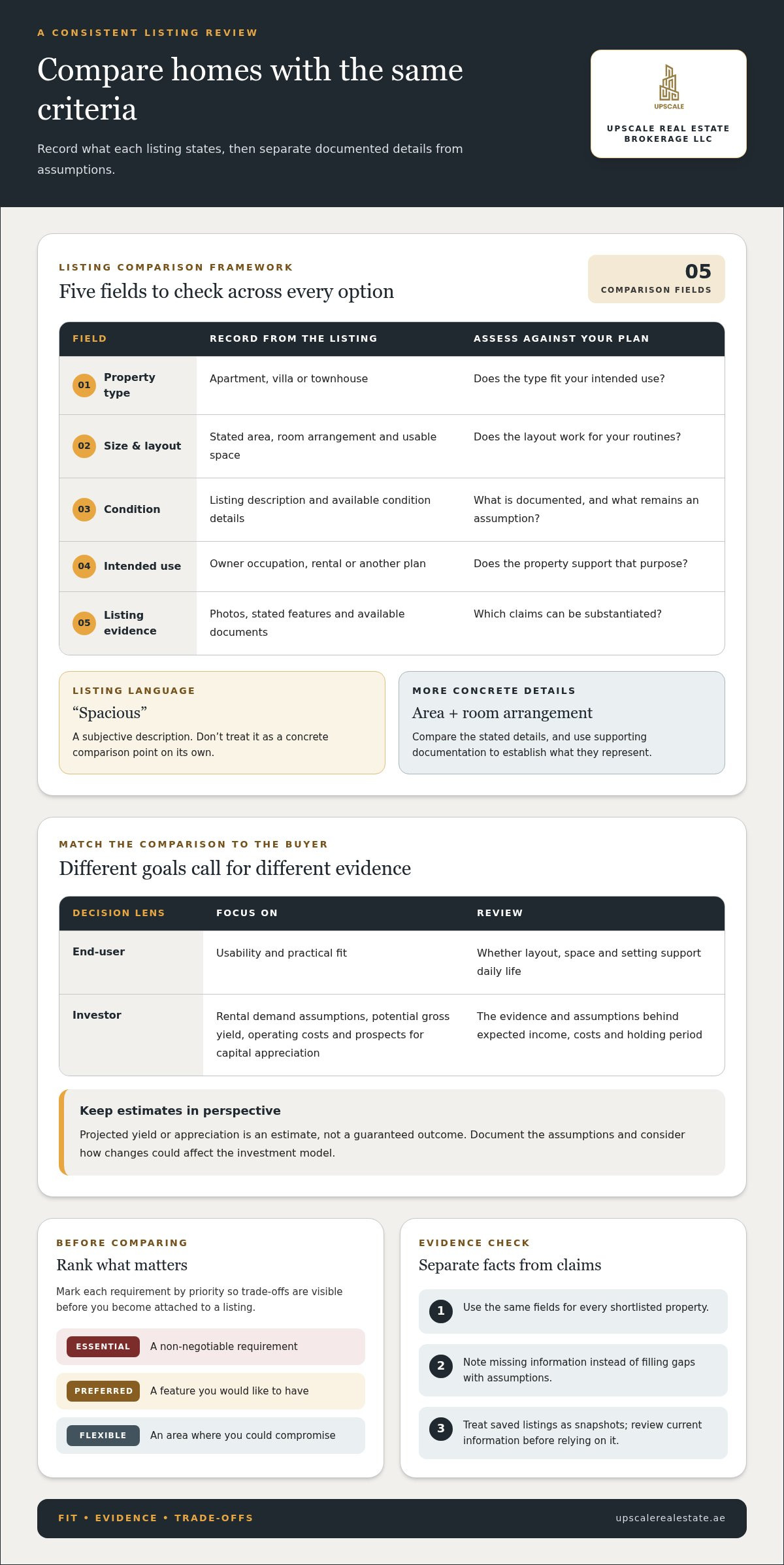
Mark each item as essential, preferred or flexible. This ranking gives you a consistent basis for comparing properties and makes trade-offs visible before you become attached to a listing.
Which lifestyle factors should buyers consider first?
Map an ordinary week, not an idealised one. Note when household members leave and return, how often they travel for work or activities, and what kind of space supports their routines. Assess amenities and transport access against your actual destinations and travel patterns, rather than general claims. Separate non-negotiables, such as a suitable layout, from preferences you could compromise on.
For example, a household that regularly hosts relatives may prioritise flexible living space, while someone who works from home may value a separate, quieter room. These are different needs, even if both buyers are considering the same property type. Write down the reason behind each priority so you can judge listings against the need, not just the feature.
How do personal priorities differ from investment criteria?
End-users typically assess usability: whether the home’s layout, space and setting support daily life. Investors may focus on rental demand assumptions, potential gross yield, operating costs and prospects for capital appreciation. Neither perspective makes a property automatically suitable. The assessment depends on the evidence and assumptions used.
State your primary objective before reviewing listings. If you’re buying to live in the property, give practical fit appropriate weight. If you’re investing, document the assumptions behind expected income, costs and holding period, then consider how changes could affect the model. Treat projected yield or appreciation as estimates, not guaranteed outcomes. A clear objective makes comparisons more consistent and helps you decide what evidence to review next.
How do property types and listing details shape the decision?
Once your priorities are clear, compare properties using the same fields instead of relying on whichever listing provides the most detail. A villa and a townhouse may both appear to offer suitable space, but differences in layout, condition and intended use can make them very different choices. Consistent criteria help reveal those distinctions.
Use a simple comparison framework for each shortlisted option. Record what the listing states, then flag where you need supporting evidence. A description is a starting point, not proof of every feature or assumption.
| Comparison field | What to record | What to assess |
|---|---|---|
| Property type | Apartment, villa or townhouse | Does the type fit your intended use? |
| Size and layout | Stated area, room arrangement and usable space | Does the layout work for your routines? |
| Condition | Listing description and any available condition details | What is documented, and what remains an assumption? |
| Intended use | Owner occupation, rental or another plan | Does the property support that purpose? |
| Listing evidence | Photos, stated features and available documents | Which claims can be substantiated? |
Which property details are useful for a first comparison?
Begin with property type, layout, usable space and condition. Compare each against your requirements, not the language used to promote the listing. For instance, “spacious” is subjective. The stated area and room arrangement give you more concrete points to compare, while supporting documentation may be needed to establish what those details represent.
Keep descriptions and evidence distinct. A listing may describe a feature, but property documentation or other evidence may be needed to verify it. Use identical fields for every option, note missing information and avoid filling gaps with assumptions. Listing details can change, so treat saved listings as snapshots and review current information before relying on it. Don’t reproduce figures unless you can identify their source and context.
How should buyers compare ready and off-plan options?
A ready resale property is an existing home being offered for sale, so you can consider its current condition and features as part of the comparison. An off-plan purchase relates to a property being sold before completion, so you’re assessing the project and property information available rather than a completed home. These are different purchase contexts, not guarantees of a particular outcome. For a deeper review, explore property options and advisory and compare the evidence relevant to each choice.
Keep the comparison grounded: assess a ready property through its current condition and documented details, and an off-plan option through the information available about the proposed property. Don’t assume appreciation, completion timing or suitability. A consistent record makes the trade-offs easier to see and helps you identify what to examine next.
How can buyers test whether a property fits their plans?
A structured process turns a broad preference into a decision you can explain and review. Use the same steps whether you’re buying a home or assessing an investment, but weight the criteria according to your objective. This keeps appealing features from distracting you from essential requirements.
- Define the goal. State whether you plan to live in the property, rent it out or hold it as part of a wider investment strategy. Be specific about intended use and time horizon.
- Set criteria. Separate essential requirements from preferences. For an end-user, these could include a workable layout and enough space. An investor might focus on expected rental demand, costs and the assumptions behind potential income.
- Shortlist options. Compare properties against the same criteria. Remove options that fail an essential requirement, even if they have other attractive features.
- Review evidence. Record which listing details and supporting information substantiate the property’s features. Keep unanswered questions separate from confirmed facts.
- Assess trade-offs. Consider what each option offers, what it lacks and whether the compromises fit your goal. Revisit your criteria if new evidence changes the comparison.
What should buyers include in a shortlist?
Give every candidate the same record: property type, key requirements, intended use, available supporting details and unresolved questions. A simple table or notes document works if you assess each option consistently. Mark essential criteria as met, unmet or unresolved. Remove properties that fail a non-negotiable, and keep unresolved items visible rather than treating a listing statement as proof.
This approach lets end-users and investors apply the same method without using identical priorities. A household may reject a property because its layout won’t support daily routines. An investor may set it aside because the income assumptions don’t align with their strategy. Record the reason for each decision, not just the property’s strongest selling point.
How can investors evaluate assumptions without overclaiming?
Yield modelling tests how an investment might perform under stated assumptions. Set out the expected rental income, relevant ownership costs and holding period, then consider how a different assumption could change the result. Capital-appreciation data can inform analysis, but it cannot establish what a particular property will be worth later.
Investment assumptions should be explicit and evidence-based, because a model is only as reliable as the information and scenarios behind it. Label estimates clearly, distinguish them from documented facts and avoid presenting projected yield or appreciation as a promise. If you’re assessing a property alongside other holdings, consider how it fits your wider portfolio objectives and risk exposure before deciding what to explore next.
What should buyers verify before taking a property decision?
Before moving forward, bring the listing, supporting information and your decision assumptions into one review. The aim isn’t to reach a legal conclusion from a marketing description. It’s to identify what is stated, what available documentation supports and what remains unclear, so you can choose a considered next step.
A listing describes a property; independently reviewable documentation helps you assess which claims it supports. Keep those sources distinct. A photograph or description can help you understand how a home is presented, but it shouldn’t be treated as proof of every detail.
How should buyers review listing information?
Compare each listing with your shortlist criteria. Check that the stated property type, layout, size, condition and intended use align with what you’re seeking, then compare those claims with the supporting details available for that property. Record gaps instead of filling them with assumptions. If information changes, rely on the update only when you have current details to support it.
Use a neutral checklist for every option:
- Listing details: Record the stated features and distinguish descriptions from documented facts.
- Property documentation: Review the materials available for the specific property and note what they do and don’t establish.
- Intended use: Consider whether the property information supports your plan to live in, lease or hold the asset.
- Decision assumptions: Separate confirmed information from estimates about income, costs, future value or suitability.
- Open points: Keep unresolved questions visible and avoid relying on outdated availability, listing counts or unverified figures.
This checklist helps you focus on evidence without treating an educational review as legal advice. Transaction requirements and legal conclusions depend on the circumstances and relevant documentation. Don’t infer them from a listing or this article.
Why do brokerage credentials and transparent communication matter?
Credentials provide context about the brokerage involved, while clear communication helps you understand the basis for information presented. Upscale Real Estate Brokerage LLC is RERA-licensed and holds ORN 23084. Its listings are DLD-verified. This describes Upscale’s listings and should not be assumed to apply to every listing a buyer may encounter elsewhere.
For a property decision, look for clarity about how listing details, supporting information and assumptions are distinguished. That makes it easier to compare options consistently, understand what the available evidence supports and identify what still needs review. A careful process won’t remove uncertainty, but it can make the basis of your decision more transparent.
For a structured review of property options and supporting details, explore property advisory.
How can Upscale support a clear property decision?
A clear decision starts with a defined objective and a consistent way to compare options. Upscale Real Estate Brokerage LLC provides property services for buyers, renters, landlords and investors, with advice grounded in available information. The aim is to help you organise priorities and understand trade-offs, not to promise a particular result.
Upscale’s approach is described through these principles:
- RERA compliance - every transaction follows DLD and RERA protocols.
- Professional guidance - multilingual consultants with deep local expertise.
- Local market expertise - on-the-ground insight into each community.
- Transparent communication - clear pricing, honest advice and full paperwork visibility.
- Investor-centric approach - decisions backed by yield modelling and capital-appreciation data.
Upscale is RERA-licensed, holds ORN 23084 and works with DLD-verified listings. These credentials and listing practices offer context for the brokerage’s work; they don’t replace your review of the specific property and its supporting information.
Which Upscale services align with different property goals?
Property Sales supports buyers exploring ready resale and off-plan purchases. Property Leasing provides residential and commercial leasing support for tenants and landlords. Investment Advisory helps investors consider property options in relation to their strategy. Owners seeking ongoing support after acquiring a property can use Property Management.
Each goal calls for a different discussion. A buyer may need to clarify preferred property type and intended use. A tenant or landlord may focus on leasing requirements. An investor may want to review assumptions and compare options against their objectives. Starting with that distinction keeps the conversation focused.
What happens when a reader requests a consultation?
A Free Property Consultation gives you an opportunity to share your priorities and discuss the property decision you’re considering. You can outline your intended use, preferred property type and the factors that matter most. That context helps frame the discussion around your requirements rather than a general list of options.
Bring the criteria and open questions you’ve developed while researching. If you’re comparing alternatives, explaining the trade-offs you’re weighing can keep the conversation grounded. Any review should distinguish listing details from assumptions and should not treat projected performance as a guaranteed outcome. The next step remains yours, based on the information and options you decide to consider.
For a measured discussion of your property goals, request a Free Property Consultation.
Make your next property decision with clarity
Your next step doesn’t have to be a commitment to buy. As you consider nad al sheba 1, start with a focused review of what matters most, the information gaps and which options deserve closer attention. Keep your priorities visible as you move from research to action, and let evidence guide your decisions.
Upscale’s approach is grounded in transparent communication and clear property information, including its stated No Hidden Fees commitment. This gives you a basis for discussing your objectives without treating a consultation as a promise of a particular result.
Whether you’re weighing a home for your household or considering an investment, bring your key criteria and questions to the discussion. A well-defined next step can make a complex decision more manageable, while leaving the final choice firmly in your hands.
Discuss your property priorities and take the next step with confidence.
Frequently Asked Questions
Is a residential community guide enough to make a property decision?
No. A guide can help you form an initial view, but it can’t establish whether a particular home suits your needs or whether its details support your assumptions. A general description may sound suitable while a specific layout doesn’t work for your household. Use a guide as orientation, then assess the individual property, available documentation and intended use before deciding what to pursue.
How can I compare residential properties using the same criteria?
Create one comparison sheet and apply it to every option. Alongside property type, layout, size and condition, record how each home meets your essential needs and what evidence supports its stated details. You can also use a simple rating, such as strong fit, partial fit or poor fit, for each priority. This makes differences easier to see without allowing one standout feature to outweigh several important mismatches.
What should I review in a property listing before making a decision?
Check whether the description, photographs and stated features give a consistent picture of the property. For example, compare the room arrangement shown in images with the layout information provided. Note ambiguity, missing details or changes in availability, and keep the listing’s claims separate from information supported by documents. Avoid basing a decision on an old screenshot or a figure whose source and date you can’t establish.
Can an investment advisory model guarantee rental yield or capital appreciation?
No. A model can organise assumptions and show how different scenarios may affect an investment analysis, but it can’t guarantee rental income or future value. For example, consider how your assessment changes if expected rent, ownership costs or the holding period differs from your base case. Treat projections as estimates, identify the information behind them and keep uncertainty in view rather than relying on a single forecast.
How do ready resale and off-plan property purchases differ?
A ready resale purchase concerns an existing property, so your assessment can include its current condition and features. An off-plan purchase involves a property before completion, so you’re considering the available information about the proposed property and purchase. For a home you intend to occupy, timing and present usability may shape your priorities. For either option, base comparisons on relevant information and avoid assuming a particular future outcome.
What does DLD-verified listing mean in this article?
Here, it refers to Upscale Real Estate Brokerage LLC’s stated DLD-verified listings. It describes the brokerage’s listings, not every property advertisement a buyer may encounter, and it shouldn’t be treated as a guarantee of investment performance or a substitute for reviewing property-specific information. When assessing a listing, keep its verification status distinct from the evidence you review for the individual property.
How can Upscale Real Estate help me assess my property options?
Upscale Real Estate Brokerage LLC can help you organise your priorities and consider property options in relation to your intended use. Its Property Sales, Property Leasing and Investment Advisory serve different buying, renting and investment objectives. Property Management supports ongoing ownership. Share your criteria and key questions so the discussion can stay focused on your decision.