
You don’t need to buy an entire property to gain exposure to UAE real estate. Crowdfunding and REITs can let beginners invest without owning a property outright, while direct ownership remains an option for those prepared to take on its costs and responsibilities. The right approach depends on your budget, preferred level of involvement and investment horizon.
It’s sensible to look beyond a property’s purchase price. Transaction costs and ongoing expenses affect returns, and your exit plan matters as much as your entry. This guide compares four real estate investment strategies for beginners in the UAE, covers the main costs to plan for and explains how different approaches may suit different goals.
You’ll also see how direct ownership compares with indirect investment, what to consider before committing to an off-plan purchase or rental strategy, and how to plan for selling or changing course. The aim is to give you a practical starting point for an informed decision.
Key Takeaways
- Compare direct ownership with pooled or listed real estate exposure to find an entry route that matches your capital and desired level of involvement.
- Before choosing a property, assess its location, rental demand, ongoing costs and likely resale appeal, not just its purchase price.
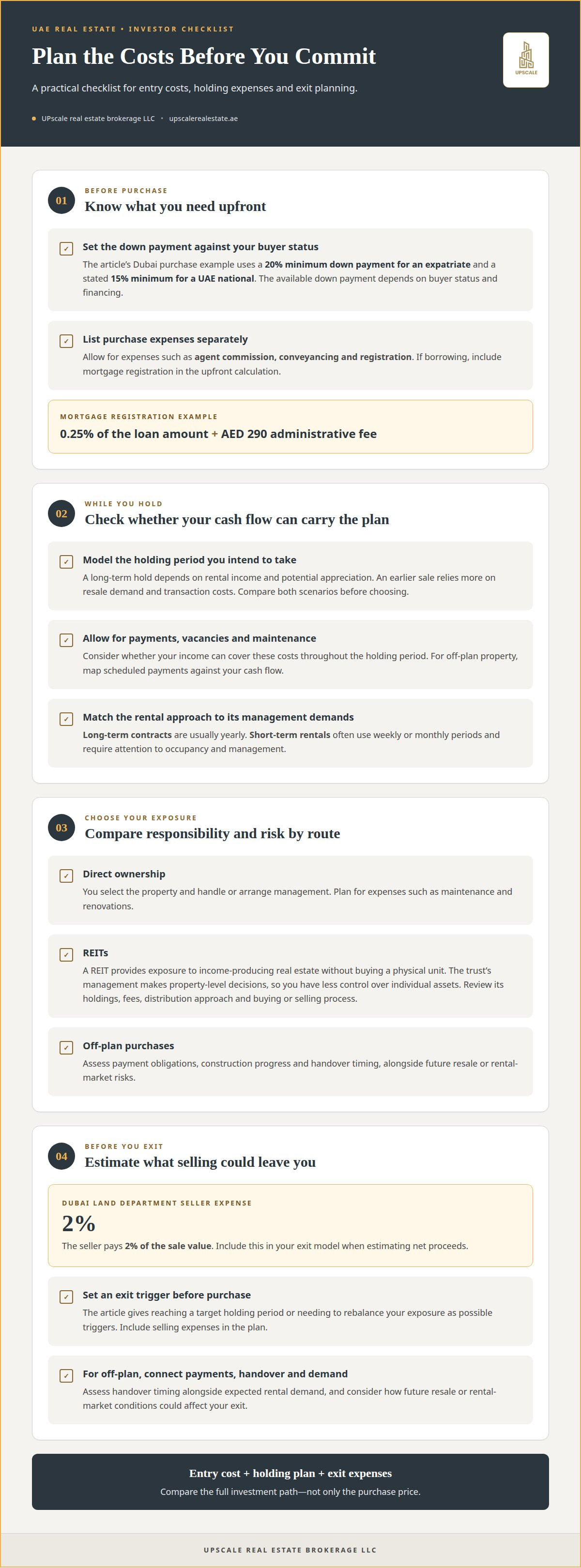
- Include selling expenses in your exit model: according to Dubai Land Department, the seller pays 2% of the sale value.
- Use ready-property sales, off-plan options, leasing and property management to align a direct investment with your goals and capacity to manage it.
1. Can I invest in Dubai real estate without buying an entire property?
Yes. You can invest in Dubai real estate without buying an entire property. Crowdfunding pools investors’ money for real estate projects, while tokenisation initiatives are being developed with the Dubai Land Department and other authorities. These routes differ in ownership, control and liquidity, so understand the investment structure before committing funds.
Start with the fundamentals: define your financial goals, review your income and expenses, and decide how much upfront capital you can comfortably commit. Then study demand, available supply and infrastructure in the specific area. Dubai’s market recorded 180,900 transactions in the last 12 months, with transaction value exceeding AED 522 billion, up 36% over the previous year. These figures describe market activity, not a forecast for an individual property.
How do rental yields and property prices compare across Dubai, Abu Dhabi and other emirates? They vary by neighbourhood, property type, purchase price and tenant demand, so compare similar units rather than emirate-wide averages. Prime areas in the UAE often deliver gross rental yields of 6% to 8%, but gross yield doesn’t account for operating costs or vacancy.
When assessing a location, compare nearby employment, schools, amenities and transport links. Consider whether infrastructure already supports demand or depends on future development. A property near established services may appeal to a different tenant profile than one in a developing area. Review comparable sales and rents to estimate property value and potential income realistically.
Before investing, review ownership documents, payment obligations, service charges and maintenance needs. For an off-plan property, assess construction progress, handover risks and the future resale or rental market. Government policies and market conditions can affect transactions and returns, so account for vacancy, price changes and the time it may take to resell.
These checks can help you compare direct ownership with pooled investment. Keep an emergency reserve separate from your investment capital, and don’t base your decision on projected income alone. A written comparison of costs, holding period and exit options makes it easier to see which approach fits your goals.
2. Property investment costs and exit strategies
Set your investment horizon before choosing a property. A long-term hold depends on rental income and potential appreciation; an earlier sale relies more on resale demand and transaction costs. Model both scenarios, then consider whether your income can cover payments, vacancies and maintenance throughout the holding period.
Budget for entry and exit costs separately. Dubai Land Department states that the seller pays 2% of the sale value. Other purchase expenses can include agent commission, conveyancing, registration and, when borrowing, mortgage registration. For example, mortgage registration costs 0.25% of the loan amount, plus an AED 290 administrative fee. Include these expenses when calculating the amount you need upfront and the net proceeds you may retain after selling.
How do long-term rentals, short-term holiday rentals, REITs and off-plan investments compare in the UAE? Long-term rental contracts are usually yearly, while short-term rentals often use weekly or monthly periods and require attention to occupancy and management. REITs offer exposure to income-producing real estate without buying a physical property. Off-plan purchases involve payment obligations and construction, handover and future resale or rental-market risks.
For a first-time buyer, the available down payment depends on buyer status and financing. The example for an expatriate purchasing a Dubai property uses a 20% minimum down payment, while the stated minimum for UAE national buyers is 15%. Mortgage interest rates vary with the lender’s product and loan terms, so compare the repayment structure and total financing cost alongside the upfront contribution.
Choose an exit trigger before purchase, such as reaching a target holding period or needing to rebalance your exposure. For off-plan property, map each scheduled payment against your cash flow and assess handover timing alongside expected rental demand. A property investment advisory can help frame these costs and exit assumptions around your goals.
3. REITs and indirect real estate exposure
Real estate investment trusts, or REITs, provide exposure to income-producing property without requiring you to buy a physical unit. Instead of funding an entire apartment, you buy an interest in a trust that holds property assets. This can reduce your direct involvement in tenant matters, maintenance and renovations. Your return depends on the trust’s income and investment performance.
A REIT can diversify your portfolio beyond a single building or neighbourhood. For example, a trust may hold different property types or assets across multiple locations, spreading exposure across its holdings. This does not eliminate real estate market risk: vacancy, rental demand, operating expenses and changes in property values can affect income and performance. Before investing, review the trust’s asset mix, tenant concentration, debt and distribution policy.
Compare a REIT with direct ownership by mapping the responsibilities and costs of each. A direct owner selects the property, handles or arranges management, and pays expenses such as maintenance and renovations. A REIT investor delegates property-level decisions to the trust’s management but has less control over individual assets. Review the fund documents for its holdings, fees, distribution approach and the process for buying or selling interests.
Real estate bonds offer a different type of exposure. A bond investor lends capital to an issuer under stated interest and repayment terms; a REIT investor holds an interest linked to a property portfolio. Compare the issuer or trust, payment structure, maturity or holding period, and how each option fits your financial goals. A bond’s interest payment or a REIT distribution is not the same as rental income from a property you own.
A practical first step is to compare one REIT and one real estate bond against the same checklist: underlying assets, income source, expenses, liquidity and principal risks. Then consider how each could complement your other investments, rather than concentrating your portfolio in a single property-related holding.
4. UAE real estate investment
To buy an investment property in the UAE, first set your financial goal and budget, then compare locations, property types and rental demand. Review purchase documents, payment obligations, ongoing expenses and likely exit options before committing. If you use a mortgage, include financing costs in your cash-flow model rather than judging affordability by the deposit alone.
Choose a strategy that matches the property’s use. A rental investment involves assessing likely income against service charges, maintenance, vacancy, management and financing costs. Prime areas in the UAE often deliver gross rental yields of 6% to 8%; this is before expenses. Treat gross yield as a comparison tool, not the cash flow available after costs.
Appreciation is a separate part of the investment case. Use this as a worked scenario, not a projection for another property. Your own model should show purchase costs, renovation needs, holding expenses and sale proceeds.
Before selecting an investment property, compare similar units by location, condition, tenant profile and access to amenities. For off-plan purchases, review the developer’s delivery record, construction progress, payment schedule and intended rental or resale market. For a ready property, inspect its condition and compare current rental demand with ongoing ownership costs. These steps help connect property value to both income potential and your planned holding period. If you’re assessing direct ownership, explore UAE property opportunities as a next step in your comparison.
Upscale Real Estate Brokerage: Ready Property Sales
Upscale Real Estate Brokerage LLC supports investors considering ready-property purchases in Dubai. Ready Property Sales can help when you’ve narrowed your investment criteria and want to compare available properties against your budget, location priorities and intended holding period.
If you’re weighing a completed home against a development still under construction, Upscale Real Estate’s Property Sales service covers both ready and off-plan options. After purchase, Property Leasing and Property Management can support the transition to rental ownership. These options suit different investment plans, so match the property type and management approach to your income goals and capacity for ongoing involvement.
Bring your priorities into the discussion: target location, property type, rental strategy and preferred exit horizon. That gives you a practical basis for comparing direct ownership options with the indirect approaches covered above. Contact Upscale Real Estate Brokerage LLC to discuss your investment requirements.
Build your next step around a clear investment plan
Your first decision doesn’t have to define your entire investment journey. Start with the outcome you want, the level of involvement you can sustain and the role property should play in your wider financial plans. Use those priorities to guide your research, and revisit your assumptions as circumstances change.
Choosing real estate investment strategies for beginners in the UAE comes down to matching the investment structure to your goals. A disciplined approach can help you move from general interest to a considered decision while leaving room to reassess your plan as your needs develop.
If you’re ready to explore a direct property route, speak with Upscale Real Estate Brokerage LLC about your investment priorities. A clear starting point can make the next decision more focused. Take the time to shape a plan that feels considered, practical and aligned with the future you’re working toward.
Frequently Asked Questions
Can I invest in Dubai real estate without buying an entire property?
Yes. Crowdfunding and REITs offer ways to gain real estate exposure without purchasing an entire property. Before investing, read the structure carefully: establish which asset or portfolio your money supports, how returns are distributed, what fees apply and how you can exit. For tokenised property, understand the ownership or economic rights attached to the tokens rather than assuming they provide the same control as direct ownership.
Are short-term rentals more profitable than long-term rentals in Dubai?
Not necessarily. Short-term rentals may generate higher gross income in suitable locations, but occupancy, operating costs and management affect what you retain. Long-term contracts are usually yearly, while short-term stays often run weekly or monthly. Compare the models using realistic occupied nights, vacancy gaps, cleaning and maintenance needs, and management expenses. A higher nightly rate alone does not mean stronger net returns.
What Makes a Property Investment Strategy Successful?
A sound strategy links the property to a specific financial goal and tests the assumptions behind it. For example, an investor seeking regular income should model achievable rent, vacancy and ongoing costs. Someone prioritising appreciation should assess resale demand and the planned holding period. Set an exit condition before buying, such as a change in cash-flow needs, and revisit the model when costs or circumstances shift.
What is the gross rental yield?
Gross rental yield is annual rental income divided by the property’s purchase price, expressed as a percentage. For example, annual rent of AED 42,000 on a property priced at AED 1.5 million gives a gross yield of approximately 2.8%. This figure helps compare properties, but excludes costs such as service charges, maintenance, vacancy and management, so it isn’t the same as net return.
What are the main real estate investment strategies for beginners in the UAE?
Beginners can compare direct ownership, buy-and-hold rentals, off-plan purchases, commercial property, REITs and crowdfunding. These options differ in capital needs, control and involvement. Direct ownership makes you responsible for a specific asset; REITs provide exposure through a property portfolio. To narrow the choices, decide whether income, long-term appreciation or less day-to-day involvement matters most, then compare risks and exit flexibility.
How much money is needed to invest in UAE real estate?
The upfront capital required also depends on whether you use financing and on the transaction and ownership expenses. If that level of commitment doesn’t fit your budget, REITs and crowdfunding may provide indirect exposure without buying an entire property. Compare the investment terms before deciding.