
Did you know that off-plan sales accounted for 76% of all residential property transactions in Dubai during the second quarter of 2026? This data points to a market that prioritizes future growth, yet many investors still face valid concerns regarding project timelines and the nuances of escrow account protections. You aren't just looking for a unit; you're seeking a secure entry point into a maturing market. It's vital to look past marketing brochures to find the actual net appreciation potential after accounting for the 4% Oqood registration fee and other administrative costs.
This guide serves as your professional framework to master the mechanics of off plan properties dubai. We'll provide a transparent roadmap for acquisition that balances high-yield goals with rigorous risk mitigation. You'll learn how to navigate the 2026 regulatory landscape, identifying high-growth urban corridors where infrastructure development aligns with long-term value. We'll move from basic concepts to advanced financial modeling, ensuring your portfolio is built on a foundation of local mastery and strategic clarity.
Key Takeaways
- Learn the fundamental mechanics of off plan properties dubai, including how to leverage lower entry points and flexible financial structures for maximum capital appreciation.
- Gain clarity on common 2026 payment architectures, such as 50/50 and post-handover models, to align your investment strategy with specific construction milestones.
- Understand the critical legal safeguards, specifically the role of the Dubai Land Department and mandatory escrow accounts, that protect your capital throughout the development phase.
- Master a strategic due diligence framework to evaluate developer delivery history and future infrastructure plans before committing to a specific project.
- Discover how to transition off-plan acquisitions into a professionally managed portfolio that balances aggressive growth with stable, long-term rental yields.
Understanding the Mechanism of Off-Plan Properties in Dubai
Understanding the Mechanism of Off-Plan Properties involves recognizing that you're acquiring an unbuilt asset directly from a developer's blueprint. In this model, you commit to a purchase before or during the construction phase, typically at a price point lower than a completed unit. This entry-level discount serves as a primary driver for capital appreciation. By the time the structure reaches completion, the market value often exceeds the initial purchase price, rewarding investors for their early-stage participation.
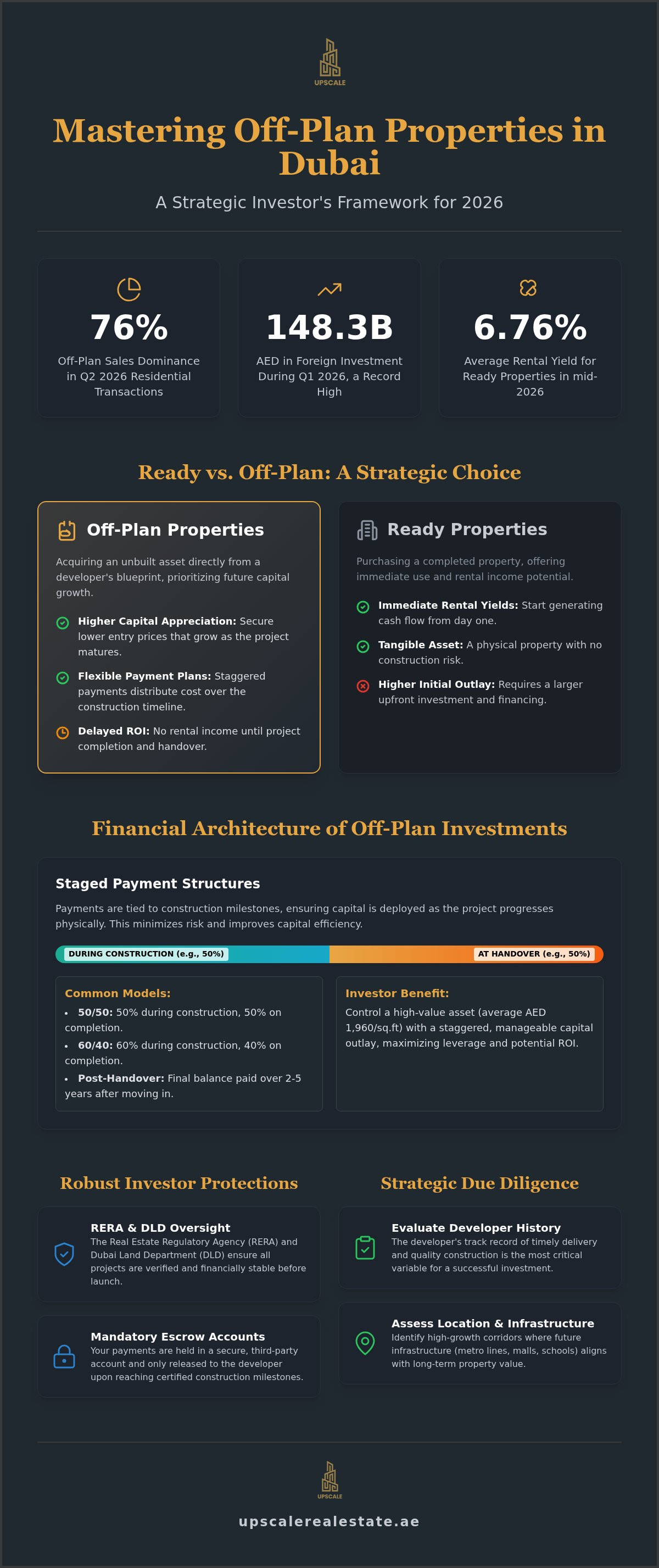
The core value proposition of off plan properties dubai centers on capital efficiency. Most projects utilize flexible financial structures where the total cost is distributed across the construction timeline. This allows you to secure a high-value asset with a relatively small initial outlay, often just 5% to 10% of the property value. In the 2026 market, where off-plan sales dominate 76% of residential transactions, these structures are essential for building a diversified portfolio without tying up massive amounts of liquid capital in a single ready asset.
Developers act as the primary managers of the project lifecycle, from site acquisition to final handover. Their role is to execute the architectural vision while adhering to strict regulatory standards. For the investor, the developer's track record is the most critical variable in the acquisition roadmap. A stable developer ensures that the transition from a conceptual model to a physical asset remains transparent and predictable.
The Evolution of the Off-Plan Market
Dubai's market has matured significantly, shifting from a speculative environment to a highly regulated investment landscape. Regulatory oversight by the Real Estate Regulatory Agency (RERA) ensures that project launches are backed by verified construction progress and financial stability. This maturation has attracted record foreign investment, which reached AED 148.35 billion in the first quarter of 2026. Off-plan property represents a strategic asset class designed to capture capital growth through the compression of market prices between project launch and physical completion.
Ready vs. Off-Plan: A Strategic Choice
Choosing between asset types requires a clear understanding of your portfolio's goals. Ready properties offer immediate rental yields, which averaged 6.76% across the city in mid-2026. However, off-plan assets prioritize future appreciation over current cash flow. If your strategy focuses on long-term wealth building rather than immediate monthly income, the off-plan route provides a superior trajectory for equity growth. For a deeper analysis of these trade-offs, consult our Off-Plan vs. Ready Property in Dubai: A 2026 Strategic Investor’s Guide. Determining which asset type fits depends on whether you value the security of a tangible unit today or the higher ROI potential of a project finishing in two to three years.
The Financial Architecture: Payment Plans and Capital Appreciation
The financial success of an investment in off plan properties dubai relies on precise cash flow modeling rather than speculative hope. Most developers utilize staged payment structures, such as 50/50 or 60/40, where a portion of the price is paid during construction and the balance is due upon completion. Some projects offer post-handover payment plans, extending the final installments over two to five years. These payments are strictly linked to construction milestones, ensuring your capital is deployed only as the project physically manifests. This structure allows you to control a high-value asset, which averaged AED 1,960 per square foot for apartments in mid-2026, with a staggered capital outlay.
Capital appreciation occurs through the compression of the project's risk profile. As a building moves from a conceptual blueprint to a physical structure, the delivery risk decreases, which naturally increases the market value. Early-stage investors capture the "early bird" advantage, securing lower entry prices that appreciate as the project reaches key milestones. By the time of handover, the equity built through market maturation often exceeds the initial down payment, providing a significant return on the invested capital even before the property is tenanted.
Modeling Your Investment Cash Flow
When Navigating the Legal Landscape of payment structures, it's essential to account for the 4% Dubai Land Department (DLD) registration fee, often referred to as Oqood. This fee is a mandatory upfront cost that must be factored into your initial liquidity requirements alongside the developer's down payment. For properties valued at AED 500,000 or more, you should also budget for a property registration fee of AED 4,000 and a title deed issuance fee of AED 250. Our team provides investment advisory services to help you model these costs against projected appreciation to ensure your net yield remains optimized.
Forecasting Capital Growth in Urban Corridors
Identifying high-growth urban corridors requires analyzing the proximity to future infrastructure outlined in the Dubai 2040 Urban Master Plan. Price surges in the off-plan sector are frequently triggered by the completion of new transport links or community amenities. While off-plan assets offer high growth potential, some investors prefer the immediate cash flow of existing units. You can compare these strategies in our Strategic Guide to Ready Property Sales: Maximizing Immediate ROI in 2026. Balancing future growth with immediate returns is a hallmark of a sophisticated property portfolio.
Navigating the Legal Landscape and Investor Protections
The security of investing in off plan properties dubai is underpinned by a robust regulatory framework that prioritizes capital protection. The Dubai Land Department (DLD), through its regulatory arm, the Real Estate Regulatory Agency (RERA), acts as the primary oversight body for every transaction. This administrative layer ensures that developers don't operate in a vacuum; every project must be registered, and every sales contract must be logged through the Oqood system. These protocols provide a level of transparency that has transformed the city into a globally recognized hub for secure real estate acquisition.
A central pillar of this protection is the mandatory Sales and Purchase Agreement (SPA). This document is more than a mere receipt; it's a legally binding contract that outlines the specific technical specifications, payment timelines, and the anticipated completion date. In the 2026 market, the SPA serves as the investor's primary defense, clearly defining the developer's obligations and the legal recourse available if those obligations aren't met.
The Security of the Escrow Account System
The escrow system is the backbone of investor trust in the UAE. Under local law, developers are required to set up a project-specific escrow account for every off-plan development. Your payments don't go directly into the developer's general operational fund. Instead, they're held by an accredited bank and only released in stages as construction milestones are verified by DLD inspectors. This ensures that your capital is used exclusively for the construction of your specific asset. You can verify the registration status and construction progress of any project in real-time through official regulatory portals or the Dubai REST app, providing total visibility into the lifecycle of your investment.
Understanding Your Rights as an Investor
Investor rights extend beyond the construction phase into the critical period of project delivery. If a project faces significant delays or cancellation, RERA has established clear protocols for project liquidation and the return of funds to investors. Once the project reaches completion, you're entitled to a final inspection, commonly known as snagging. This process allows you to identify any deviations from the SPA or quality issues before the formal handover. Managing an asset effectively starts the moment you receive the keys. For a detailed breakdown of how to maintain your property's value after handover, refer to our Landlord Property Maintenance Checklist Dubai: The 2026 Investor’s Guide. Understanding these rights ensures you remain a protected participant in the metropolitan growth story.
Strategic Due Diligence: How to Evaluate a Project in 2026
Evaluating off plan properties dubai requires a transition from emotional buying to a data-driven framework. In a market where residential sales reached approximately 35,900 transactions in Q2 2026, distinguishing between high-performance assets and oversupplied corridors is essential. You must analyze the supply-demand balance within the specific asset class you're targeting. If a district is seeing a massive influx of similar apartment units without corresponding infrastructure growth, future rental yields may face downward pressure. A rigorous due diligence process ensures your capital is placed in projects where market maturation aligns with your exit strategy.
Reviewing the feasibility of a proposed payment plan is equally critical. You should compare the developer's requested installments against current market trends and construction realities. If a payment structure is heavily front-loaded without clear links to physical milestones, it may signal a need for closer scrutiny. Consulting with an independent investment advisory provides access to unbiased data that marketing brochures often omit. This professional oversight helps you model the true ROI, accounting for the 4% Oqood fee and administrative costs that impact your net entry price.
Vetting the Developer and Project Feasibility
Investigating a developer's track record is the most reliable predictor of your project's success. You should research their delivery history, looking specifically for handover punctuality and the sustained quality of their older communities. It's also vital to understand the dynamic between a Master Developer, who manages the overall district infrastructure, and the Sub-Developer responsible for your specific building. Project location within a master community dictates long-term liquidity because it ensures the asset remains integrated with essential amenities and transport links. Vetting the sub-developer's financial standing and past RERA compliance records provides an additional layer of security for your portfolio.
Case Studies in Market Success
Analyzing historical performance provides a blueprint for future gains. For example, reviewing high-performance projects like Villanova Dubai Properties demonstrates how family-oriented master plans can maintain high demand even during market shifts. On the other end of the spectrum, entry-level investments such as Lawnz by Danube Properties show how targeting affordable segments can lead to consistent occupancy and stable yields. These case studies prove that success comes from identifying projects that solve a specific demographic need. If you want to refine your selection process with professional data, our team offers expert Investment Advisory to help you identify the most resilient assets in the current market.
Integrating Off-Plan Assets into a Managed Investment Portfolio
Successful acquisition is only the first phase of a sophisticated wealth strategy. The transition from securing off plan properties dubai to active asset management determines the long-term sustainability of your returns. For overseas investors, who contributed significantly to the AED 148.35 billion in foreign investment during Q1 2026, professional oversight isn't a luxury; it's a necessity. It ensures that the handover process is handled with technical precision and the property is immediately integrated into a yield-generating structure. Managing an asset from a distance requires a partner who prioritizes accountability and maintains local mastery over regulatory changes.
Professional management bridges the gap between a developer's completion and an investor's cash flow goals. This includes handling the final Oqood registrations, managing the snagging process, and executing residential leasing strategies that target stable, long-term tenants. By removing the administrative burden, you can focus on the strategic growth of your portfolio rather than the granular details of daily maintenance. Our approach emphasizes transparency, providing you with clear visibility into your asset's performance through every stage of the property lifecycle.
Portfolio Diversification Strategies
Diversification within a metropolitan market requires a strategic mix of asset classes and construction stages. While ready properties provided an average gross rental yield of 6.76% in mid-2026, off-plan assets serve as the primary engine for capital appreciation over a five to ten year horizon. A resilient portfolio often balances these two types:
- Growth Assets: Off-plan apartments or villas in emerging urban corridors designed for equity build-up.
- Income Assets: Ready townhouses or commercial units that provide immediate, predictable rental income.
- Risk Mitigation: Spreading investments across different developers and master communities to avoid localized supply shocks.
The Upscale Advisory Approach
Our advisory-led model moves beyond the traditional brokerage transaction to focus on long-term wealth preservation. We don't just facilitate a sale; we act as strategic consultants who model your portfolio's performance against 2026 market trends. This end-to-end service ensures that your transition from buyer to landlord is seamless and data-driven. By prioritizing integrity and regulatory compliance, we provide a secure environment for you to scale your holdings in one of the world's most dynamic real estate landscapes. Consult with our advisors to model your 2026 property portfolio.
Securing Long-Term Value in a Maturing Market
Mastering the acquisition of off plan properties dubai requires a shift from speculative buying to a rigorous, advisory-led framework. We've explored how RERA-mandated escrow accounts and transparent payment structures provide the necessary safeguards for capital protection. Success in 2026 isn't just about finding a project; it's about modeling cash flows against construction milestones and vetting developers with a proven delivery record. By integrating these high-growth assets into a professionally managed portfolio, you secure a pathway to sustained appreciation and future rental yields.
Upscale Real Estate provides the steady hand needed to navigate this complex landscape. As a RERA-licensed brokerage (ORN 23084), our team offers data-driven investment advisory and comprehensive portfolio management solutions. We move beyond the transaction to ensure your assets are positioned for maximum efficiency in the metropolitan market. It's time to build your legacy with clarity and confidence. Explore Strategic Off-Plan Investment Opportunities with Upscale Real Estate.
Frequently Asked Questions
What is the minimum down payment for off-plan properties in Dubai?
The initial down payment for off plan properties dubai typically ranges between 5% and 10% of the total purchase price. This is paid to the developer to secure the unit and initiate the Oqood registration. If you're seeking mortgage financing, the UAE Central Bank mandates a maximum loan-to-value cap of 50% for off-plan assets. This means you must have at least half of the property value available in liquid capital before handover.
Can I sell my off-plan property before the project is completed?
You can sell your off-plan property before completion, provided you meet the developer's specific minimum payment threshold. Most developers require the owner to have paid between 30% and 40% of the total unit value before authorizing a resale. The process involves obtaining a No Objection Certificate (NOC) from the developer and transferring the Oqood registration to the new buyer, allowing you to realize capital appreciation before the project is finished.
How does the Escrow account protect my investment in the UAE?
The Escrow account system ensures that your investment remains project-specific and protected from developer insolvency. Funds are deposited into an account managed by an accredited bank and are only released in stages as construction milestones are verified by Dubai Land Department inspectors. This regulatory mechanism prevents the diversion of capital to other projects, ensuring that your money is used exclusively for the physical manifestation of the specific asset you've purchased.
What happens if a developer fails to deliver an off-plan project on time?
If a developer fails to deliver within the agreed timeframe, RERA provides specific legal protections for the investor. Most Sales and Purchase Agreements include a 12-month grace period for construction delays. Beyond this period, investors may be entitled to seek contract termination or financial compensation through the Dubai Land Department. It's essential to monitor project progress via official portals to ensure the developer remains compliant with the construction schedule outlined in your initial agreement.
Are there any hidden costs when buying off-plan real estate?
While the purchase price is the primary cost, you must budget for several administrative fees to ensure a transparent transaction. These include the 4% Oqood registration fee, trustee fees ranging from AED 1,000 to AED 6,000, and a property registration fee of AED 4,000 for assets valued at AED 500,000 or more. There is also a title deed issuance fee of AED 250. Factoring these into your initial modeling prevents unexpected liquidity issues during acquisition.
How is the 4% Land Department fee handled in off-plan transactions?
The 4% Dubai Land Department fee, often called the Oqood fee, is typically paid at the time of the initial sales contract registration. It's calculated based on the total property value and is a mandatory cost for legalizing the transaction. While this is standard, some developers offer incentives where they cover a portion or the entirety of this fee to attract investors. You should always verify whether the fee is included in the payment plan.
Do I need a local bank account to invest in off-plan projects?
You don't strictly need a local bank account to invest in off plan properties dubai, as most developers accept international telegraphic transfers for staged payments. However, having a local account becomes highly beneficial once the property is handed over. It simplifies the collection of rental income, the payment of service charges, and the management of utility accounts. For overseas investors, a local account provides better visibility and control over their long-term property management.
What are the residency benefits (Golden Visa) for off-plan property investors?
Off-plan investors can qualify for residency benefits once their total investment reaches specific financial thresholds. A property investment of AED 750,000 or more qualifies you for a two-year renewable residency visa. For a ten-year Golden Visa, the investment threshold is AED 2 million. These benefits are available for off-plan assets provided the equity paid into the project meets these requirements, allowing you to secure long-term residency status while your property is under construction.