

What if an upscale area looks impressive on paper but doesn’t suit your daily routine or investment goals? Reputation can signal prestige, but it can’t tell you whether the location offers the access, services, property performance, and ongoing responsibilities you’re prepared to manage.
It makes sense to weigh lifestyle and long-term value together when buying, renting, or investing in the UAE. This guide shows you how to assess an upscale area using consistent criteria rather than status alone. You’ll look at everyday convenience, property condition, market indicators, and recurring ownership or management obligations.
You’ll also learn how to compare locations against your priorities, review relevant property and leasing considerations, and identify due diligence steps before making a decision. A structured assessment can help you distinguish a prestigious address from a suitable one.
Key Takeaways
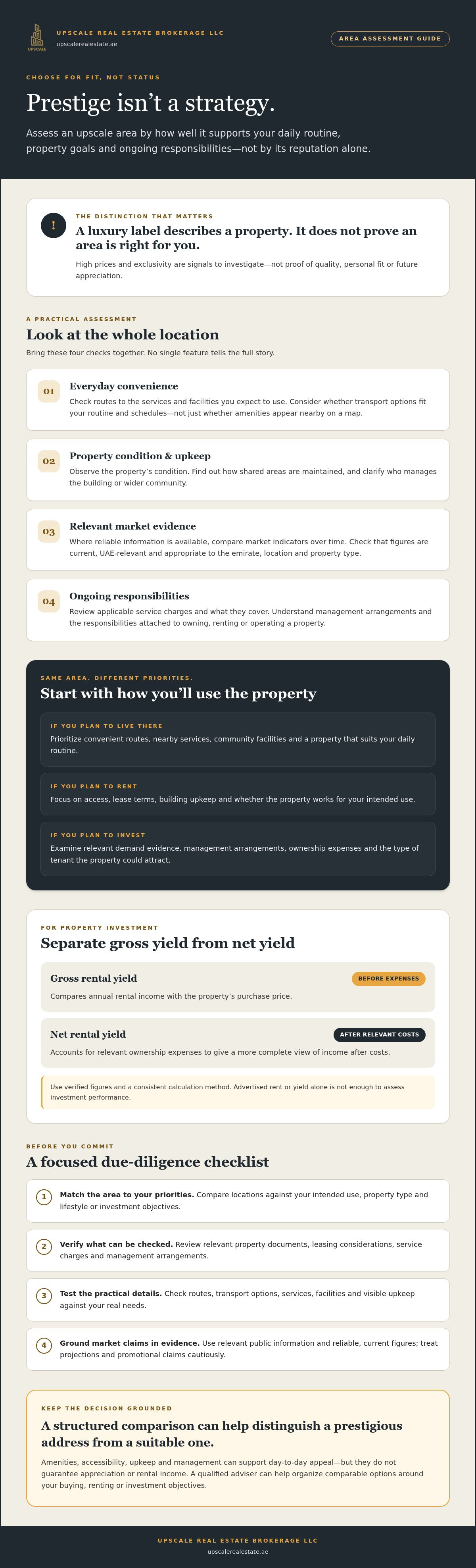
- Assess an upscale area by how well it supports your intended use and priorities, not by reputation or a luxury label alone.
- Look beyond amenities to accessibility, upkeep, and community management when judging how a location may work in daily life.
- Compare areas against your own goals, weighing lifestyle fit, property type, and ownership responsibilities rather than relying on a universal ranking.
- Before committing, verify relevant property documents, service charges, and management arrangements.
- A qualified adviser can help organize comparable options and assess them against your buying, renting, or investment objectives.
What Makes an Upscale Area Worth Considering?
An upscale area is a location whose surroundings, services, upkeep, and property options support a higher standard of living or a specific ownership goal. That’s different from a “luxury” label attached to an individual property. The label may describe its finishes or marketing position without saying much about the wider area.
Definition: An upscale area is a location assessed for the quality and practical value of its daily environment, not simply its prestige or property prices.
Suitability depends on what you need, which property type you’re considering, and how you’ll use it. A buyer planning to live in an apartment may prioritize convenient routes and nearby services. A tenant may focus on access, lease terms, and building upkeep. An investor may examine demand, management arrangements, and the type of tenant a property could attract. Consider livability, accessibility, services, maintenance, and demand together. Premium positioning alone proves neither investment performance nor personal fit.
Does upscale mean luxury, exclusivity, or everyday convenience?
Not necessarily. A polished setting or exclusive feel can contribute to an area’s appeal, but it doesn’t confirm that daily needs are easy to meet. Check whether facilities and transport options work for your routine, and whether the property itself suits your intended use. A buyer, tenant, and investor may rank the same features differently. High asking prices and exclusivity are signals to investigate, not proof of quality or future appreciation.
Area character can also change over time as investment and residents reshape local services and demand. The process of gentrification is one term for this kind of change. It may affect an area’s appeal, but it shouldn’t be treated as a forecast of returns. Look for evidence of what is changing and consider whether those changes align with your plans.
Which signals can a property seeker actually verify?
Separate what you can observe or check from what promotional material claims. During a visit, note the routes to daily services, transport options, and community facilities. Consider whether each is genuinely convenient for your routine, rather than simply nearby on a map. For the property, review its condition and ask who is responsible for management and upkeep. Where reliable information is available, compare market indicators over time instead of relying on general claims about demand.
Before shortlisting an area, gather evidence such as:
- Routes to the services and facilities you expect to use, checked against your usual travel needs.
- Visible property condition and information about building or community management.
- Relevant public information that can help you assess demand and changes in the area.
Use these checks to form a grounded view, not a guarantee. An area can have an upscale reputation and still fall short of your priorities.
Which Factors Sustain an Upscale Area’s Appeal Over Time?
Long-term appeal depends on more than a polished streetscape or a strong launch campaign. An upscale area is more likely to remain practical for residents and property owners when its amenities, accessibility, maintenance, and community management continue to meet real needs. These factors can support day-to-day value, but they don’t guarantee appreciation or rental income.
How do amenities and accessibility affect everyday value?
Assess convenience against your actual routine. Consider how easily household members, employees, or visitors can reach the services and community facilities they use, and whether available transport fits their schedules. For commercial property, consider access for staff and customers. A feature adds meaningful value only if it’s usable and relevant to your intended use.
Separate essential infrastructure from amenities that may have limited value to you. A buyer, tenant, or business occupier may prioritize different things. Before relying on market figures or projections to support an area’s appeal, check that they’re current, based on reliable UAE-relevant sources, and appropriate to the specific emirate, location, and property type.
What property fundamentals support long-term resilience?
Visible amenities can attract attention, while less visible costs and responsibilities affect ownership over time. Review the property’s construction and condition, find out how shared areas are maintained, and clarify who manages the building or community. Ask for details of applicable service charges and what they cover. If information about upkeep is limited, you may not have enough detail to judge the property’s ongoing costs and condition.
For an investment, distinguish between gross and net rental yield. Gross yield compares annual rental income with the property’s purchase price. Net yield accounts for relevant ownership expenses, offering a more complete view of income after costs. Use verified figures and a consistent calculation method. An asking rent or advertised yield is not confirmed performance.
Future demand and appreciation remain uncertain. Investigate access, property supply, local services, and evidence of rental or buyer activity. Then test whether those factors support your specific investment assumptions. Prioritize current information relevant to the emirate and property under review, and confirm its source and methodology before using it in a projection.
Ongoing responsibilities matter especially if you’ll own the property from a distance or rely on rental income. Compare the proposed management arrangements with the time and oversight you can provide. If property management or investment advisory is relevant to your plans, review property management and investment advisory as part of your research.
How Should You Compare Two Upscale Areas?
A consistent comparison helps you look past prestige and focus on what each option offers for your plans. The right area is the one that fits your priorities and ownership goals, not the one that ranks highest on a generic list. Rate each criterion by importance to you, then assess both areas using the same evidence and timeframe.
Which criteria matter most to buyers, tenants, and investors?
Start with your role and intended use. Buyers can weigh property condition, ongoing obligations, intended use, and resale considerations. Tenants may give more weight to practical access, lease terms, management arrangements, and daily convenience. Investors should test verified rental demand, net-yield assumptions, and their holding strategy rather than relying on advertised returns.
Property type matters too. Compare an apartment, villa, or townhouse against the space, upkeep, and use you actually need. Ownership options and transaction processes can vary by emirate, so verify the rules that apply to the specific property before treating an option as available to you.
How can a comparison table prevent prestige-led decisions?
Use identical criteria for each option, and record whether an entry is a confirmed fact, an estimate, or your personal preference. Give each factor an importance score, such as 1 for low priority and 5 for essential. The score reflects your needs, not an objective ranking of the areas. If helpful, multiply each assessment by its importance score, but keep the underlying evidence visible so a total does not disguise missing information.
| Criterion | Area A | Area B | Importance to you |
|---|---|---|---|
| Lifestyle fit | Evidence or notes | Evidence or notes | 1-5 |
| Access | Routes and services checked | Routes and services checked | 1-5 |
| Upkeep | Condition and management details | Condition and management details | 1-5 |
| Property type | Relevant options and fit | Relevant options and fit | 1-5 |
| Ownership goals | Costs, obligations, or strategy to verify | Costs, obligations, or strategy to verify | 1-5 |
Apply the same sources and standards to both columns. For a UAE comparison, seek current transaction, leasing, and property information relevant to the emirate and property type. Check how the data was collected and defined before drawing conclusions. Keep estimates visibly separate from confirmed information, and don’t let an appealing presentation substitute for missing evidence.
Use the comparison to identify trade-offs, not to declare a universal winner. An area that suits a tenant’s routine may not match an investor’s holding strategy. Your priorities should determine the conclusion.
What Due Diligence Should You Complete Before Choosing an Upscale Area?
A careful review turns an appealing shortlist into a decision grounded in evidence. Before committing to an upscale area, work through the same checks for the location and property. Record what’s confirmed, what’s estimated, and what still needs clarification.
- 1. Define your needs. Set out whether you plan to buy, rent, or invest, your intended use, preferred property type, and practical requirements. This gives you a clear basis for assessing claims and comparing options.
- 2. Verify the location independently. Check access, nearby services, transport options, and advertised community facilities using sources you can confirm. Visit the area if practical, and distinguish what you observe from promotional descriptions.
- 3. Review the property condition. Inspect the property and seek an appropriate independent professional’s assessment where needed. Compare documented condition with descriptions, and clarify concerns before proceeding.
- 4. Confirm recurring obligations. Request clear documentation of applicable service charges, what they cover, and how maintenance and property management are arranged. For a rental, review the lease terms and understand the responsibilities assigned to each party.
- 5. Check transaction documents and applicable rules. Confirm that relevant documents are complete and consistent, and have qualified professionals review contractual or legal questions. Ownership options and transaction processes can differ by emirate, so verify the rules that apply to the specific property rather than relying on a general summary.
- 6. Test investment assumptions. Base rental-income estimates on evidence you can substantiate, then model net yield after relevant recurring expenses. Test how vacancy, maintenance, or a different resale outcome could affect your plan. Treat projections as scenarios, not promises.
What should buyers and tenants verify before committing?
Ask for written details, not verbal reassurance alone. Buyers should clarify property condition, recurring charges, management arrangements, and transaction documentation. Tenants should check lease terms and maintenance responsibilities, then confirm that advertised features and access claims match what they can independently verify. Keep a record of open questions and resolve them before signing or proceeding.
What should investors test in their assumptions?
Use verified income and expense inputs when modelling net rental yield. Make vacancy, maintenance, and resale assumptions explicit, then test how the result changes if conditions differ. For ownership and transaction requirements, seek advice from a qualified professional familiar with the relevant emirate.
Verify every material claim independently before making a commitment. If you’d like support evaluating property options against your goals, explore investment advisory and property management.
How Can an Adviser Help You Choose an Upscale Area?
An adviser can help turn your priorities into a clear brief, then organize comparable property and area options for review. The value is in making trade-offs visible: which features support your lifestyle or investment aims, what evidence backs a recommendation, and which questions still need independent verification. Advice should support your judgment, not replace property inspections or qualified legal guidance.
What should you expect from a transparent property adviser?
Expect recommendations to connect to the requirements you’ve stated, whether you’re buying a home, renting, or assessing an investment. Ask why each option has been included, which information is confirmed, and what assumptions inform any income or market analysis. Request clear explanations of relevant documentation, potential trade-offs, and the scope of the adviser’s role.
Before engaging, confirm the adviser’s professional credentials and the services they’re authorized to provide. In the UAE, rules and transaction processes can vary by emirate, so verify the current requirements that apply to your situation with an appropriate qualified professional. An adviser can help organize property choices, but shouldn’t be treated as a substitute for independent legal or technical review.
When is brokerage or investment advisory support useful?
Support may be useful when comparing ready properties with off-plan options, or reviewing residential leasing choices against your needs. Depending on your requirements, Upscale Real Estate Brokerage LLC offers ready and off-plan property sales, residential leasing, commercial leasing, property management, and investment advisory. Options include apartments, villas, and townhouses for sale or rent. Confirm the scope of any service directly before proceeding.
For owners, property management can help clarify ongoing management responsibilities, while investment advisory can support consideration of goals and assumptions. Neither removes the need to verify documents, charges, property condition, or applicable rules independently. A sound discussion should distinguish potential outcomes from confirmed facts, and avoid presenting future demand or returns as certain.
Before speaking with an adviser, write down your intended use, preferred property type, non-negotiable requirements, and key concerns. This makes it easier to assess whether recommendations genuinely fit your plans for an upscale area. You can explore property guidance and services as a next step, then raise specific questions about the service scope and evidence behind any options discussed.
Make Your Next Property Decision With Clarity
Choosing an upscale area is about more than a prestigious reputation. The strongest choice is the one that fits your intended use, everyday priorities, and ownership goals. Compare locations with consistent criteria, then verify property condition, recurring charges, management arrangements, and relevant documents before committing.
Keep investment assumptions grounded, too. Review current evidence, distinguish estimates from confirmed information, and treat rental demand or future appreciation as uncertain rather than guaranteed. For legal and transaction questions, confirm the requirements that apply in the relevant emirate with qualified professionals.
Upscale Real Estate Brokerage LLC provides property sales, leasing, property management, and investment advisory. The firm describes its brokerage transactions as transparent. Before engaging any adviser, confirm the service scope and current professional credentials, including the approved wording of relevant licensing information.
To discuss property options in light of your stated priorities, explore property advisory and brokerage services. A measured process can help you move forward with greater confidence and a choice that supports your plans.
Frequently Asked Questions
What is an upscale area?
An upscale area is generally associated with quality housing, useful amenities, convenient access, and well-maintained surroundings. The label isn’t a formal guarantee of suitability or investment performance. Assess the features against your own needs: a location may feel premium but offer limited practical value if its services, access, or property options don’t fit your routine, intended use, or ownership plans. Verify claims independently before relying on them.
How do you know if an area is upscale?
Look beyond marketing language and assess verifiable features, including property condition, maintenance, access to everyday services, and community facilities. Ask for evidence behind claims about demand or returns, and compare the same factors across the areas you’re considering. Check whether the features fit your household or investment objectives. No single amenity, high asking price, or prestige label is enough to establish quality or suitability.
Is an upscale area always a good property investment?
No. An upscale area label doesn’t guarantee rental demand, appreciation, or an attractive net return. Investment suitability depends on the individual property, purchase assumptions, recurring expenses, management arrangements, and your intended holding period. Review current, reliable evidence and model potential risks, including expenses that could reduce income. Treat forecasts as uncertain, and consider qualified advice before committing if you need help testing your assumptions.
What should I compare when choosing between upscale areas?
Compare what affects your intended use: property type, practical access, everyday services, management arrangements, recurring obligations, and ownership or investment goals. Apply the same criteria and evidence sources to each option so the comparison is consistent. Label estimates separately from confirmed facts, and assign importance based on your priorities. A weighted comparison can make trade-offs clearer without suggesting one area is best for every buyer or tenant.
Do upscale properties always have higher service charges?
No. Service charges depend on the property and its management arrangements, so don’t assume they’re higher because an area is described as upscale. Request current documentation, confirm what recurring charges cover, and include relevant costs in your ownership or rental calculations. If details are missing or unclear, mark them as unverified and seek confirmation from the relevant parties before making a commitment.
Can an upscale area be suitable for tenants as well as buyers?
Yes. Tenants may prioritize convenience, property condition, lease terms, and management arrangements. Buyers may also weigh ownership obligations and longer-term plans. The same location can suit different people for different reasons, so assess your routine, budget, and requirements against verified details for the property and tenancy. Don’t rely on prestige or broad recommendations alone to determine whether an option is right for you.
How can I verify claims about an area’s investment potential?
Ask what evidence supports each claim, then check that information against reliable, current sources. Review rental assumptions, recurring expenses, management arrangements, and potential vacancy rather than focusing only on headline returns. Separate historical performance from forecasts, since past results don’t guarantee future outcomes. A qualified adviser can help test assumptions, but you should understand the supporting evidence, limitations, and uncertainties before deciding.