
In the 2026 market, a high-yield commercial portfolio is built on precise data modeling rather than just a prime address. Securing a successful UAE commercial real estate investment requires a shift from speculative buying to a grounded, advisory-led strategy. You likely recognize that while the potential for appreciation is high, the market often feels opaque. Navigating complex lease structures and the risk of long-term vacancy in non-prime assets can make even seasoned investors feel uneasy. It's natural to prioritize security and clarity when managing high-value assets in a fast-moving environment.
This guide provides a transparent framework to help you master asset evaluation and optimize your yields with confidence. We've designed this acquisition framework to move beyond intuition, focusing instead on the structural mechanics of the local market. You'll learn how to identify the specific sectors poised for the highest growth and understand the legal protections available to commercial landlords under current regulations. We'll preview the essential data points needed to model long-term value and ensure your portfolio remains resilient against market shifts through a methodical, professional approach.
Key Takeaways
- Understand the strategic shift toward commercial diversification for enhanced portfolio stability in the 2026 economic landscape.
- Evaluate the risk profiles of office, retail, and industrial sectors to align your acquisitions with specific capital requirements.
- Compare the yield advantages of three to five year lease structures against the standard annual cycles of residential property.
- Execute thorough due diligence for a Dubai commercial real estate investment by prioritizing permitted use and zoning verification.
- Gain a clear framework for modeling asset performance to ensure your acquisitions meet specific yield benchmarks.
Evaluating the Landscape of Dubai Commercial Real Estate Investment
In the 2026 economic context, commercial real estate (CRE) has transitioned from a niche alternative to a primary driver of portfolio stability. A successful Dubai commercial real estate investment now centers on the acquisition of high-functioning assets that serve a diversifying economy. We've observed a significant shift among institutional and private investors who are moving away from residential-only strategies. They're opting instead for diversified commercial holdings that offer a buffer against the volatility often found in the housing market.
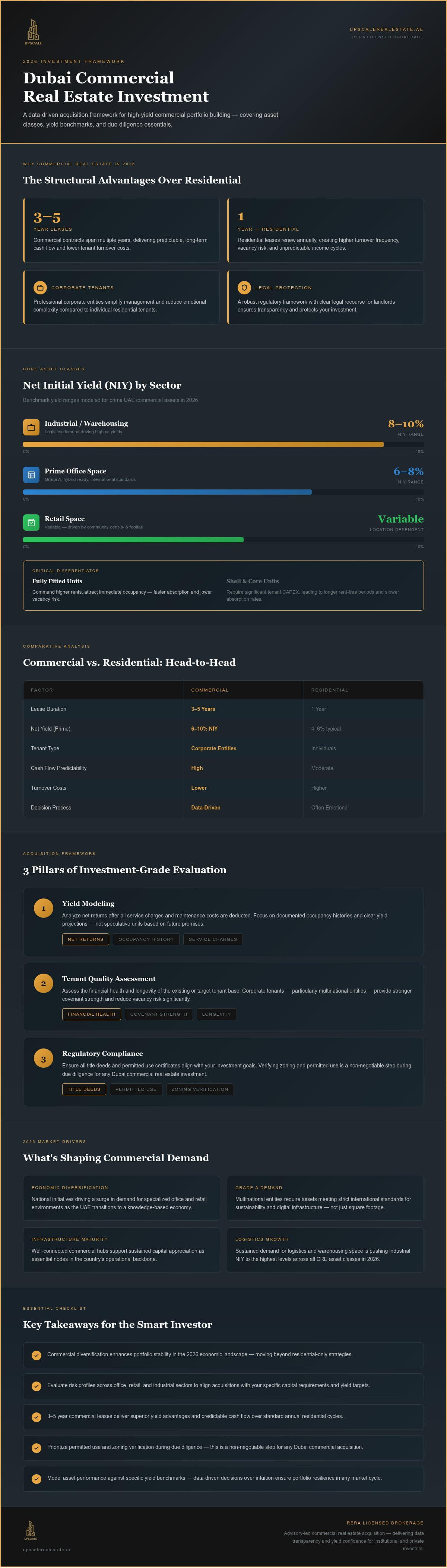
The core appeal of the commercial sector lies in its structural advantages. Unlike residential leases that typically renew annually, commercial contracts often span three to five years. This extended duration provides investors with predictable, long-term cash flow and lower turnover costs. The tenant base is also predominantly professional. Dealing with corporate entities rather than individual residents simplifies management and reduces the emotional complexity of property ownership. This professional environment is supported by a robust regulatory framework that prioritizes transparency and clear legal recourse for landlords.
Market Drivers Shaping Commercial Opportunities in 2026
National economic diversification initiatives have created a surge in demand for specialized office and retail environments. As the country moves toward a knowledge-based economy, the requirement for Grade A compliant spaces has become a priority for multinational entities. These organizations don't just look for space; they require assets that meet strict international standards for sustainability and digital infrastructure. This demand isn't localized to a single area but is a national trend driven by infrastructure maturity. Well-connected commercial hubs now support sustained capital appreciation because they're essential to the country's operational backbone.
The Investor-Centric Approach to Asset Acquisition
Acquiring commercial property requires a departure from the emotional decision-making typical of residential purchases. It's a purely data-driven process. We focus on identifying investment-grade assets. These are properties with documented occupancy histories and clear yield projections, rather than speculative units based on future promises. A grounded approach involves several critical factors:
- Yield Modeling: Analyzing net returns after all service charges and maintenance costs.
- Tenant Quality: Assessing the financial health and longevity of the existing or target tenant base.
- Regulatory Compliance: Ensuring all title deeds and permitted use certificates align with your investment goals.
Navigating these complexities requires a steady hand. Working with a RERA-licensed brokerage provides the necessary visibility to ensure your acquisition is secure. This professional oversight is vital for modeling long-term value and avoiding the pitfalls of non-prime assets. By prioritizing data over intuition, you can build a portfolio that remains resilient in any market cycle.
Core Asset Classes: Office, Retail, and Industrial Strategies
Selecting the right asset class for a Dubai commercial real estate investment depends on aligning your capital with specific risk tolerances and yield objectives. The 2026 market offers three primary pillars: office, retail, and industrial. Each sector operates under different mechanical principles, and understanding these is essential for building a resilient portfolio. While office spaces act as traditional anchors, industrial and retail assets provide specialized opportunities for those seeking alternative growth paths.
In the current landscape, Net Initial Yield (NIY) expectations have shifted to reflect market maturity. For prime office assets, we typically model an NIY between 6% and 8%. Industrial warehousing often pushes higher, reaching 8% to 10% due to the sustained demand for logistics space. Retail yields are more variable, often fluctuating based on community density and footfall. A critical differentiator in leasing speed is the property's "fit-out" status. Fully fitted units generally command higher rents and attract immediate occupancy. Conversely, shell-and-core units require significant tenant capital expenditure, which often leads to longer rent-free periods and slower absorption rates.
Office Space: The Anchor of Commercial Portfolios
Modern corporate tenants are increasingly moving away from shell-and-core options in favor of "plug-and-play" environments. The rise of hybrid-ready workspaces has redefined what makes an office unit valuable. These spaces must feature integrated technology and flexible layouts to support a professional workforce. To ensure long-term stability, investors should prioritize tenant retention strategies for commercial properties. High retention rates minimize the high costs associated with finding new corporate tenants and help maintain a consistent yield profile across the holding period.
Retail and Industrial Assets: High-Yield Alternatives
Retail investment has seen a resurgence in the community-focused segment. Small to medium-sized units that provide essential services to residential populations offer high resilience against broader economic shifts. Meanwhile, the industrial sector has become a powerhouse for institutional-grade portfolios. The explosion of e-commerce has turned logistics and warehousing into high-performance assets with high occupancy rates. These industrial properties offer excellent scalability, allowing investors to secure larger footprints with professional, long-term operational tenants. If you're looking to model these specific asset classes, our investment advisory services provide the grounded visibility needed to make an informed acquisition.
Commercial vs. Residential: A Strategic Yield Comparison
Investors often start with residential units because they're familiar. However, a Dubai commercial real estate investment offers a fundamentally different financial profile. While upscale residential assets typically net between 4% and 6% in the current market, prime commercial assets often target net yields of 7% to 9%. This premium is largely due to the increased stability of corporate tenancies. Corporate tenants generally have higher relocation costs, which makes them more likely to renew their agreements compared to individual residents.
Lease durations represent a major point of divergence. Residential contracts are almost exclusively 12-month agreements. This creates a high-frequency management cycle with recurring marketing costs. Commercial deals operate on three to five year cycles. Many of these utilize a structure similar to a "Triple Net Lease" (NNN). In this framework, the tenant assumes responsibility for a significant portion of the operational costs, including internal maintenance and sometimes insurance. This shifts the operational burden away from the landlord, making the income stream more passive than most residential counterparts.
Risk Modeling and Vacancy Considerations
Commercial vacancy periods are generally longer than residential ones. It can take several months to secure a corporate tenant that meets the necessary financial criteria. However, this is offset by the higher rental rates and the long-term nature of the commitment. The higher barrier to entry in terms of capital and technical knowledge acts as a protection for established investors. It prevents the market saturation often seen in the residential sector. For a holistic view of how this fits into a broader strategy, it's essential to understand real estate portfolio management dubai principles.
Operational Costs and Management Intensity
Service charges and sinking fund contributions are critical components of commercial modeling. These costs are often more substantial than in residential buildings because of the specialized infrastructure required for offices or retail units. Professional property management isn't just a convenience; it's a necessity for mitigating operational friction between corporate entities. Corporate-to-corporate leasing also offers distinct legal advantages. The legal framework for commercial disputes is highly structured, providing landlords with clear paths for recourse in the event of lease violations. This transparency ensures that high-value assets remain protected throughout the investment lifecycle.
Due Diligence and the Legal Framework for 2026
A successful Dubai commercial real estate investment is built on a foundation of rigorous verification. Unlike residential transactions, commercial deals require a deeper technical audit of the asset's legal standing. The first step involves a meticulous check of the title deed and ownership status through official channels. You must confirm that the seller has the absolute right to transfer the property and that no undisclosed encumbrances exist. This transparency is vital for protecting your capital in high-value acquisitions.
Checking the 'Permitted Use' or zoning of a property is non-negotiable. If you purchase a unit zoned for retail but intend to use it as a specialized medical clinic, you may face significant regulatory hurdles or a total block on operations. This verification ensures the asset aligns with your target tenant's specific business activity. Additionally, the Ejari system remains the backbone of securing commercial lease agreements. It provides a transparent, government-backed record of the contract, which is essential for legal protection. We also recommend a professional valuation and a project management audit to evaluate the building's infrastructure, such as HVAC and fire safety systems, before finalizing any deal.
Navigating Commercial Leasing Regulations
Landlords in 2026 operate within a clear set of national property laws that balance rights with professional responsibilities. Rent increases and lease renewals are governed by structured indices, ensuring market fairness and predictable modeling for your yields. If a conflict arises, specialized dispute resolution mechanisms provide a swift, legal conclusion for commercial entities. This framework offers the security needed to manage corporate tenancies without the fear of arbitrary legal shifts. To ensure your next acquisition is grounded in data and regulatory compliance, consult with our RERA-licensed investment advisors today.
The Importance of Transparency in Brokerage
Transparency starts with selecting a RERA-licensed commercial specialist who understands the mechanical nuances of the local market. You should look for advisors who prioritize data over intuition and provide clear visibility into every stage of the transaction. For those exploring 'off-market' commercial deals, the level of due diligence must be even stricter. These transactions lack public visibility, making the independent verification of documentation critical. Corporate buyers and foreign investors must also prepare specific paperwork, including notarized Articles of Association and Board Resolutions, to comply with local registration protocols. This organized approach ensures that your portfolio expansion remains secure and legally sound.
Investment Advisory: Building Your Commercial Portfolio with Upscale
Upscale Real Estate Brokerage LLC (ORN 23084) serves as a strategic consultant for those looking to expand their footprint beyond traditional residential assets. A Dubai commercial real estate investment requires a level of technical depth that exceeds standard property transactions. We provide a steady hand through the entire lifecycle of an acquisition. This starts with identifying high-value assets and continues through to professional property management. Our goal isn't just to close a deal; it's to ensure your portfolio is optimized for long-term yield and capital appreciation.
We adopt a visibility-first approach to market data. This means we don't rely on surface-level listings. Instead, we use grounded modeling to analyze net yields and operational costs. For clients transitioning from residential to commercial assets, we provide a clear roadmap. We explain the shift in management intensity and the benefits of corporate-to-corporate leasing. This end-to-end service model mitigates the friction often associated with entering a new asset class, providing you with a secure path to diversification.
Tailored Advisory for Institutional and Private Investors
We match each asset to your specific corporate or personal financial goals. Whether you're an institutional investor seeking high-volume industrial units or a private individual looking for a stable retail anchor, our strategy remains the same. We utilize precise market modeling to predict occupancy and rent trends for 2026 and 2027. This foresight allows you to make decisions based on where the market is going, not just where it has been. Our commitment to transparent transaction management ensures that every step of the acquisition is documented and verified, maintaining the highest professional standards.
Next Steps: Securing Your Commercial Asset
Initiating a commercial portfolio review is the first step toward long-term security. By leveraging our local mastery, you gain access to a network of investment-grade opportunities that aren't always visible on the open market. We invite you to experience a more professional, data-driven approach to Dubai commercial real estate investment. Our team is ready to provide the visibility and accountability your capital deserves. Contact Upscale Real Estate Brokerage LLC for a professional consultation and take the next step in building a resilient, high-yield commercial portfolio that stands the test of time.
Securing Your Position in the 2026 Commercial Market
Building a resilient portfolio requires moving beyond traditional residential boundaries to embrace the structural stability of the commercial sector. By prioritizing professional tenancies and longer lease cycles, you can secure a predictable yield profile that withstands broader market shifts. Success in a Dubai commercial real estate investment is no longer about following trends; it's about applying a rigorous, data-driven framework to every acquisition. Verification of zoning, permitted use, and technical infrastructure remains the cornerstone of any secure transaction.
Upscale Real Estate Brokerage LLC (ORN 23084) is a RERA-licensed entity committed to this level of transparency. Our team provides the visibility you need to transition from residential assets to high-performing commercial holdings with confidence. We specialize in end-to-end commercial leasing and management, ensuring your assets are optimized for the economic landscape of 2026 and beyond. Optimize your portfolio with Upscale's commercial investment advisory and take a grounded approach to your next high-value acquisition. We're here to guide you toward long-term growth.
Strategic Insights: Frequently Asked Questions
Is commercial real estate investment in Dubai better than residential in 2026?
Commercial investment offers higher net yields, often between 7% and 9%, compared to the 4% to 6% typical of residential assets in 2026. While residential property benefits from higher liquidity, commercial holdings provide longer lease terms and professional tenancies. The choice depends on your risk appetite; however, a Dubai commercial real estate investment often provides superior stability for long-term portfolio modeling and growth.
What are the typical service charges for commercial properties?
Service charges for commercial units are generally higher than residential fees due to specialized infrastructure and intensive maintenance requirements. These costs are calculated per square foot to cover building insurance, cooling, and common area upkeep. In many cases, a Triple Net Lease structure allows the landlord to pass these operational costs to the tenant. However, the owner typically remains responsible for the sinking fund and major structural repairs.
Can foreign investors own 100% of a commercial property?
Yes, foreign investors can achieve 100% ownership of commercial assets located within designated freehold areas. This applies to both individual buyers and corporate entities. Outside these freehold zones, ownership structures may require different legal setups or be limited to leasehold agreements. Verifying the freehold status during your due diligence is a critical step in any Dubai commercial real estate investment to ensure full control.
What is the average ROI for office space in the current market?
Prime office spaces in the current market typically target a Net Initial Yield between 6% and 8%. This ROI is heavily influenced by the unit's fit-out status; fully fitted offices command higher rents and faster occupancy. Industrial and logistics assets often push yields higher, sometimes reaching 8% to 10%. These figures are driven by the national push for economic diversification and the resulting demand for high-quality corporate space.
How do commercial lease renewals differ from residential ones?
Commercial renewals are governed by long-term contracts that often span three to five years. Unlike residential renewals that rely on annual RERA index updates, commercial agreements usually include pre-negotiated rent escalation clauses. This structure provides both the landlord and corporate tenant with long-term financial visibility. It also reduces the frequency of turnover costs, making the management of commercial assets more predictable than residential counterparts.
What happens if a commercial tenant defaults on rent?
If a commercial tenant defaults, the legal process follows a structured path through specialized dispute resolution centers. Landlords can seek rent recovery or eviction based on the terms in the registered Ejari contract. Because these are corporate-to-corporate agreements, the legal framework is designed for professional recourse. Security deposits and bank guarantees are standard requirements in commercial deals to protect your cash flow in the event of a default.
Are there specific zoning restrictions I should know about before buying retail?
Zoning and Permitted Use certificates are essential documents to review before any retail acquisition. Every unit has a specific designation that dictates the types of businesses allowed to operate. A unit zoned for general retail might not be suitable for a cafe or clinic due to specific utility or safety requirements. You must verify these restrictions with the relevant authorities to ensure the property aligns with your target tenant's operational needs.
How does the Golden Visa program apply to commercial property investment?
Commercial property investment qualifies for the Golden Visa program if the total investment value meets the current threshold of د.إ2,000,000. This value can be comprised of one or more commercial assets, such as offices or retail units. The property must be owned, and specific equity requirements apply if the asset is financed. This residency program offers significant long-term security for international investors managing high-value portfolios.