
A regulated property transaction can still be a poor investment. If you’re asking, “is buying property in UAE a safe investment 2026”, the answer depends on more than market growth or advertised rental yields. The UAE has formal safeguards, but ownership, registration and off-plan protections can vary by emirate and transaction.
It’s reasonable to want confidence before committing significant capital, especially when forecasts can’t guarantee rent, resale demand or appreciation. Safety isn’t a blanket promise. It depends on understanding what legal and transactional protections cover, where they stop, and whether the risks fit your objectives.
This guide offers a practical framework for assessing those questions. It covers safeguards and their limits, compares ready and off-plan risks, and explains how to test an investment against your time horizon and risk tolerance. The aim is a grounded decision, not a guarantee.
Key Takeaways
- Whether “is buying property in UAE a safe investment 2026” is the right question depends on your objectives, risk tolerance, and property-specific due diligence.
- Ownership records, transaction documents, contract review, and eligible off-plan escrow arrangements address different risks, but none guarantees a return.
- Compare ready and off-plan property by income timing, construction exposure, and resale flexibility before choosing an investment route.
- Build base-case and downside scenarios for occupancy, operating costs, rental income, and resale timing to test whether an investment fits your plans.
- Structured investment advisory and transparent brokerage guidance can help clarify assumptions and assess whether a property fits your objectives.
Is Buying Property in the UAE a Safe Investment in 2026?
The direct answer is conditional: buying property in the UAE can be a considered investment, but no legal safeguard or market trend makes it risk-free. Whether is buying property in UAE a safe investment 2026 is the right question for you depends on the property, the rules that apply, and your financial position. Legal protections can reduce certain ownership and transaction risks, but they cannot guarantee rent, appreciation, or a profitable sale.
Investment protection concerns whether ownership and the transaction are properly documented and enforceable. Investment performance concerns what the asset earns or is worth over time. These are related, but not the same. A secure title can support your claim to a property, yet it cannot ensure tenants will be available, operating costs will stay within budget, or a future buyer will pay your target price.
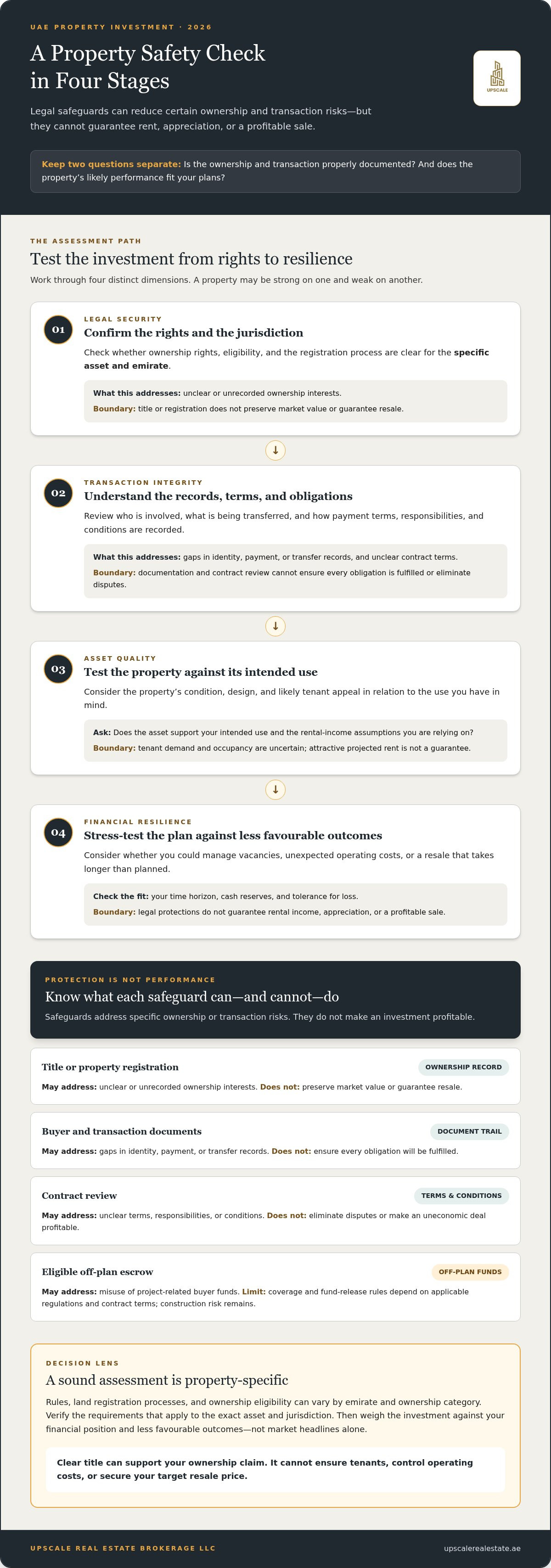
Assess safety across four separate dimensions:
- Legal security: Are the ownership rights and registration process for this asset clear?
- Transaction integrity: Are the contract, payment arrangements, and supporting documents properly understood and recorded?
- Asset quality: Does the property’s condition, design, and likely tenant appeal support your intended use?
- Financial resilience: Could you manage vacancies, unexpected costs, or a delayed resale without putting other financial commitments under pressure?
A property may perform well on one dimension and poorly on another. Strong paperwork does not offset an unsuitable asset, and attractive projected rent does not remove uncertainty about occupancy or resale timing. Base your 2026 decision on current evidence and a realistic assessment of your time horizon, cash reserves, and tolerance for loss.
What does a safe property investment actually mean?
Secure title and lawful registration address ownership, not future value. Rental-income reliability depends on tenant demand, occupancy, and ongoing costs. Capital appreciation depends on future market conditions, while resale liquidity is about how readily you can sell when needed. An investor with a long holding period and capacity to absorb income gaps may accept uncertainty that would not suit someone who needs quick access to capital.
Why does the answer vary across the UAE?
Property rules, land registration processes, and ownership eligibility can depend on the emirate and the relevant ownership category. This overview of a land department describes one real estate authority, but its framework should not be treated as a nationwide rulebook. Verify the requirements that apply to the exact asset and jurisdiction instead of relying on broad UAE market headlines.
Before weighing projected yield or growth, establish what rights the transaction gives you, how those rights are recorded, and what conditions apply to the property. Then test the investment against less favourable outcomes, such as lower occupancy, higher operating costs, or a sale taking longer than planned. This turns “safe” from a broad market label into a decision grounded in your circumstances.
Which UAE Property Safeguards Protect Buyers, and What Do They Cover?
Buyer safeguards work best when you understand what each one is designed to do. Registration records property rights, transaction documents support the purchase process, and contract review clarifies the parties’ obligations. None protects a property’s market value or ensures rental income. For anyone asking is buying property in UAE a safe investment 2026, the practical question is whether the protections relevant to that property address its main risks.
How do registration and ownership protections work?
The relevant emirate’s land department records property rights under its applicable processes. Registration or title documentation can help establish the owner’s recorded interest, but it does not promise future prices, demand, or resale timing. Ownership eligibility can depend on the property’s location, ownership category, and applicable rules. Verify the requirements for the specific asset and jurisdiction before committing, rather than assuming one UAE-wide rule applies to every buyer.
Buyer documentation and contract review serve separate purposes. Identity and transaction records help establish who is involved and what is being transferred. Reviewing the agreement helps clarify payment terms, obligations, and conditions. A clear document trail can reduce avoidable misunderstandings, but it cannot remove every dispute or financial risk. This overview of land department responsibilities provides additional context on jurisdiction-specific oversight.
| Safeguard | Risk it may address | Important limitation |
|---|---|---|
| Title or property registration | Unclear or unrecorded ownership interests | Doesn’t preserve market value or guarantee resale. |
| Buyer and transaction documents | Gaps in identity, payment, or transfer records | Documents don’t ensure every obligation will be fulfilled. |
| Contract review | Unclear terms, responsibilities, or conditions | Doesn’t eliminate disputes or make an uneconomic deal profitable. |
| Eligible off-plan escrow | Misuse of project-related buyer funds | Coverage and fund-release rules depend on applicable regulations and contract terms; construction risk remains. |
What does an escrow account protect in an off-plan purchase?
For eligible off-plan transactions, a regulated project escrow account is intended to manage buyer payments within a defined framework. It is a financial control, not a guarantee that construction will finish on schedule, that the completed property will meet your investment assumptions, or that you’ll recover funds in every scenario. Eligibility, release conditions, and available remedies depend on applicable regulations and signed contracts.
Before paying, establish whether escrow requirements apply to the specific project and understand how payment milestones and release conditions are described in the documents. Compare this construction-dependent exposure with the different risks of a completed property using this off-plan and ready property comparison. For a structured review of property fit and transaction assumptions, investment advisory support can help clarify the questions without presenting safeguards as a promise of performance.
How Do UAE Property Risks Compare Across Investment Scenarios?
Ready and off-plan property expose investors to different uncertainties. You can inspect a completed home and assess its current condition and rental potential before purchase. That gives you more visibility, not certainty: future occupancy, maintenance needs, rent levels, and resale demand can still change. Off-plan property adds dependence on construction delivery, the final specification, and the expected completion timeline. Its investment case may rely on assumptions about a property that isn’t yet available to inspect in its finished condition.
How do ready and off-plan investments differ in risk?
Ready assets may offer a clearer view of immediate income potential, but income can be interrupted by vacancy or repairs. Off-plan buyers generally face a longer wait before a property can generate rental income, alongside delivery and specification uncertainty. Resale flexibility differs too: you can evaluate a completed asset’s condition directly, while an off-plan investor’s exit may depend on the contract, project progress, and buyer demand at the time. Neither route is inherently safer for every investor.
Gross yield cannot establish net investment performance. It compares rental income with the property price, but does not account for vacancy, maintenance, operating costs, or financing. Model income after these items, then test whether the result remains workable if rent is lower or costs are higher than planned. Rental income and appreciation are separate return drivers: rent may support ongoing cash flow, while resale value depends on future demand and market conditions. Neither is assured.
Which financial and market risks can change the outcome?
Use scenarios that reflect your holding period. A temporary price decline may matter less to someone able to hold the property than to an investor who needs to sell soon. A slower sale can affect liquidity even if the asset remains occupied. Review financing assumptions alongside rental income, since repayments continue regardless of whether a tenant is in place.
| Scenario or risk | Possible effect | Practical test |
|---|---|---|
| Vacancy or weaker tenant demand | Reduces rental income and may extend the time needed to secure a tenant. | Model periods without rent and assess whether reserves can cover commitments. |
| Maintenance and operating costs | Can reduce net cash flow, particularly if repairs arise earlier or cost more than assumed. | Include routine costs and a downside allowance in your projections. |
| New supply or market-cycle shifts | May influence tenant competition, rents, buyer demand, and resale values. | Assess comparable properties and avoid relying on a single growth forecast. |
| Construction delays or specification changes | Can postpone income or affect the completed asset’s suitability. | Consider how a later handover would affect your cash flow and investment horizon. |
| Limited liquidity or a short holding period | A sale may take longer than planned or require less favourable pricing. | Test whether you can hold through a slower resale market. |
The practical answer to is buying property in UAE a safe investment 2026 depends partly on which risks you can absorb. Compare a base case with a downside case for occupancy, operating costs, financing, and resale timing. If the investment only works under optimistic assumptions, the projected return may not compensate for the uncertainty.
How Can You Assess Whether a UAE Property Investment Fits?
A disciplined assessment starts with your investment case, not a headline yield or forecast. Define what the property needs to achieve, then test whether the numbers and risks remain acceptable when conditions are less favourable. Keep assumptions visible, use inputs you can substantiate, and treat future rent, value, and timing as uncertain.
What should your investment model test?
Use this sequence before comparing properties. Each step moves from your objectives to a realistic exit plan.
- Set your objective. Decide whether your priority is rental income, long-term appreciation, or a combination. Clarify the holding period and the level of downside you could absorb.
- Estimate income transparently. Label gross yield as annual rent divided by purchase price. Then estimate net yield after applicable operating costs, vacancy, maintenance, management, transaction charges, and financing costs. Use verified inputs, not unsupported market averages.
- Build two scenarios. In the base case, use supportable assumptions for occupancy, income, costs, and resale timing. In the downside case, test lower or interrupted rent, higher expenses, and a slower sale. Record the source and date for each assumption.
- Check the property against the model. For a completed asset, consider its observed condition and likely maintenance needs. A ready property investment guide can help frame how immediate usability fits into an investment assessment.
- Plan the exit. Identify when and why you may sell, how much flexibility you have if the sale takes longer, and whether the investment remains manageable if you do not achieve your preferred exit value.
Don’t let a positive base case carry the whole decision. If a modest change in occupancy, operating costs, or resale timing makes the investment unworkable, that sensitivity matters. Investors with other properties should also consider how one asset affects concentration, cash-flow exposure, and overall portfolio balance. A property portfolio management framework can help structure that wider view.
Which documents and assumptions need independent review?
Keep a due-diligence record for the specific asset and emirate. Organise the title or registration information, sale agreement and key terms, payment schedule, relevant disclosures, and available information about property condition. Record which ownership and regulatory requirements apply, along with the official source and date used to verify them. Where a contract term, cost, or legal interpretation is material, arrange suitable independent review rather than treating an estimate as fact.
Separate confirmed information from projections in your file. Date market data, identify its source, and label forecasts as uncertain. Investment advisory can help organise objectives, compare property options, and document assumptions; it cannot remove market risk or guarantee performance. Discuss your investment objectives and property options as part of a transparent, evidence-led assessment.
How Can an UAE Property Adviser Support a Safer Investment Decision?
An adviser can make a property decision more structured, but cannot remove market risk or promise a particular return. The value lies in connecting your objectives to the asset, making assumptions visible, and keeping transaction considerations in view. That is a more useful basis for judging whether is buying property in UAE a safe investment 2026 for your circumstances than relying on broad claims about demand or future growth.
What should an investment advisory conversation clarify?
Start with your intended holding period, risk tolerance, income requirements, and preferred ownership approach. These factors shape which properties are worth comparing. For example, an investor who needs income soon may assess completed properties differently from someone prepared to wait for an off-plan asset. The discussion should turn your preferences into clear criteria, not assume one property type or market trend suits every buyer.
Then compare suitable ready and off-plan options against the same documented criteria. Consider expected income timing, property condition or construction exposure, likely operating demands, and your exit plan. A transparent comparison separates verified information from estimates, shows where assumptions come from, and identifies what still needs current legal, financial, or property-specific verification. Advisory supports the decision; it does not replace due diligence or guarantee the result.
A focused review can also surface gaps before they become costly surprises. Does your cash-flow model allow for a period without a tenant? Does your preferred exit date depend on achieving a particular resale value? Do you understand the ownership conditions and transaction terms for the specific property and applicable emirate? Clear answers help you decide whether to proceed, revise your assumptions, or rule out an option.
How can management support ownership after purchase?
Ownership continues after the transaction. Professional property management can support tenant relations and ongoing property operations, helping owners handle the practical demands of leasing and maintaining an asset. It does not guarantee occupancy, uninterrupted rent, or that every operating issue will be avoided. Its role is to support the work of ownership, not change the investment’s underlying risk.
Clear management information can help owners maintain visibility into occupancy, income, and property-related decisions. That visibility is useful when comparing actual performance with the assumptions used before purchase. If results differ, you can revisit costs, leasing decisions, or your holding strategy with a more grounded view of the asset.
- Before purchase: Clarify objectives and compare assets against documented criteria.
- During the transaction: Keep property selection, relevant documents, and due diligence aligned.
- After purchase: Monitor ownership and tenant operations against your investment assumptions.
A safer decision is not a guaranteed outcome. It is a decision made with clear criteria, transparent assumptions, and a realistic view of what could change. Discuss your UAE property investment objectives and compare suitable ready or off-plan options without treating projected performance as certain.
Make Your Next Move With Clear Criteria
Before committing, decide what would make you pause or walk away. Set a minimum acceptable net income, a maximum downside you can absorb, and a holding period that gives you room to respond if the market or your circumstances change. These thresholds turn due diligence into a decision, rather than an exercise in collecting information.
The question “is buying property in UAE a safe investment 2026” has no universal yes or no. A property may suit an investor who can hold through uncertainty but be a poor fit for someone who needs predictable income or quick access to capital. Base your decision on evidence for the specific asset and consider the consequences if your assumptions prove wrong.
A considered next step is to compare your criteria with suitable ready or off-plan opportunities, while keeping projected performance separate from verified facts. Upscale Real Estate Brokerage LLC supports this assessment through investment advisory and transparent transaction guidance, without presenting outcomes as certain.
Discuss your UAE property investment objectives and take the next step with a clearer view of what fits your plans. A measured decision is a stronger starting point for long-term ownership.
Frequently Asked Questions
Does buying property in the UAE automatically qualify an investor for a Golden Visa?
No. Property ownership alone doesn’t automatically grant a Golden Visa. As of 2026, the stated real estate investment threshold is د.إ2 million, but applicants must also meet the applicable eligibility and application requirements. Qualifying property may include off-plan or mortgaged property under specified conditions, so the purchase price alone isn’t enough to establish eligibility. Verify current requirements with official sources before relying on a visa outcome as part of your investment decision.
Can UAE property guarantee rental income or capital appreciation?
No. A lease can set agreed terms with a tenant, but it can’t ensure continuous occupancy or prevent a tenant from leaving or failing to pay. Appreciation is also uncertain and depends on future demand, supply, and the property’s appeal to buyers. For example, a vacant period can reduce income even if asking rents remain stable. Treat rent and resale growth as scenarios to test, not outcomes promised by ownership.
How much rental yield can a UAE property generate?
There’s no single yield figure that applies across UAE properties. Gross yield is estimated from annual rent relative to purchase price; net yield is lower after vacancy, maintenance, management, operating costs, and financing. Use comparable rental evidence for the specific property type and current conditions, then show your assumptions clearly. A projected yield is not the same as achieved income, particularly if the property sits vacant or expenses exceed expectations.
What happens if an off-plan property is delayed?
The next steps depend on the purchase contract and rules applicable to the project. Review the stated completion date, any permitted extension or grace period, notification provisions, and remedies for delay. Keep written records of developer updates and payments, and assess how a later handover affects your cash flow if rental income was expected. Escrow arrangements don’t, by themselves, establish a particular compensation or cancellation outcome for every delay.
Are rental returns from UAE property tax-free for every investor?
No, not necessarily. The UAE doesn’t impose personal income tax on individuals, but that doesn’t mean every investor’s rental returns are free from tax obligations. The outcome can depend on whether the property is held personally or through a business, as well as the investor’s tax residence and obligations elsewhere. UAE corporate tax may apply to business profits under applicable rules. Get advice based on your ownership structure and circumstances.
Is UAE property suitable for an investor who may need to sell quickly?
It may not be a good fit if you need certainty about when you can access your capital. A sale can take longer than expected, and the price a buyer will accept depends on market conditions and the property’s appeal at that time. Before purchasing, consider whether you could hold the asset longer or accept a less favourable offer. The question “is buying property in UAE a safe investment 2026” depends partly on this liquidity risk.