
The office segment in Dubai saw a staggering 199% increase in transaction value during the first half of 2026, reaching AED 15.81 billion. This surge highlights a critical shift in the market that many investors are still overlooking. To succeed in this maturing environment, your Dubai real estate investment strategy must move beyond simple acquisition and toward sophisticated asset modeling.
It's understandable if the recent introduction of Law No. (4) of 2026 regarding shared housing or the evolving 2033 sector regulations feel complex. You're likely looking for more than just a one-off purchase; you want a resilient portfolio that delivers consistent 7-9% net yields despite shifting transaction volumes. This guide provides the data-driven framework needed to build that security through professional advisory and transparent management.
We'll break down the optimal allocation between off-plan projects and ready assets while explaining how updated investor visa rules impact your long-term capital growth. You'll gain a clear roadmap for navigating the 2026 landscape with the confidence of a seasoned institutional expert.
Key Takeaways
- Understand how the Dubai Real Estate Sector Strategy 2033 is transitioning the market from speculative growth to a mature, data-driven investment landscape.
- Develop a sophisticated Dubai real estate investment strategy by balancing the immediate rental income of ready assets with the capital appreciation potential of off-plan projects.
- Learn to calculate true net yields by utilizing professional modeling that accounts for service charges, maintenance, and comprehensive management fees.
- Navigate the 2026 regulatory environment with confidence by aligning your portfolio with Dubai Land Department standards and RERA-licensed advisory services.
- Discover why transition from simple transaction to long-term property management is the key to maintaining resilient 7-9% yields for international owners.
The Evolution of Dubai’s Real Estate Market: 2026 Strategic Outlook
Dubai's real estate market has undergone a fundamental transformation, moving away from the high-volatility cycles of previous decades. It's now a globally recognized, mature investment hub characterized by regulatory depth and institutional grade assets. A successful Dubai real estate investment strategy in 2026 relies on understanding this maturation. Investors are no longer chasing speculative "flips" but are instead focused on long-term capital preservation and predictable income streams. Reviewing Dubai's Real Estate Market Evolution reveals a trajectory toward stability that rivals established markets like London or Singapore.
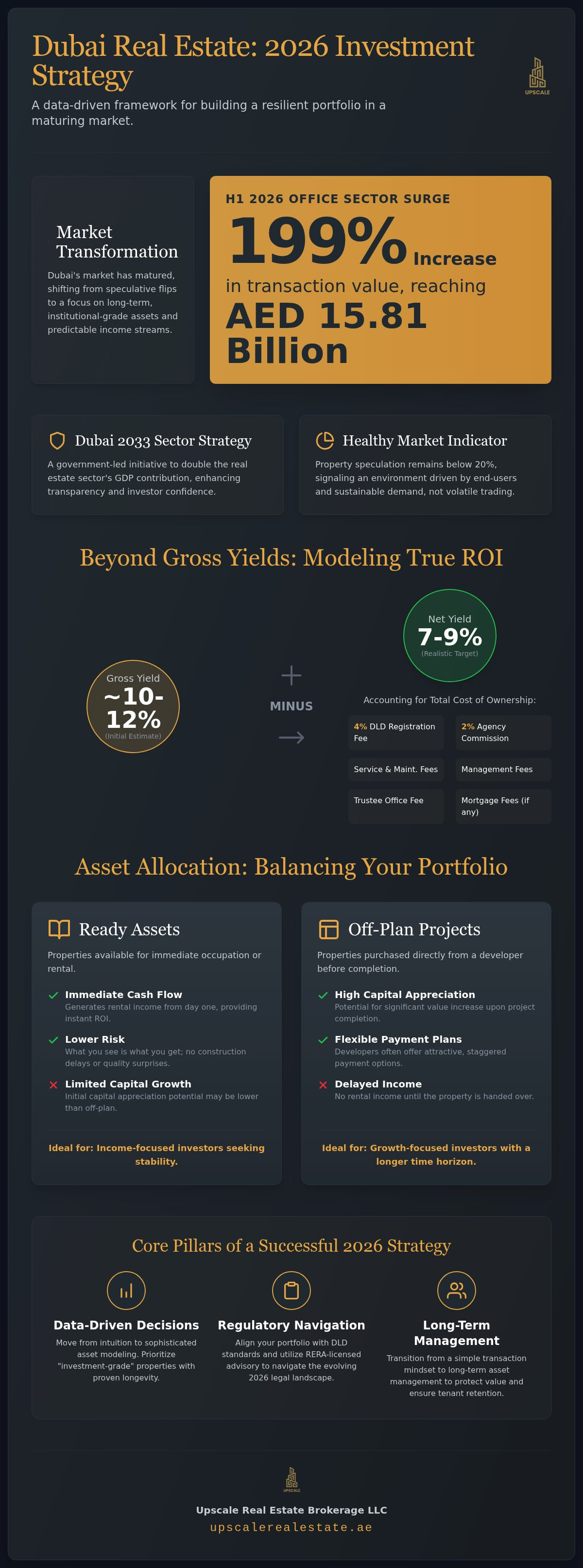
In the 2026 context, "investment-grade" property is defined by tangible quality and strict adherence to the Dubai Land Department (DLD) framework. Data from the first half of 2026 confirms a trend toward "premiumisation," where buyers prioritize asset longevity over marketing hype. This is particularly evident in the commercial sector; the office segment saw transaction values surge by 199% to AED 15.81 billion in H1 2026. Market transparency has become the cornerstone of this landscape, providing investors with the visibility needed to move from intuition-based buying to precise, data-backed modeling.
Aligning with the 2033 Sector Strategy
The Dubai Real Estate Sector Strategy 2033 provides a clear roadmap for doubling the sector's contribution to the national GDP. This government-led initiative has successfully bolstered international confidence by mandating higher standards for transaction transparency. For private investors, this means clearer visibility into historical data and future supply pipelines. Enhanced infrastructure, such as the expansion of the Dubai Metro and new transport corridors, continues to act as a primary driver for national property value appreciation, ensuring that well-located assets remain resilient against market fluctuations.
Market Maturation and Speculation Limits
A key indicator of market health is the level of speculative activity. When property speculation remains below 20%, it signals an environment driven by end-users rather than volatile traders. We've seen a distinct shift toward lifestyle acquisitions, with 50% of villa buyers now seeking four or more bedrooms to accommodate home offices and growing families. This demand for space and quality supports sustained capital growth across the residential segment. The 2026 market status represents a sophisticated balance of high-quality supply and sustained, data-backed demand.
Core Pillars of a Successful Real Estate Investment Strategy
A resilient Dubai real estate investment strategy begins with a fundamental choice: are you investing for immediate cash flow or long-term capital preservation? While rental yields in Dubai remain attractive, the 2026 market demands a more nuanced approach than previous years. Success isn't found in gross figures but in net yield modeling. This means your strategy must account for the 4% Dubai Land Department (DLD) registration fee, the 2% real estate agency commission, and the AED 4,000 Trustee Office fee applicable to properties valued above AED 500,000.
Liquidity is an equally vital pillar. In a maturing market, the ability to exit an asset efficiently depends on its "investment-grade" status. Data from the Dubai Land Department 2026 H1 Report indicates that while transaction volumes have stabilized, demand remains concentrated in high-quality, well-managed developments. Diversifying your portfolio across different asset types ensures you aren't over-exposed to a single market segment, allowing for more predictable performance across economic cycles.
Mathematical Modeling for Real ROI
Professional real estate portfolio management dubai moves beyond vanity metrics like "gross yield" to focus on the Total Cost of Ownership (TCO). You must factor in annual service charges, maintenance reserves, and the 0.25% mortgage registration fee if financing is involved. Strategic management protects your asset’s value by ensuring high tenant retention and optimal property condition. For those seeking grounded visibility, our investment advisory services provide the detailed modeling required to identify true net returns before you commit capital.
Asset Class Synergy
Building a balanced portfolio requires understanding how different property types interact. Each asset class serves a specific strategic purpose in the 2026 landscape:
- High-density apartments: These are the workhorses of a portfolio, offering high rental frequency and consistent cash flow in urban hubs.
- Townhouses: These fill the "mid-market" gap, providing a stable foundation for family-oriented, long-term leasing strategies with lower turnover rates.
- Villas: As of August 2026, 50% of villa buyers are searching for properties with four or more bedrooms. This trend makes larger villas an excellent hedge for long-term capital appreciation as supply for premium family homes remains tight.
By aligning these asset classes with your primary objectives, you create a synergy that balances immediate income with sustained growth.
Asset Allocation Modeling: Balancing Ready and Off-Plan Property
A resilient Dubai real estate investment strategy for 2026 often relies on a structured "70/30" allocation framework. This model suggests placing 70% of your capital into ready assets to secure immediate cash flow and 30% into off-plan projects to capture long-term capital appreciation. This specific ratio provides a steady hand in a maturing market, allowing you to benefit from current rental yields while positioning your portfolio for future growth. By balancing these two asset states, you mitigate the risk of over-exposure to construction timelines while ensuring your capital isn't sitting idle.
Mitigating risk in this environment requires deep developer due diligence and full visibility into escrow accounts. The Dubai Land Department (DLD) provides robust oversight, but an investor's role is to verify project milestones through official channels. Ensuring your brokerage is RERA-licensed is the first step in maintaining regulatory compliance and protecting your international assets.
The Case for Ready Property Sales
Ready properties offer the lowest execution risk for conservative portfolios. They provide immediate visibility into the physical build quality and the surrounding infrastructure, which is vital for calculating true net yields. For investors seeking residency, ready assets are the primary vehicle; the April 2026 updates have made this path more accessible by removing fixed minimum property values for sole owners seeking 2-year visas. You can find deeper analysis on this in our Strategic Guide to Ready Property Sales. These assets serve as the defensive anchor of a portfolio, providing the liquidity needed to exit or reinvest when market conditions shift.
Maximizing Upside with Off-Plan Strategies
Off-plan acquisitions remain a primary driver for capital growth, provided you identify high-potential projects before they hit the secondary market. When navigating the off-plan vs ready property dubai debate, it's essential to consider the impact of a high-interest environment on your leverage options. Off-plan entries typically offer lower price-per-square-foot rates compared to completed units in the same district. Post-handover payment plans function as an interest-free leverage tool that allows you to manage cash flow while the asset appreciates during the construction phase. This strategy is particularly effective for investors who prioritize long-term appreciation over immediate monthly checks.
Success in the off-plan segment is grounded in data rather than intuition. We focus on modeling the projected handover value against current secondary market trends to ensure your entry point offers a genuine margin of safety. This methodical approach ensures that your Dubai real estate investment strategy remains focused on long-term value rather than short-term speculation.
Strategic Risk Management: Navigating the Regulatory Landscape
A sophisticated Dubai real estate investment strategy is only as resilient as the legal framework that supports it. In the 2026 market, regulatory compliance has evolved from a procedural hurdle into a primary tool for capital protection. Investors who prioritize transparency and adhere to the Dubai Land Department (DLD) protocols are better positioned to weather market shifts. Understanding these safeguards ensures that your property remains a high-yielding asset rather than a legal liability.
One of the most significant updates in the current landscape is Law No. (4) of 2026, which regulates shared residential accommodation. Issued in March 2026, this law requires property owners to obtain specific permits for shared housing and strictly prohibits unauthorized subleasing. For landlords, staying ahead of these occupancy standards is essential to avoid penalties and ensure long-term tenant stability. Professional property management services can handle these regulatory nuances, acting as a steady hand for international owners who can't be on the ground.
The Dubai Land Department Framework
The dubai land department maintains one of the world's most transparent digital land registries, providing investors with an immutable record of ownership. This system is the backbone of investor security, ensuring that title deeds are issued accurately and efficiently. Beyond registration, the DLD's 'Mollak' system provides essential visibility into service charges. By mandating that all service fee invoices are issued through this centralized platform, the government prevents arbitrary hikes by developers or homeowners' associations (HOAs). This transparency is vital for accurate net yield modeling, as it allows you to forecast maintenance costs with high precision.
Due Diligence Checklist for 2026
Success in the 2026 market requires moving beyond marketing brochures. Your due diligence process should be methodical and data-driven. Before committing capital, ensure you've checked the following:
- Developer Track Record: Verify completed projects and handover timelines rather than relying on future promises.
- RERA Project Status: Use official government apps to check real-time construction milestones and escrow account balances for off-plan investments.
- Brokerage Licensing: Confirm your advisor is RERA-licensed (Upscale Real Estate Brokerage LLC operates under ORN 23084) to ensure adherence to professional standards.
- HOA Regulations: Review the Master Community rules to understand long-term cost controls and any restrictions on asset usage.
Escrow account protections remain a cornerstone of off-plan safety. Under current regulations, your payments are held in a project-specific account and only released to the developer as verified construction milestones are met. This ensures that your capital is used exclusively for the build, significantly reducing execution risk. Navigating these legalities requires more than just a broker; it requires a strategic consultant. If you're looking to secure your portfolio against regulatory shifts, our team provides the investment advisory expertise needed to vet contracts and ensure total compliance.
Executing Your 2026 Strategy with Professional Investment Advisory
The transition from acquiring an asset to managing a high-performing portfolio requires a fundamental shift in perspective. A Dubai real estate investment strategy is only as effective as its execution phase. For many international owners, the distance between their primary residence and their UAE assets can lead to operational gaps that erode returns. This is where professional investment advisory becomes the essential bridge between merely owning a property and maintaining a sophisticated financial vehicle. It's the difference between a static asset and a dynamic, yield-generating investment.
Upscale Real Estate Brokerage LLC operates as a strategic consultant rather than a traditional middleman. We integrate granular market data with your specific financial objectives, ensuring every decision is grounded in transparency and long-term value. Whether you're focused on residential leasing for high-density apartments or managing premium villa assets, having a steady hand on the ground ensures that your portfolio remains resilient. We provide the local mastery required to navigate a complex market with confidence and integrity.
The Role of Professional Property Management
Managing a property effectively involves a proactive approach to both residential and commercial leasing. Our goal is to reduce vacancy rates by identifying high-quality tenants and maintaining strong relations without owner intervention. Professional management preserves both the physical and financial health of the asset, ensuring it remains "investment-grade" for years to come. This includes handling all regulatory compliance, such as the specific permit requirements of the 2026 shared housing laws. By delegating these responsibilities, you secure the longevity of your yields while maintaining full visibility through our accountable reporting systems.
Scaling Your Portfolio
Moving from a single unit to a diversified real estate portfolio introduces new layers of complexity. Managing multiple assets across different categories, such as townhouses and apartments, requires a unified strategy to prevent over-exposure to any single asset type. The benefit of a single point of contact for multi-asset management is clarity; it provides a holistic view of your total net yields and simplifies the decision-making process for future acquisitions. We focus on process over pressure, helping you scale at a pace that matches your risk appetite.
Scaling isn't just about increasing your unit count. It's about optimizing your existing holdings while identifying new opportunities within the Dubai Land Department's 2033 framework. If you're ready to move beyond transactional buying and toward a long-term partnership, you can Consult with our Investment Advisory team to build your 2026 strategy. Our commitment is to provide the data-driven tactics and professional oversight required to protect and grow your international assets.
Securing Your Position in Dubai’s Mature Market
The 2026 landscape offers a unique opportunity for those who prioritize data over speculation. By aligning with the Dubai Real Estate Sector Strategy 2033, you aren't just buying property; you're participating in a regulated, institutional-grade environment. A successful Dubai real estate investment strategy today requires meticulous net yield modeling and a balanced allocation between ready assets and off-plan projects. Protecting your capital means looking beyond marketing brochures to verify developer milestones and RERA compliance through official channels.
Navigating these complexities shouldn't be a solitary endeavor. At Upscale Real Estate Brokerage LLC, we provide the steady hand needed for long-term growth. Our RERA-licensed expertise (ORN 23084) and commitment to data-driven investment modeling ensure your portfolio remains optimized for the years ahead. We offer end-to-end portfolio management that transforms international assets into seamless, high-yielding income streams.
Ready to move from a single transaction to a long-term strategic partnership? Scale your portfolio with Upscale Real Estate’s Strategic Advisory and build a resilient future in the heart of the UAE. We're here to ensure your investment journey is grounded in transparency and sustained success.
Frequently Asked Questions
What is the best real estate investment strategy for Dubai in 2026?
The best Dubai real estate investment strategy in 2026 is a balanced approach that prioritizes risk mitigation through asset diversification. We recommend a 70% allocation in ready properties for immediate liquidity and 30% in off-plan projects for capital appreciation. This framework ensures your portfolio remains resilient against market fluctuations while capitalizing on long-term growth trends. Success relies on moving from speculative buying to data-backed asset modeling that accounts for every operational expense.
Is it better to invest in off-plan or ready property for high ROI?
Choosing between off-plan and ready property depends on your primary financial objective. Ready properties are ideal for investors seeking immediate cash flow and residency benefits; especially after the April 2026 update removed minimum property values for sole owner 2-year visas. Off-plan projects offer higher capital gains potential through lower entry points and post-handover payment plans. A high-ROI portfolio typically combines both to balance immediate rental income with the appreciation of future-ready assets.
How does the Dubai Land Department protect international investors?
The Dubai Land Department (DLD) protects international investors by maintaining a transparent, digital land registry that provides immutable proof of ownership. All off-plan payments are secured in project-specific escrow accounts; funds are only released to developers as construction milestones are verified by RERA. Additionally, the Mollak system ensures total transparency for service charges. These regulatory frameworks significantly reduce execution risk and provide a secure environment for high-value asset management.
What are the typical net rental yields for apartments vs. villas in 2026?
In 2026, well-located apartments typically deliver net rental yields between 7% and 9% due to high occupancy rates in urban hubs. Villas and townhouses generally offer slightly lower yields, ranging from 5% to 7%, but they often provide superior long-term capital appreciation. These figures are net of service charges and management fees. Our Dubai real estate investment strategy focuses on identifying specific asset classes that align with your required income profile and risk tolerance.
Can I manage my Dubai investment property while living abroad?
Yes, managing your investment from abroad is seamless when you partner with a RERA-licensed property management firm. We handle the entire lifecycle; this includes residential leasing, tenant relations, and ensuring compliance with the latest regulations like Law No. (4) of 2026 regarding shared housing. You receive regular performance reports and transparent financial visibility without needing to be on the ground. This "end-to-end" service model allows international owners to scale their portfolios efficiently.
What impact does the 2033 Real Estate Strategy have on property prices?
The Dubai Real Estate Sector Strategy 2033 aims to double the sector's contribution to GDP, which fosters long-term price stability and international confidence. By enhancing infrastructure and mandating higher transparency standards, the government is attracting institutional capital that supports sustained property value appreciation. For individual investors, this strategy provides a clear roadmap of future supply and demand; it reduces the likelihood of speculative bubbles and ensures that property prices reflect genuine economic value.
Are there any taxes on real estate investment income in the UAE?
The UAE remains a highly tax-efficient environment with no personal income tax or capital gains tax on property investment income. However, investors must account for the 4% DLD registration fee and the 5% VAT applicable to commercial leasing. While residential rental income is currently tax-free for individuals, it's essential to monitor any updates to the corporate tax framework if you hold assets through a business entity. We provide clear visibility into these costs during our modeling process.
How do I calculate the net yield of a property after all fees?
To calculate net yield, subtract all annual operating expenses from your total rental income and divide by the total investment cost. You must include the 4% DLD fee, the AED 4,000 Trustee fee for properties above AED 500,000, annual service charges, and professional management fees. For example; if a property generates AED 100,000 in rent but has AED 20,000 in combined fees, your net income is AED 80,000. This provides a grounded view of your actual ROI.