

Could a single line item on your balance sheet silently erode your net yield by 20% or more? For many real estate investors, the lack of transparency regarding fee increases and the distinction between operational costs and sinking funds is a constant source of friction. You likely understand that maintaining a premium asset within the UAE requires consistent capital, yet the complexity of local service charge management systems often makes financial visibility difficult. It's a challenge that requires an advisory-led approach rather than guesswork.
This 2026 investor's guide from Upscale Real Estate Brokerage LLC ensures you have dubai property service charges explained with the technical precision required for high-value asset management. We promise to help you master these regulatory frameworks and calculation methods to protect your portfolio's performance. You'll gain a clear breakdown of fee components across a spectrum of prestigious developments, alongside strategies to navigate relevant regulatory frameworks and optimize your property yields effectively. Our goal is to provide the grounded data you need to move from uncertainty to strategic control.
Key Takeaways
- Understand the fundamental structure of mandatory fees for communal maintenance to ensure your asset remains competitive in the Dubai market.
- Gain clarity on how the dubai property service charges explained in this guide are regulated by RERA and the Mollak system to ensure transparency.
- Learn the precise "per square foot" calculation model and the specific factors, from luxury amenities to building usage, that dictate your annual liability.
- Discover how to factor these costs into your financial modeling to accurately determine net yield and protect your long-term investment returns.
- Identify the legal obligations of property owners and the potential consequences of non-payment, including restrictions on property resale and legal action.
Understanding Service Charges in the UAE Real Estate Market
Asset management in a high-growth market requires absolute financial clarity. Service charges are recurring, mandatory fees paid by property owners to cover the upkeep of common areas and shared facilities within a development. In this guide, you'll find dubai property service charges explained as a strategic necessity for asset preservation rather than a mere operational expense. High-quality maintenance preserves the building's structural integrity and ensures that the aesthetic appeal of the community remains high, which is vital for long-term capital appreciation.
The Dubai Land Department (DLD) provides the overarching legal framework for these collections to ensure market stability. Within this framework, Dubai's Real Estate Regulatory Agency (RERA) acts as the primary auditor and governing body. They review and approve every budget submitted by management companies before any invoices are issued to owners. This level of oversight prevents arbitrary fee hikes and ensures that every dirham collected is grounded in actual operational requirements and verified data.
The Core Components of a Service Charge
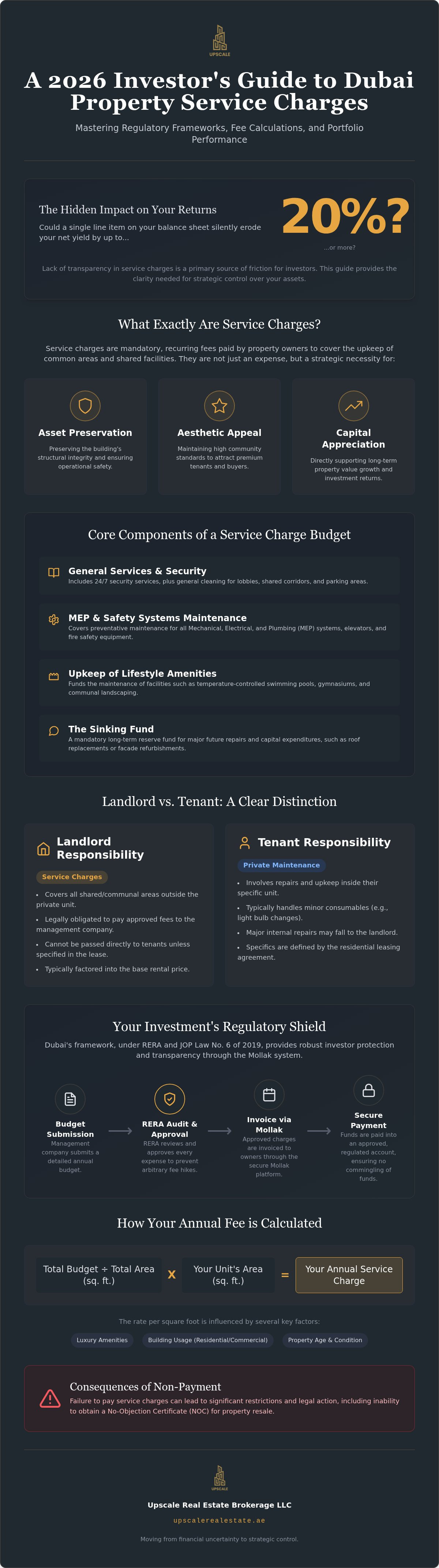
Service charges aren't a single flat fee for one service; they represent a consolidated budget for several critical operational areas. The structure varies depending on whether the property is residential, commercial, or mixed-use, as each has different utility loads and security requirements. Typically, the budget includes:
- General cleaning and 24/7 security services for lobbies, shared corridors, and parking areas.
- Preventative maintenance of mechanical, electrical, and plumbing (MEP) systems, including elevators and fire safety equipment.
- Upkeep of lifestyle amenities such as temperature-controlled swimming pools, gymnasiums, and communal landscaping.
- The sinking fund, which is a mandatory reserve for major future repairs like roof replacements or facade refurbishments.
Service Charges vs. Maintenance Fees
Distinguishing between communal service charges and private unit maintenance is essential for effective portfolio management. Service charges cover everything outside your front door, while private maintenance involves the repair of items inside your specific unit. It's a common point of confusion for new landlords.
- Landlord Responsibility: Owners are legally obligated to pay the approved service charges to the management company. These cannot be passed on to the tenant as a separate bill unless specifically agreed upon in the contract, though they're usually factored into the base rent.
- Tenant Responsibility: Tenants typically handle minor internal maintenance or consumables, such as light bulb replacements or AC filter cleaning, depending on the specific terms of the residential leasing agreement.
- Billing and Frequency: These fees are usually billed quarterly or annually. They are processed through the Mollak system to ensure full visibility and accountability for every transaction.
The Regulatory Framework: RERA, Mollak, and Jointly Owned Property Laws
Regulatory stability is the backbone of Dubai's real estate market. The Real Estate Regulatory Agency (RERA) acts as the enforcement arm of the government, ensuring that every expense item in a building's budget is justified and verified. Under Law No. 6 of 2019, also known as the Jointly Owned Property (JOP) Law, the governance of common areas moved from developers to specialized management companies overseen by RERA. This shift ensures that you, as an investor, aren't subject to the whims of a developer but are protected by a standardized legal framework. Having dubai property service charges explained through this lens of legal protection helps you understand why Dubai remains a global benchmark for investor safety.
All payments for service charges must be made through approved RERA channels to be legally recognized. The system is designed to prevent the commingling of funds, ensuring that the money you pay for your unit's upkeep is used specifically for that purpose. If a management company requests a direct transfer to a personal or unverified corporate account, it's a violation of DLD protocols. Sticking to approved channels is the only way to protect your rights in the event of a future dispute at the Rental Dispute Centre.
How the Mollak System Protects Investors
The Dubai Land Department's Mollak system is a sophisticated online portal designed to provide total financial visibility for property owners. It serves as a centralized hub where all service charge transactions are recorded, monitored, and audited. Before a management company can issue an invoice, they must upload audited financial statements and verified service contracts to the system. RERA then reviews these documents to ensure the proposed fees align with actual operational requirements.
Investors can log into the Mollak portal to verify their specific unit's charges and check the payment status of the entire building. This digital trail eliminates the risk of financial malpractice and ensures that your payments go directly into a RERA-approved escrow account. If you're managing a large portfolio, utilizing professional investment advisory services can help you monitor these digital records to ensure your assets remain in good standing.
RERA Service Charge Index: A Benchmark for Costs
To maintain a competitive investment environment, RERA maintains an official Service Charge Index. This tool allows you to compare the rates of your specific tower against the community average, whether your assets are in Business Bay or Jumeirah Village Circle. It acts as a vital check against artificial inflation. If a management company proposes a rate significantly higher than the index without a valid operational reason, such as a major MEP upgrade, RERA will likely reject the budget during the approval phase.
The RERA Service Charge Index serves as a critical transparency tool for 2026 market stability by providing a standardized benchmark for all property stakeholders. By using this index, you can perform accurate financial modeling and ensure that the service charges for your ready property are fair and sustainable for the long term.
How Service Charges are Calculated and Audited
Precision in financial modeling is the cornerstone of successful real estate investment. In Dubai, the calculation of these fees follows a standardized "Per Square Foot" (PSF) model. To determine your liability, the total RERA-approved budget for the building is divided by the total net area of all units. This ensures that every owner pays a share proportional to the size of their asset. Having dubai property service charges explained through this mathematical lens allows you to forecast your carrying costs with high accuracy before you even finalize a purchase.
Complexity often arises in master-planned communities where multiple layers of management coexist. In these scenarios, a sub-developer or their management company oversees the specific tower, while a master developer manages the broader infrastructure. Your total bill might include a community fee for master-level services like district security and road maintenance; this sits alongside the building-specific charge for internal amenities and MEP systems. Coordination between these entities is strictly regulated to ensure no overlap in billing occurs.
The Auditing Process and Transparency
Accountability is maintained through a rigorous third-party auditing process. Management companies aren't permitted to self-certify their budgets. Instead, they must appoint RERA-approved independent auditors to review all financial records and service contracts. These auditors verify that every expense is necessary and that the funds are managed according to DLD standards. You can use the Official DLD Service Charge Index to verify that your building's audited rates stay within the expected market range for its specific category.
Transparency is a right, not a privilege. As an owner, you can request a detailed breakdown of the annual budget through the Mollak system. This visibility allows you to see exactly how much is allocated to staff, utility bills, and the sinking fund. Professional property management companies act as the executors of this budget, ensuring that service providers meet their contractual obligations without overspending.
Variable Factors: Why Charges Differ Between Buildings
It's common for two towers in the same neighborhood to have vastly different rates. Building age is a primary driver. Older structures often require more frequent and expensive maintenance for their mechanical, electrical, and plumbing (MEP) systems. Additionally, the level of luxury amenities significantly impacts the PSF rate. Features like a 24-hour concierge, valet parking, and rooftop infinity pools require higher staffing levels and utility consumption, which are reflected in the final bill.
Occupancy rates also play a subtle but important role in cost distribution. While the PSF rate is fixed based on the total area, high occupancy can lead to more efficient utility usage or, conversely, higher wear and tear on communal facilities. Strategic investors often look for buildings with a balanced amenity-to-cost ratio to maximize their net yields while maintaining the property's premium status.
Rights and Obligations: Managing Delinquencies and Disputes
Ownership in a jointly owned property carries a statutory duty to contribute to the collective maintenance fund. Under Dubai law, paying approved service charges is a non-negotiable obligation. Having dubai property service charges explained clearly means recognizing that your individual contribution sustains the building's insurance, security, and utility infrastructure. You have the right to demand a RERA-approved budget before making any payment; however, once that budget is verified in the Mollak system, the liability is absolute. Proactive payment ensures the management company can meet its contractual obligations to service providers, which directly protects your unit's market value.
Investors also hold the right to participate in the governance of their community. While RERA regulates the appointment of management companies, owners can voice concerns regarding service quality or financial transparency through official general assembly meetings. If a management company fails to maintain the building to the agreed standards, owners can collectively petition RERA for a review of the management contract. This level of participation ensures that the entities managing your asset remain accountable to those who fund the operations.
Dealing with Service Charge Delinquencies
Failure to meet payment deadlines triggers a structured legal recovery process. Management companies are required to issue a formal 30-day notice period for any outstanding amounts. If the balance remains unpaid after this window, the consequences become severe. RERA has the authority to block all property-related transactions for the specific unit. This means you won't be able to sell the property or obtain a new lease contract until the debt is cleared. Late payment fees may also be applied to the principal balance, further impacting your net yield.
If you face temporary financial hardship, it's advisable to communicate with the management company early. Many are open to negotiating structured payment plans to avoid the costs of litigation at the Rental Dispute Centre. Proactive negotiation can prevent the filing of a legal case and the subsequent blocking of your title deed. Maintaining an open line of communication is a hallmark of professional portfolio management.
Dispute Resolution via the Dubai Land Department
The Dubai Land Department (DLD) provides a robust mechanism for resolving conflicts between owners and management entities. If you believe a fee increase is unapproved or that funds are being misappropriated, you can file a formal complaint through the Dubai Rest app. The Rental Dispute Centre (RDC) handles these cases with specialized judges who understand the nuances of the Jointly Owned Property Law. They have the power to order audits or freeze management accounts if foul play is suspected.
Navigating these legal frameworks is a core component of a successful long-term strategy. Understanding these rights is part of a broader Dubai Real Estate Market Analysis 2026. For landlords who prefer a hands-off approach, our property management services include full handling of service charge audits and dispute resolution to ensure your investment remains compliant and profitable.
Strategic Impact on ROI and Portfolio Management
Service charges represent the most significant recurring expenditure for any landlord after finance costs. While gross rental yields in Dubai remain attractive, your true profitability is dictated by net yield. This figure is calculated by subtracting all operational costs, including management fees and service charges, from your annual rental income. Having dubai property service charges explained as a variable in your financial modeling is the only way to ensure your asset remains a high-performer. A building with a high "per square foot" rate isn't necessarily a poor investment if that capital is used to maintain a premium environment that commands top-tier rents.
The resale value of a ready property is inextricably linked to the health of its service charge fund. Savvy buyers in the 2026 market perform deep due diligence on the building's maintenance history and the status of the sinking fund. If a tower has a history of underfunding or poor maintenance, it becomes a distressed asset that is difficult to exit. Conversely, a building with a transparent, well-managed budget sees higher capital appreciation because the physical asset is preserved, ensuring it remains attractive to both tenants and future investors.
Optimizing Yields through Efficient Management
Proactive maintenance is a primary strategy for cost optimization. It's far more cost-effective to invest in regular MEP servicing than to face a massive, unbudgeted structural repair. Many modern developments are now implementing energy-saving initiatives, such as LED retrofitting and smart HVAC controls for common areas. These upgrades lower the building's total utility consumption, which RERA considers during the annual budget audit. Lower operational costs eventually lead to a more competitive PSF rate for owners, directly boosting your net returns.
Selecting the right asset from the start is equally vital. We advise investors to look for communities with sustainable service charge structures where the amenity-to-unit ratio is balanced. Over-serviced buildings with low occupancy can lead to rising fees as the shared costs are distributed among fewer active owners. Professional investment advisory helps identify these risks before you commit capital.
Advisory: Integrating Service Charges into Your Investment Model
Long-term success requires modeling your ROI over a 5-year or 10-year horizon. You must account for projected fee escalations and the eventual need for major capital works funded by the sinking fund. This level of foresight is a core pillar of Real Estate Portfolio Management in Dubai. Without this data-driven approach, your yields may appear strong on paper but fail to meet targets in practice.
Upscale Real Estate provides specialized support by auditing potential acquisitions for fee transparency. We verify the Mollak records to ensure there are no hidden liabilities or pending legal disputes regarding communal fees. By grounding your strategy in verified data and regulatory compliance, you can build a resilient portfolio that thrives in Dubai's sophisticated real estate landscape.
Securing Your Real Estate Yields through Strategic Oversight
Mastery of the Dubai market requires moving beyond surface-level data to embrace full financial visibility. Having dubai property service charges explained through the lens of RERA compliance and the Mollak system provides the transparency needed to protect your long-term capital. You've seen how accurate "per square foot" modeling and proactive maintenance directly influence your net yield. These fees are the primary mechanism for maintaining asset appreciation and securing high-quality tenants in a competitive landscape.
Managing these regulatory frameworks alone can be complex; having a trusted guide ensures your interests are always prioritized. As a RERA-licensed brokerage (ORN 23084), Upscale Real Estate offers end-to-end property management and specialized ROI modeling for international investors. Consult our Investment Advisory team to optimize your property yields and ensure your portfolio remains resilient. We're here to help you turn operational costs into strategic advantages for your real estate journey.
Frequently Asked Questions
What exactly do service charges cover in a typical Dubai apartment?
Service charges cover the essential maintenance of all communal areas and shared facilities. This includes 24/7 security, cleaning of lobbies and corridors, and the upkeep of lifestyle amenities like swimming pools and gyms. It also accounts for building insurance and the utilities required for common spaces. These fees ensure the building remains in peak condition, which is vital for maintaining high rental demand and long-term asset value.
Can a developer increase service charges without RERA approval?
No, developers or management companies are strictly prohibited from increasing fees without explicit RERA approval. Every proposed budget must be audited by an independent third party and uploaded to the Mollak system for government review. If a hike isn't justified by verified operational costs or audited financial statements, RERA will reject the application. This system provides a layer of security that protects investors from arbitrary or unauthorized price hikes.
How is the sinking fund different from the standard service charge?
The standard service charge handles daily operational expenses like staff salaries and routine cleaning. In contrast, the sinking fund is a mandatory reserve specifically for major capital works and long-term structural repairs. This includes high-cost items like replacing elevators, repairing the roof, or refurbishing the building facade. It acts as a financial safety net, ensuring the building's longevity without requiring sudden, large payments from owners when major repairs arise.
What happens if a tenant refuses to pay the service charges?
Service charges are legally the landlord's responsibility regardless of the tenant's actions. If a lease agreement states the tenant should pay but they refuse, the owner must still settle the bill with the management company to avoid late fees or legal blocks on the title deed. The owner can then file a case at the Rental Dispute Centre to recover those funds from the tenant based on the signed contract terms.
Are service charges applicable to off-plan properties before completion?
No, service charges only become applicable once the property has reached completion and the official handover process has started. During the construction phase, the developer is responsible for all costs associated with the site. Your financial liability begins only after you receive the keys and the building's management budget has been formally approved by RERA for the first operational year.
How can I check the official service charge for a specific building?
You can verify the approved rate by using the Service Charge Index on the Dubai Land Department website or through the Dubai REST app. This digital tool provides dubai property service charges explained through a transparent "per square foot" rate for every registered development in the city. It allows you to perform accurate due diligence by comparing the tower's fees against the community average before finalizing an investment.
Can the Owners Association change the property management company?
Yes, owners have the right to request a change if the management entity fails to maintain the building to the required standards. This process requires a collective decision and must be facilitated through RERA to ensure legal compliance. Owners must demonstrate that the current company hasn't met its contractual obligations or has mismanaged the audited budget. Professional oversight ensures that the transition doesn't disrupt essential services like security or MEP maintenance.
Are service charges higher for commercial properties than residential ones?
Commercial service charges are typically higher due to more intensive operational requirements. Office towers often have higher security needs, greater utility consumption for central cooling, and more frequent wear and tear on elevators and common lobbies. These buildings require specialized maintenance of high-load electrical and plumbing systems to support business operations. When modeling your ROI, it's essential to account for these higher carrying costs to determine the true net yield of the asset.