

What if the space with the most appealing rent creates the greatest strain on your business or property goals? In commercial leasing, the right decision depends on more than the advertised rate. Property use, lease structure, operating costs and contractual responsibilities all shape the value of an agreement. A practical comparison helps you see what the rent does, and does not, include before making a long-term commitment.
This guide explains how to assess commercial space in the UAE, compare lease terms and build a leasing strategy around your objectives, whether you’re seeking premises for a business or leasing property as an owner. You’ll learn how to create a focused shortlist, compare the full occupancy obligations and identify key terms to address during negotiations.
We’ll also outline the steps from initial search through signing, including approvals and jurisdiction-specific requirements that may affect a transaction. With a structured process and clear communication, tenants and landlords can make decisions with greater visibility. Upscale Real Estate Brokerage LLC is a RERA-licensed brokerage, ORN 23084, providing commercial leasing support alongside property management and investment advisory.
Key Takeaways
- Start with your intended use, space needs and business priorities to narrow the search to suitable commercial properties.
- Compare commercial leasing options by reviewing every financial obligation in the agreement, not just the headline rent.
- Check property suitability, operational needs and contractual terms in a set sequence before signing.
- For a more structured process, define your requirements, review options, evaluate terms and progress negotiations with brokerage support.
Commercial Leasing: Define the Business Need Before Searching
Commercial leasing gives a business or other tenant the right to occupy a property for an agreed use and period in return for rent and other agreed obligations. Buying property transfers ownership; leasing provides the right to use space without purchasing the asset. For a business, this can leave capital available for staffing, equipment, inventory or expansion. It also creates an ongoing occupancy commitment that should fit the business’s plans.
Quotable definition: A commercial lease connects three things: the property being occupied, the use permitted under the agreement and the contractual term governing that occupancy.
Tenants and landlords approach the same agreement from different perspectives. A tenant needs space that supports daily operations, with obligations that fit its budget and plans. An owner wants terms that support reliable occupancy and longer-term property objectives. Clear requirements help both sides discuss suitability and terms on a practical basis.
Which commercial property types may suit different operations?
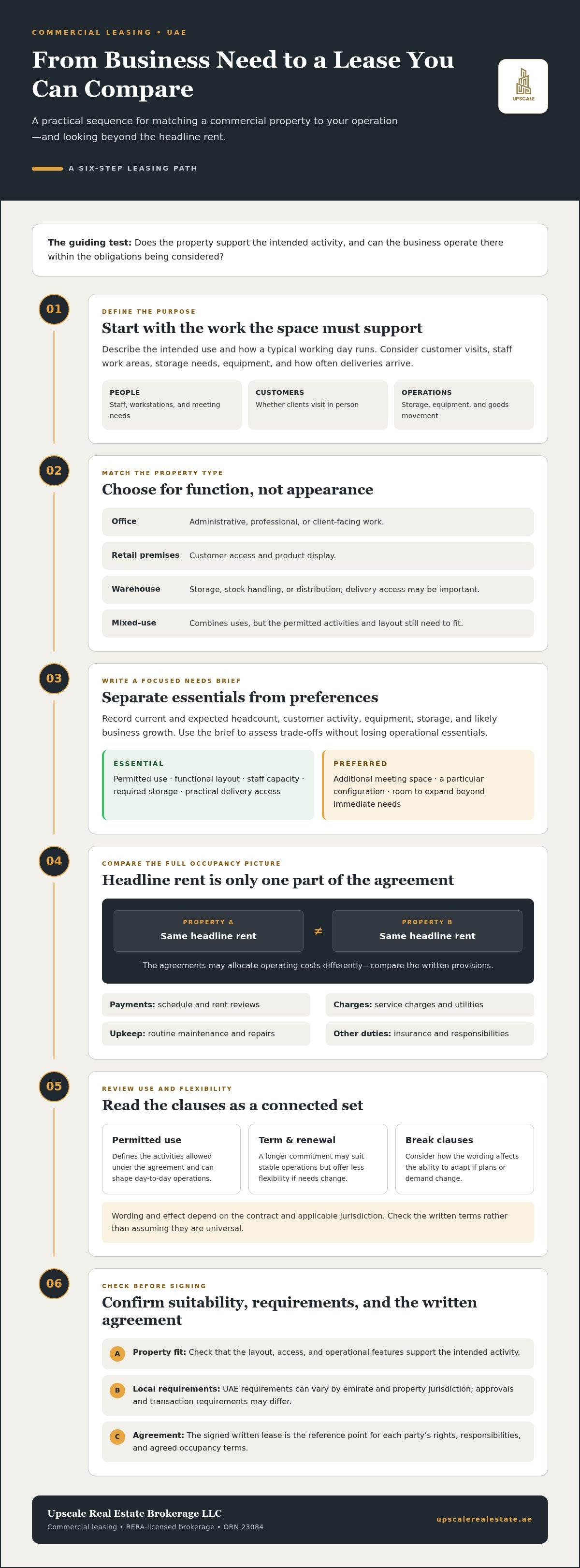
Choose a property type based on the work carried out there, not just its appearance. Offices typically support administrative, professional or client-facing work. Retail premises are designed around customer access and product display. Warehouses can suit storage, stock handling or distribution, where room for goods and delivery access may matter more than a customer-facing entrance. Mixed-use properties combine different uses, but the permitted activities and layout still need to fit the intended operation.
Walk through a typical working day before deciding what matters most. Will customers visit in person? Do staff need workstations or meeting areas? Is secure storage essential? How often will deliveries arrive, and can they be handled efficiently? A retail unit may work for a walk-in business but be unsuitable for an operation that depends on substantial storage or frequent goods movement. A warehouse may offer useful logistics space without meeting an office-based team’s access or workspace needs.
How should a business define its space requirements?
Write a concise needs brief before comparing individual properties. Include current and expected headcount, customer activity, equipment, storage and likely business growth. Then separate non-negotiable requirements from preferences. This makes trade-offs easier to assess without losing sight of operational essentials.
- Essential: permitted use, functional layout, staff capacity, required storage and practical delivery access.
- Preferred: additional meeting space, a particular configuration or room to expand beyond immediate needs.
Add occupancy costs and responsibilities to the brief alongside physical requirements. Headline rent may not capture every payment or duty under a lease. Lease structures differ: an overview of the Net Lease explains how certain net lease arrangements allocate property expenses between landlord and tenant. The allocation depends on the agreement, so note which costs and responsibilities need clarification as you compare properties.
A focused brief gives the search a clear test: does the property support the intended activity, and can the business operate there within the obligations being considered? This helps tenants assess space and gives landlords a clearer picture of a property’s potential fit.
Commercial Lease Terms: Understand What Shapes the Agreement
A commercial lease sets out the conditions under which a tenant occupies a property and the responsibilities each party accepts. Its terms depend on the property, the parties’ agreement, the proposed use and the applicable jurisdiction. In the UAE, requirements can vary by emirate and property jurisdiction, so don’t assume that the same agreement or process applies everywhere.
The signed written agreement is the reference point for each party’s rights, responsibilities and agreed occupancy terms. A listing’s headline rent is only one part of the picture. The lease may also address service charges, utilities, maintenance, insurance, rent reviews and other costs or duties. For example, two properties may advertise the same rent, but their agreements may allocate operating costs differently. Compare the written provisions rather than relying on assumptions based on a listing.
Which financial and operational provisions deserve close attention?
Record the payment schedule and any rent review mechanism, then identify how service charges and utilities are calculated and allocated. Check maintenance clauses to distinguish routine upkeep from responsibility for particular repairs. Insurance provisions may also affect the tenant’s operating plan and the owner’s risk management. For a like-for-like commercial leasing comparison, list each recurring payment and responsibility separately instead of treating rent as the full occupancy cost.
How do permitted use and lease duration affect flexibility?
The permitted use clause describes the activities allowed under the agreement and can shape what a tenant may do day to day. Term length, renewal provisions and break clauses affect how readily the arrangement can adapt if staffing, customer demand or business plans change. These provisions are not universal: their wording and effect depend on the contract and applicable jurisdiction. Consider them together. A longer commitment may suit stable operations but offer less flexibility if requirements change.
How can both parties compare proposals fairly?
Tenants can compare shortlisted properties against operational requirements, including permitted use, access, layout and recurring obligations. Owners can assess each proposal against property objectives, the proposed activity and expected management needs. The highest rent may not represent the strongest overall fit if other terms, responsibilities or communication expectations are less aligned.
| Criteria | Questions to consider | Implications for each party |
|---|---|---|
| Business fit | Does the permitted use and layout support the intended activity? | Tenants assess operational suitability; owners consider the proposed use of the asset. |
| Financial obligations | What rent, charges, utilities and other costs are allocated in writing? | Tenants plan occupancy costs; owners assess the arrangement’s financial contribution and responsibilities. |
| Flexibility | How do the term, renewal and break provisions fit future plans? | Tenants consider potential business changes; owners weigh continuity against their ownership objectives. |
| Ongoing management | Who handles maintenance, insurance matters and communication? | Both parties clarify expectations and plan for the practical demands of the arrangement. |
Owners weighing lease decisions against wider asset goals can use a commercial property investment framework to consider how leasing relates to ownership objectives. A structured review of proposed terms helps tenants and owners move toward an agreement with clearer expectations. For support evaluating commercial property options and lease proposals, explore commercial leasing guidance.
Commercial Leasing Due Diligence: Reduce Surprises Before Signing
A disciplined review separates what the property can support from what the contract requires. In the UAE, leasing, registration and approval processes can differ by emirate and property jurisdiction. Use the steps below as a working sequence, then align the transaction with requirements that apply to the specific property and intended use.
Before signing, check the property’s suitability, permitted use, access and services, financial obligations, responsibilities, key dates, local processes and final contract wording.
- Screen the opportunity. Compare the property’s stated use and basic features with the business’s operational needs. Identify immediate mismatches, such as access arrangements that don’t support customer visits or delivery requirements, before spending time on a detailed review.
- Assess the property in practice. Review the layout, access, building services and condition against the intended activity. Consider how staff, customers, equipment and goods will use the premises. Clarify practical handover expectations, including the property’s expected condition and what will be available at occupancy.
- Map operational and local requirements. Confirm that the proposed activity aligns with the stated permitted use, and identify any approvals or registration steps relevant to the property’s jurisdiction. Keep the review specific: processes may differ across the UAE, so don’t assume a requirement or timeline applies nationally.
- Build the occupancy plan. Record the payment schedule, recurring charges, utilities, maintenance responsibilities and other agreed obligations in one plan. Add key dates, such as payment deadlines, handover milestones and notice periods stated in the draft. This gives the business a clear view of its practical commitments.
- Review the draft against the negotiations. Compare each clause with the commercial terms discussed and the operational needs identified. Check permitted use, duration, renewal or break provisions, responsibilities and payment obligations. Resolve discrepancies in the written draft before signing. A verbal understanding won’t provide the same clarity as accurately recorded terms.
Tenants should involve the people who will manage the space day to day when reviewing access, services and handover expectations. A detail that seems minor during a property visit may become an operational issue if it affects deliveries, equipment use or staff routines. Keep a record of questions and agreed responses so they can be addressed during negotiations and reflected in the final documents where appropriate.
Landlords can support a transparent process by organising property information, proposed terms and relevant ownership documentation before discussions progress. Set out property responsibilities and communication expectations clearly. As terms change during negotiations, maintain a single record of the agreed position and compare it with the final contract. This helps reduce confusion between earlier drafts and the terms both parties intend to sign.
For a structured commercial leasing process, from property review through negotiation, explore commercial leasing support.
Upscale Commercial Leasing Support: Move from Search to Agreement
Commercial leasing involves decisions on both sides of the agreement. Businesses need premises that support their operations, while property owners need a leasing arrangement aligned with ownership objectives and ongoing responsibilities. Upscale Real Estate Brokerage LLC supports tenants and landlords through a structured process focused on clear communication, informed comparisons and the client’s stated goals.
The process moves through four practical stages:
- Define the requirements. Clarify the tenant’s intended use, operational priorities and preferred terms, or the owner’s property objectives and expectations for a leasing arrangement.
- Review the options. Organise relevant property choices around the requirements, so discussions stay focused on suitability rather than disconnected features.
- Evaluate the terms. Compare proposed obligations and flexibility against the client’s priorities. Make trade-offs visible and identify points that need further discussion.
- Progress negotiations. Keep communication organised as the parties work through terms and move toward an agreement that reflects the negotiated position.
How does brokerage guidance support a more considered lease?
A clear brief gives property discussions a useful reference point. For a business, that may mean prioritising customer access or an operational layout over a feature that is simply attractive. For an owner, it may mean weighing a proposal against intended use, property oversight and longer-term plans. Comparing options against agreed criteria makes the trade-offs easier to see.
Negotiation support can bring structure to questions about responsibilities, flexibility and written terms. It helps clarify what each party is discussing without promising a particular outcome. Where leasing forms part of a wider ownership strategy, the property portfolio management guide offers context on connecting property decisions with longer-term objectives.
What can property owners consider after leasing begins?
Signing marks the start of the landlord-tenant relationship, not the end of property oversight. Clear communication about responsibilities helps both parties understand how maintenance matters are raised, coordinated and followed through. Owners can also consider how tenant relations and property management fit into their broader approach to the asset.
For practical ownership planning, the landlord maintenance checklist provides a related reference. Upscale’s commercial leasing and property management services connect transaction decisions with ongoing property considerations. As a RERA-licensed brokerage with ORN 23084, Upscale brings a transparent approach to leasing discussions.
Discuss your commercial leasing requirements with Upscale Real Estate Brokerage to frame the next steps around your business or property objectives.
Set Your Leasing Decision in Motion
A commercial lease can shape how a business operates and how an owner manages an asset well beyond the signing date. Treat signing as the start of an ongoing decision process: keep your objectives visible, assign responsibility for key dates and obligations, and revisit the arrangement as business or property priorities evolve.
For tenants, that means choosing space with a clear view of how it supports day-to-day work and future plans. For landlords, it means considering how the leasing arrangement fits wider ownership goals and ongoing oversight. A considered approach to commercial leasing gives both parties a stronger foundation for clear communication and practical decisions.
Upscale Real Estate Brokerage LLC is a RERA-licensed brokerage, ORN 23084, with commercial leasing, property management and investment advisory services. Discuss your commercial leasing requirements with Upscale Real Estate and take the next step with a strategy shaped around your objectives.
Frequently Asked Questions
How long should a commercial lease be?
Choose a lease term that fits the business’s planning horizon and need for flexibility. A business expecting stable operations may value longer occupancy certainty, while one anticipating changes in staffing or space needs may prioritise renewal options or a break clause. Compare the commitment with forecast growth and the time needed to establish operations. Check how the agreement handles renewal, notice and exit before deciding.
Can a tenant sublease commercial space in the UAE?
A tenant should sublease only if the lease and applicable requirements allow it, and after obtaining any required landlord consent. Review the agreement for restrictions on subletting, assignment, sharing occupation or changing the permitted use. A sublease also raises practical questions: who remains responsible to the landlord, how the subtenant’s activities are controlled and what happens when the main lease ends. Record approvals and responsibilities in writing before the arrangement begins.
How much does commercial leasing cost?
There’s no single cost for commercial leasing. The amount depends on the property and agreed terms, and can include rent alongside charges, utilities, insurance or maintenance obligations allocated to the tenant. A business may also need to plan for moving, equipment installation and any approved work to prepare the premises. Build a cost schedule from the draft agreement, and distinguish recurring payments from one-time setup expenses before committing.
Is VAT charged on commercial property rent in the UAE?
Commercial property rent in the UAE is generally subject to VAT at the standard 5% rate when the supply is taxable and the landlord is required to account for VAT. The lease documentation and tax invoice should make the VAT treatment clear. Because the outcome can depend on the transaction and the parties’ tax status, don’t assume the rent figure includes VAT. Review the stated treatment against current UAE tax rules before finalising your occupancy budget.
What documents are usually needed to lease commercial property?
Landlords commonly request documents to identify the tenant, establish its legal status and confirm who can sign. A business may be asked for its trade licence, company formation or registration documents, identification for authorised signatories and evidence of signing authority. Requirements can vary with the property, landlord and jurisdiction. Prepare a current document set and ensure the proposed tenant name matches the entity that will enter the lease.
Can a tenant make fit-out changes to leased commercial space?
Usually, a tenant should obtain the landlord’s written approval before making alterations, and determine whether any separate approvals apply to the proposed work. The lease may distinguish removable equipment from changes to fixed elements, and may set conditions for reinstatement at the end of the tenancy. Submit a clear description of the proposed changes, their scope and timing, then retain written approvals with the lease records before work starts.
What happens if a business needs to end a commercial lease early?
The consequences depend on the lease wording and applicable requirements. Check for a break clause, notice period, conditions for exercising an early exit and any stated financial consequences. If no exit right applies, the tenant shouldn’t assume it can end the agreement without further obligations. Discuss the situation with the landlord, document any agreed surrender or replacement arrangement in writing, and plan for handover, outstanding payments and return of the premises.