

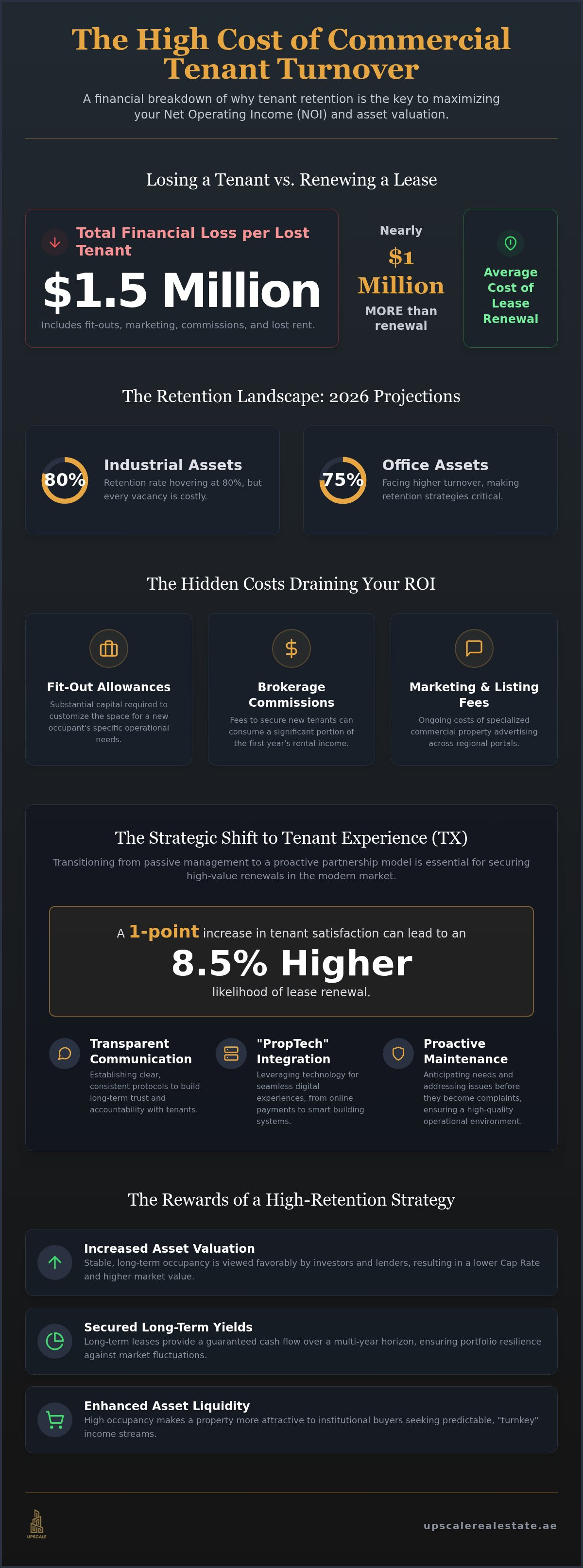
A single lost commercial tenant can result in a total financial loss of $1.5 million, which is nearly $1 million more than the average cost of a lease renewal. With industrial retention rates hovering at 80% and office assets at 75% in 2026, the financial stakes of vacancy have never been higher. You likely recognize that high turnover costs and evolving expectations for green certifications are the primary threats to your net operating income. It's a challenge to maintain stable yields when communication gaps lead to non-renewals and unexpected fit-out expenses.
This guide provides the frameworks and professional management tactics required to implement effective tenant retention strategies for commercial properties. We promise to show you how to minimize turnover and maximize long-term yields through transparent advisory and disciplined asset modeling. We will examine the shift toward proactive maintenance, the impact of ESG standards on asset valuation, and the specific communication protocols that build lasting partnerships with your tenants. By the end of this article, you'll have a clear roadmap to reduce administrative burdens and secure the long-term appreciation of your commercial portfolio.
Key Takeaways
- Identify the hidden financial impact of turnover by quantifying the direct costs associated with fit-outs, marketing, and brokerage commissions.
- Transition from standard property management to a "Tenant Experience" (TX) model that utilizes transparent communication protocols to build long-term trust.
- Learn how professional tenant retention strategies for commercial properties and third-party advisory services can optimize your yield modeling and asset valuation.
- Explore how to leverage ESG initiatives and strategic lease restructuring to attract and retain high-value corporate tenants in the 2026 market.
- Establish a standardized retention playbook that combines national scaling with "on the ground" mastery of local regulatory requirements.
The Economics of Retention: Why Turnover is the Silent ROI Killer
Commercial tenant retention isn't a "soft" management goal; it's a critical financial metric that dictates the long-term health of your investment. When a lease expires without a renewal in the competitive UAE market, the resulting vacancy triggers a cascade of expenses that immediately erode your Net Operating Income (NOI). Implementing effective tenant retention strategies for commercial properties is the most direct way to protect your capital and ensure consistent cash flow. In 2026, where competition for high-quality occupants in prime business hubs is fierce, understanding the math behind turnover is essential for any serious investor.
The visible costs of turnover are often just the tip of the iceberg. Landlords must account for several heavy financial burdens when a unit goes dark:
- Brokerage Commissions: Fees paid to secure a new tenant can consume a significant portion of the first year's rent, particularly for high-value office spaces.
- Fit-out Allowances: Capital required to customize the space for a new occupant's specific operational needs can be substantial, often requiring a complete strip-out of the previous tenant's modifications.
- Marketing and Listing Fees: The ongoing cost of specialized commercial property advertising and professional listings across regional property portals.
Beyond these immediate cash outflows, turnover impacts your property's terminal value. Investors and lenders view frequent vacancies as a sign of operational instability. This perceived risk often leads to a higher Cap Rate during appraisal, which directly lowers the asset's market valuation. Stable occupancy is the foundation of a premium valuation and a secure exit strategy.
Quantifying the Cost of a Vacant Commercial Unit
A vacant unit represents much more than just a lack of rent. You're also responsible for unrecovered operating expenses and service charges, such as security and insurance, which a tenant would typically cover under a net lease. There's also a significant "hidden" cost in the management time required to vet new applicants and oversee complex legal documentation. Frequent vacancies signal to the market that your asset may have underlying issues, potentially deterring institutional-grade investors who prioritize predictability and grounded data over speculative gains.
The Correlation Between Retention and Yield Appreciation
Long-term leases significantly improve the risk profile of your asset by providing a guaranteed cash flow over a multi-year horizon. High occupancy levels enhance asset liquidity by making the property more attractive to buyers who seek "turnkey" income streams. Utilizing professional real estate portfolio management allows you to model these long-term outcomes and see exactly how a small increase in retention leads to a substantial rise in total yield. By treating retention as a strategic advisory function, you ensure your portfolio remains resilient against market fluctuations and continues to appreciate in value.
Core Pillars of Commercial Tenant Satisfaction and Experience
The standard model of passive asset oversight is no longer sufficient to secure high-value renewals. To implement successful tenant retention strategies for commercial properties in 2026, investors must transition from traditional property management to a "Tenant Experience" (TX) framework. This shift treats the occupant as a strategic partner rather than a mere source of rent. Research indicates that a one-point increase in tenant satisfaction can lead to an 8.5% higher likelihood of lease renewal. By prioritizing the operational environment, you directly influence the longevity of your cash flow.
Leveraging technology is a fundamental requirement in this new landscape. Modern tenants expect seamless digital experiences, from online payments to efficient maintenance requests via dedicated platforms. Integrating "PropTech" like smart building systems and AI analytics doesn't just improve efficiency; it provides the data needed to understand tenant behavior and anticipate their needs before they become complaints.
Building Trust Through Transparent Communication
Reliable partnerships are built on visibility and accountability. Establishing transparent communication protocols means moving beyond the occasional email to structured, regular touchpoints. This includes implementing annual satisfaction surveys and maintaining clear documentation for Service Level Agreements (SLAs). When tenants understand the specific metrics of building performance and see honesty in service charge allocations, their sense of security increases. Providing this level of clarity reduces the communication gaps that often lead to non-renewals. If you require assistance in auditing your current communication frameworks, our team provides expert investment advisory to help align your management practices with international standards.
Maintenance as a Retention Tool
Poor maintenance is consistently cited as a top reason for tenant dissatisfaction. Moving from reactive repairs to proactive, preventative maintenance schedules is a critical differentiator for modern assets. In 2026, tenants expect their physical workspace to mirror their corporate values of efficiency and reliability. This requires a disciplined approach to facility management:
- Systematic Audits: Conducting regular inspections of critical systems like HVAC and elevators to address issues before tenants are impacted.
- Service Request Efficiency: Ensuring that all maintenance tickets are tracked and resolved within documented timelines.
- Infrastructure Upgrades: Maintaining the property to 2026 standards for commercial efficiency, including high-speed connectivity and energy-efficient systems.
A well-maintained property does more than just look professional; it supports the day-to-day operations of your tenants. When a building functions flawlessly, it becomes an indispensable part of their success. This operational excellence makes the decision to renew a logical business choice rather than a point of negotiation.
Leveraging Professional Commercial Property Management Services
Professional management is the bridge between a static asset and a high-yield portfolio. While the financial impact of turnover and the importance of tenant experience are now clear, executing these frameworks requires a specialized skill set. Professional commercial property management services offer more than just administrative support. They provide a strategic layer of advisory that aligns daily operations with your long-term investment goals. For many investors in the UAE, the choice between in-house management and third-party advisory is the difference between reactive troubleshooting and proactive wealth preservation.
Third-party experts bring a level of local mastery that's difficult to replicate internally. These professionals have access to national market data, allowing them to benchmark rental rates and incentives against current 2026 trends across the UAE. This visibility ensures you aren't over-leveraging your position or missing opportunities to secure early renewals. Additionally, the regulatory landscape is increasingly complex. With evolving mandates from the Real Estate Regulatory Agency (RERA) and enhanced Anti-Money Laundering (AML) reporting requirements, maintaining full compliance is a full-time necessity. A RERA-licensed firm, such as one with ORN 23084, provides the security and accountability required to navigate these legal nuances safely.
The Advisory-Led Approach to Management
A professional manager acts as a strategic consultant rather than a mere middleman. By implementing sophisticated tenant retention strategies for commercial properties, they can predict occupant needs before they escalate into lease disputes. This advisory-led model involves regular portfolio reviews and yield modeling to ensure each asset is performing at its peak. It significantly reduces your administrative burden. You maintain full visibility through transparent reporting while the management team handles the granular details of tenant relations and service level agreements.
Data-Driven Decision Making in Leasing
Success in the 2026 commercial market depends on data over intuition. Professional managers utilize national occupancy trends to inform renewal strategies, ensuring that lease terms are both competitive and profitable. They also optimize service charge recovery, ensuring that operating expenses are managed with integrity and transparency. Integrating professional commercial property management into your broader asset strategy allows for more accurate financial modeling. This approach ensures that every maintenance schedule and tenant touchpoint is designed to support the ultimate goal: stable cash flow and long-term capital appreciation.
Advanced Retention Tactics: From ESG to Lease Restructuring
Securing high-value renewals in 2026 requires a shift toward sophisticated, value-add incentives. While previous sections established the importance of communication and data, advanced tenant retention strategies for commercial properties focus on aligning your asset with the modern corporate mandate. Today's tenants don't just look for space; they look for strategic partners who facilitate their sustainability goals and business growth. By implementing ESG initiatives and creative lease restructuring, you can maintain premium rental rates while fostering deep-rooted loyalty.
ESG and Sustainability as a Competitive Advantage
Environmental, Social, and Governance (ESG) considerations are no longer optional for institutional-grade tenants. Properties that carry green certifications, such as LEED or ENERGY STAR, are currently commanding higher market values and attracting a more stable class of corporate occupants. These upgrades do more than satisfy regulatory requirements; they directly reduce tenant utility costs, which improves their overall affordability without lowering your base rent. Green lease clauses are an effective way to codify these benefits, ensuring that both the landlord and the tenant share the financial gains of energy efficiency. If your portfolio requires a sustainability audit to remain competitive, our investment advisory team can help you model the ROI of these critical upgrades.
Sustainability also plays a pivotal role in corporate wellness. Modern office layouts now prioritize air quality, natural lighting, and adaptable spaces that support hybrid work models. Investing in these physical enhancements creates an environment that tenants are reluctant to leave, as the cost of replicating such a high-performance workspace elsewhere is often prohibitive.
Creative Lease Structuring and Incentives
Retaining a growing business requires flexibility. Instead of offering flat rent discounts, consider tiered expansion options or a right-of-first-refusal on adjacent spaces. These terms provide tenants with the security to grow within your portfolio, preventing them from seeking larger premises elsewhere. Another effective tactic is the "fit-out refresh" allowance. By providing a capital injection for cosmetic or technology upgrades at the time of renewal, you provide immediate value that enhances the tenant's daily operations while simultaneously maintaining the quality of your asset.
Balancing rental appreciation with tenant affordability is a delicate process. Utilizing professional yield modeling allows you to structure incentives that protect your long-term appreciation while addressing the tenant's immediate cash flow constraints. This advisory-led approach ensures that every lease renewal is a win-win scenario, reinforcing the stability of your commercial assets in a shifting national market.
Implementing a National Strategy for Long-Term Occupancy
Scaling success across a diverse commercial portfolio requires moving beyond asset-level tactics to a standardized management framework. While individual efforts like ESG upgrades or lease restructuring are effective, their impact is maximized when integrated into a comprehensive national strategy. Transitioning to a portfolio-wide model ensures that your tenant retention strategies for commercial properties are consistent, measurable, and aligned with your broader financial objectives. In the 2026 UAE market, fragmented management is a liability that leads to operational leakage and inconsistent yields across different emirates.
Effective scaling relies on a combination of centralized data and "on the ground" mastery of the local landscape. While technology provides the visibility needed to track occupancy trends, local regulatory expertise remains indispensable for maintaining institutional-grade standards. Whether navigating the latest RERA circulars or managing specific disclosure requirements for free-zone versus mainland assets, a professional partner ensures your portfolio remains compliant and secure. Upscale Real Estate Brokerage LLC acts as your Trusted Guide, providing the local mastery required to execute complex management protocols with absolute integrity and transparency.
Standardizing Excellence Across Assets
Developing uniform Tenant Experience (TX) standards is the first step toward reducing operational friction. Regardless of the property grade or its location in a primary business district, tenants should experience the same level of transparent communication and proactive service. Centralizing your data allows for better visibility into portfolio performance, making it easier to identify which assets require strategic intervention before a lease expiration occurs. By partnering with a professional firm, you move away from reactive troubleshooting and toward a disciplined, advisory-led model that prioritizes long-term appreciation over short-term fixes.
Partnering for Strategic Growth
Professional investment advisory services do more than just manage buildings; they optimize your entire capital structure. By integrating sophisticated yield modeling with day-to-day operational excellence, you position your commercial assets for maximum market valuation. This strategic partnership allows you to focus on high-level portfolio growth while we handle the granular complexities of tenant relations and regulatory adherence. If you're ready to stabilize your cash flow and reduce the administrative burden of turnover, the next step is a comprehensive audit of your current holdings. Contact Upscale Real Estate Brokerage LLC for a portfolio review to align your assets with 2026 market standards.
- Does your current renewal rate meet or exceed the 2026 national average for your specific asset class?
- Are your properties equipped with the ESG and sustainability features required by modern corporate tenants?
- Do you have a documented communication protocol that includes regular feedback loops and satisfaction surveys?
- Is your maintenance schedule strictly preventative, or are you still relying on reactive repairs?
- Are your lease structures flexible enough to accommodate the growth and shifting operational needs of your occupants?
Securing Your Portfolio’s Future Through Strategic Retention
Commercial asset management in 2026 is no longer about simple rent collection. It's about protecting your Cap Rate and Net Operating Income through disciplined, data-driven frameworks. We've explored how turnover acts as a silent ROI killer and why the transition to a "Tenant Experience" model is essential for maintaining long-term occupancy. Implementing proactive maintenance and ESG initiatives creates a competitive advantage that corporate occupants value, ensuring your assets remain resilient against market fluctuations.
By adopting comprehensive tenant retention strategies for commercial properties, you transform your real estate into a stable, high-yield investment vehicle. Successful execution requires more than just oversight; it requires a partner with deep expertise in national real estate regulatory frameworks and a commitment to transparent, data-driven management reporting. Our team provides expert investment advisory for national commercial portfolios, ensuring your strategy is grounded in visibility and accountability. Optimize your commercial asset retention with Upscale Real Estate today. Your portfolio’s long-term appreciation starts with the strategic partnerships you build today.
Frequently Asked Questions
What is a healthy tenant retention rate for commercial properties in 2026?
A healthy retention rate depends on the asset class, with industrial properties currently averaging approximately 80% and office assets reaching around 75%. Retail properties generally see lower averages near 70%. Maintaining these benchmarks is critical for stabilizing cash flow and ensuring the long-term appreciation of your commercial portfolio.
How much does it typically cost to replace a commercial tenant?
Replacing a commercial tenant can cost nearly $1 million more than the expense of a lease renewal, as evidenced by recent case studies in major markets. These costs include brokerage commissions, professional marketing, and substantial fit-out allowances for the new occupant. Vacancy also forces the landlord to cover unrecovered operating expenses that would otherwise be paid by a tenant.
Can professional commercial property management services actually lower my expenses?
Professional management services lower overall expenses by implementing proactive maintenance schedules that prevent costly emergency repairs and system failures. Expert managers also optimize service charge recovery and utilize national market data to ensure rental rates remain competitive. This advisory-led approach reduces the administrative burden while protecting the asset's net operating income.
How do ESG initiatives impact commercial tenant retention?
ESG initiatives improve retention by aligning your property with the corporate sustainability mandates of premium institutional tenants. Energy-efficient upgrades and green certifications directly lower occupant utility costs, which enhances overall affordability without requiring a base rent reduction. These tenant retention strategies for commercial properties ensure your asset remains a preferred choice for modern businesses.
What are the most effective lease renewal incentives for office tenants?
The most effective incentives include fit-out refresh allowances and flexible lease structures that accommodate future business growth. Providing tiered expansion options or a right-of-first-refusal on adjacent space gives tenants the security to remain in your building as their needs evolve. These strategic incentives build long-term loyalty more effectively than simple rent discounts.
How often should I conduct tenant satisfaction surveys?
You should conduct formal tenant satisfaction surveys at least once per year to establish a reliable data-driven feedback loop. Supplementing these annual reviews with quarterly touchpoints ensures that operational issues are identified and resolved before they impact lease renewal negotiations. Regular communication is a pillar of a successful "Tenant Experience" framework.
What is the role of technology in modern tenant retention strategies?
Technology streamlines the "Tenant Experience" by providing digital platforms for seamless service requests, payments, and document management. Advanced tenant retention strategies for commercial properties also utilize smart building systems and AI analytics to monitor asset performance and anticipate maintenance needs. This tech-enabled transparency builds trust and improves day-to-day operational efficiency.
How does professional advisory help in lease restructuring?
Professional advisory services use sophisticated yield modeling to ensure lease restructuring protects the asset's long-term valuation while addressing tenant affordability. Consultants provide the market insights needed to negotiate tiered terms or expansion options that secure occupancy during shifting economic cycles. This strategic guidance ensures that every lease modification supports your broader portfolio goals.