
Could a single overlooked clause in your commercial property lease agreement dubai be the difference between a high-performing asset and a costly legal stalemate? Many investors enter the UAE market with a focus on capital appreciation, only to find their yields eroded by unexpected service charge escalations or disputes over maintenance responsibilities. It's a common challenge to reconcile the ambition of a strategic investment with the granular demands of local regulatory compliance.
We understand that transparency and visibility are the foundations of any successful partnership. You've likely felt the pressure of navigating complex registration processes or the frustration of unpredictable overheads. This guide serves as your steady hand, offering a professional framework designed to protect your capital and optimize long-term yields. We've moved beyond simple brokerage to provide an advisory-led approach that prioritizes your stability in an evolving landscape.
This strategic 2026 guide breaks down the essential components of a legally robust lease. We'll explore how to secure predictable overheads, ensure seamless Ejari registration, and align your contracts with the latest RERA regulations to maintain total control over your commercial portfolio.
Key Takeaways
- Understand how to treat your commercial property lease agreement dubai as both a regulatory requirement and a strategic asset to ensure long-term stability.
- Learn to align "Permitted Use" clauses with specific trade licenses to avoid operational delays and regulatory friction.
- Evaluate the financial impact of Gross versus Net lease structures on your total investment yield and service charge obligations.
- Master essential due diligence steps, including title deed verification, to protect your capital before finalizing any binding agreements.
- Discover how professional advisory services streamline the transition from initial negotiation to seamless Ejari registration and asset management.
The Fundamentals of a Commercial Property Lease Agreement in Dubai
Understanding The Fundamentals of a Commercial Property Lease Agreement is the first step toward securing a high-value asset in this market. A commercial property lease agreement dubai is a legally binding contract that connects a landlord with a business entity. It's more than a simple occupancy permit; it's a strategic partnership grounded in strict regulatory compliance. The Dubai Land Department (DLD) provides the overarching governance for these contracts, ensuring that every agreement adheres to established standards. Unlike residential leases, commercial agreements involve higher stakes regarding fit-out permissions, utility load requirements, and trade license alignment. This distinction is critical because commercial tenancies are often tied to the tenant's ability to operate legally within the emirate.
Legal Frameworks and Regulatory Compliance
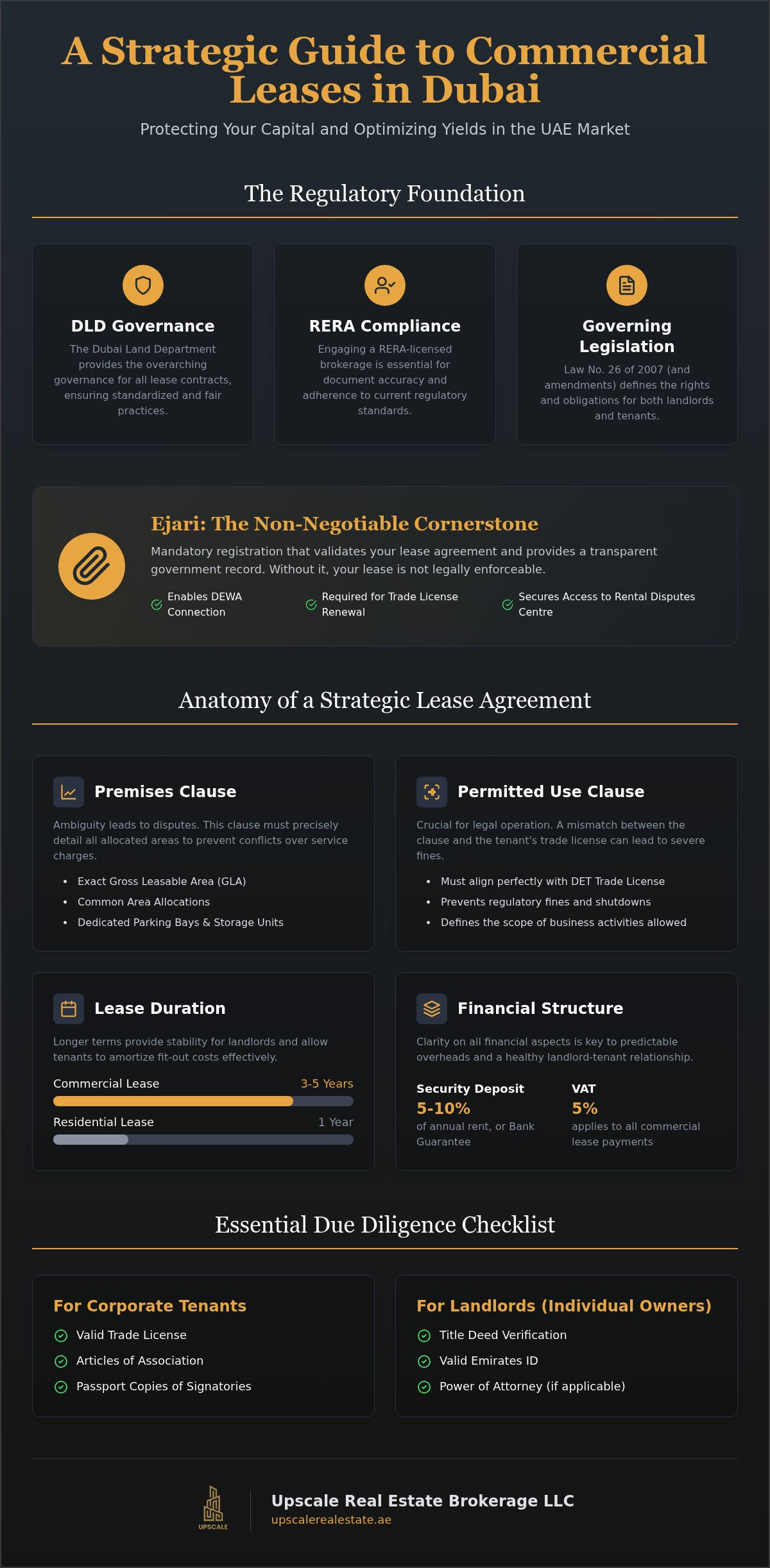
The primary legislation governing these tenancies is Law No. 26 of 2007, as amended by Law No. 33 of 2008. These laws define the rights and obligations of both parties, particularly regarding renewal terms and eviction protocols. Engaging a RERA-licensed brokerage (ORN 23084) is essential to ensure document accuracy and adherence to current standards. For corporate entities, mandatory documentation includes a valid trade license, the company's Articles of Association, and passport copies of authorized signatories. Individual owners must provide a title deed and a valid Emirates ID. This meticulous approach to documentation prevents future disputes and secures the legal standing of the asset. It's also vital to note that commercial leases often demand specific "Permitted Use" clauses that match the tenant's trade license activity to avoid operational fines.
Ejari Registration and Its Strategic Importance
Ejari registration is the non-negotiable cornerstone of the Dubai real estate sector. It's a mandatory system that validates the lease agreement and provides a transparent record for the government. Without an active Ejari certificate, a business cannot connect utility services through DEWA or renew its trade license. From a strategic perspective, Ejari acts as a safeguard. It ensures that the terms of your commercial property lease agreement dubai are enforceable if a dispute arises at the Rental Disputes Centre (RDC). Professional real estate management dubai ensures this registration is handled accurately, linking the lease to the correct plot and unit identifiers to maintain operational continuity and yield protection.
Essential Clauses in a Strategic Commercial Lease Agreement
Precision is the foundation of a high-value commercial property lease agreement dubai. A strategic contract begins with a robust "Premises" clause. This must detail the exact Gross Leasable Area (GLA) and specify the allocation of common areas, storage units, and dedicated parking bays. Ambiguity here often leads to disputes over service charge contributions. Equally critical is the "Permitted Use" clause. This section must align perfectly with the tenant's Department of Economy and Tourism (DET) trade license activities. If a business operates outside these defined parameters, it risks significant regulatory fines or even a forced shutdown by local authorities.
Investors should prioritize long-term stability when defining the lease duration. While residential terms are often annual, commercial agreements typically span three to five years. This duration allows the tenant to amortize fit-out costs while providing the landlord with predictable cash flow. For security, most landlords require a deposit of 5% to 10% of the annual rent. However, modern structures often utilize bank guarantees as a liquid alternative to cash deposits, offering a sophisticated layer of security for high-value assets. If you require assistance in structuring these complex terms, our commercial leasing experts provide the advisory-led support necessary for secure transactions.
Rent and Payment Structures
Commercial rent is typically paid via post-dated cheques, with a frequency of one, two, or four installments per year. It's vital to remember that a 5% Value Added Tax (VAT) applies to all commercial lease payments and must be clearly accounted for in the contract. Transparency regarding who handles the VAT registration and payment to the Federal Tax Authority (FTA) prevents administrative friction. In the 2026 market, rent escalation clauses are increasingly structured around fixed annual percentages or specific RERA Rental Index benchmarks to ensure long-term visibility for both parties.
Maintenance and Fit-out Responsibilities
A common point of contention is the distinction between structural and minor maintenance. Generally, the landlord remains responsible for the building's structure and core systems, while the tenant handles internal repairs and upkeep. A major SERP gap in many guides is the failure to distinguish between the lease commencement date and the rent commencement date. A strategic commercial property lease agreement dubai includes a "Fit-out Period." This is a negotiated rent-free window, often ranging from 30 to 90 days, allowing the tenant to customize the office or retail space before operations begin. Finally, the "Restoration" clause must specify whether the property is to be returned in its original "shell and core" state or in its improved condition at the end of the term.
Evaluating Lease Structures: Gross vs. Net and Market Standards
Selecting the appropriate financial structure for a commercial property lease agreement dubai is a strategic decision that directly influences the net operating income (NOI) of an asset. In a Gross lease, the tenant pays a fixed, all-inclusive rate. The landlord remains responsible for all operating expenses, including service charges, insurance, and property taxes. This model is often preferred by small businesses for its predictability. However, institutional-grade commercial assets typically utilize Net lease structures. The "Triple Net" (NNN) lease is the market standard for high-value portfolios, where the tenant pays a base rent plus their proportionate share of building insurance, real estate taxes, and maintenance costs. This shifts the risk of rising service charges from the landlord to the tenant, protecting the investment yield over long durations.
Financial Modeling for Commercial Tenants
A sophisticated investor looks beyond the headline rent to calculate the Total Cost of Occupancy (TCO). This modeling is essential for maintaining liquidity and ensuring the business remains viable within the chosen premises. When budgeting, stakeholders must account for several mandatory overheads:
- Utility security deposits with DEWA.
- District cooling charges, which can vary significantly by community.
- Annual Ejari registration fees, currently set at AED 177.75 for online applications.
- The standard 5% VAT applied to all commercial transactions.
Understanding Service Charges and HOA Roles
Service charges are calculated based on Dubai Land Department standards and are managed through the Mollak system to ensure transparency. These charges often include Master Community fees, which fund the upkeep of shared infrastructure like roads, landscaping, and security. For a commercial property lease agreement dubai to remain stable, there must be absolute visibility regarding service charge audits. Landlords who provide detailed disclosures regarding these costs foster a sense of long-term partnership. Adhering to a landlord property maintenance checklist dubai ensures that these funds are being used effectively to preserve the asset's physical integrity and market value. This disciplined approach prevents the "yield erosion" that occurs when maintenance is neglected, protecting the landlord's capital appreciation and the tenant's operational environment.
Strategic Negotiation and Due Diligence for Corporate Entities
Negotiation is the phase where an investor moves from broad market data to specific asset protection. Securing a commercial property lease agreement dubai requires a methodical four-step due diligence process. First, you must verify the landlord's ownership status through the Dubai REST app to ensure the title deed is current and free of encumbrances. Second, assess the property's zoning; a retail license cannot operate in an office-zoned unit, regardless of the contract's internal language. Third, negotiate a "Right of First Refusal" (ROFR), which grants you the first opportunity to lease adjacent units or even purchase the property if it goes to market. Finally, define clear "Force Majeure" events to protect your business against unforeseen disruptions, a practice that has become standard in the 2026 market.
Mitigating Risks in Commercial Tenancies
Corporate entities often require flexibility that standard contracts lack. If you operate under a holding structure, ensure the agreement explicitly allows for sub-leasing to subsidiaries or affiliates without additional landlord consent fees. Branding is another high-stakes area; the lease must clearly state your rights to exterior signage and the specific dimensions allowed by the building management. Failure to verify a title deed's authenticity in commercial transactions can result in the total loss of fit-out investments if the contract is later deemed invalid by the Land Department.
Renewal and Termination Rights
Strategic agility depends on well-defined exit and renewal pathways. A standard 90-day notice period for non-renewal is the baseline, but corporate tenants often negotiate for six months to allow for complex relocation logistics. Negotiating an "Early Termination" clause, typically involving a penalty of two to three months' rent, provides a vital safety net if market conditions shift. Insights from ready property sales show that properties with clearly defined, transferable lease terms often hold higher market value and offer smoother transitions. To ensure your contract is optimized for both operational success and future exit strategies, consult with our commercial advisory team today.
Optimizing Commercial Portfolios with Upscale Real Estate Advisory
Optimizing a commercial portfolio requires moving beyond the transactional mindset of simple brokerage. A commercial property lease agreement dubai is a strategic asset that demands active management to sustain its long-term value. We act as strategic consultants for corporate leasing, ensuring every contract aligns with your broader financial objectives. Our approach is grounded in meticulous adherence to dubai land department protocols, providing a steady hand in a market where regulatory precision is mandatory. By prioritizing transparency and data over intuition, we eliminate the ambiguity that often plagues high-value asset management.
End-to-End Leasing Management Services
Managing a commercial asset involves a complex lifecycle that extends far beyond signing a contract. Our team provides comprehensive end-to-end support, beginning with a target-driven property search and concluding with successful Ejari registration. We provide essential fit-out coordination to ensure your commercial property lease agreement dubai remains productive during the customization phase. Post-occupancy, we maintain ongoing tenant relations and manage lease renewals with a focus on yield preservation. This commitment to integrity ensures that regulatory compliance is never a hurdle, but a foundation for a secure, long-term partnership.
Strategic Investment Advisory
Investment success in the commercial sector depends on sophisticated financial modeling and local mastery. We help investors identify high-appreciation assets that fit long-term hold strategies across the national landscape. By modeling potential yields and accounting for all operational overheads, we provide the visibility needed for confident decision-making. Our advisory services include:
- Benchmarking lease terms against current market standards to maximize ROI.
- Identifying emerging commercial hubs with high capital appreciation potential.
- Structuring portfolios to mitigate risks associated with service charge escalations.
- Integrating lease management into a cohesive, end-to-end investment strategy.
Securing Your Commercial Future with Strategic Precision
Navigating the 2026 market requires more than just a signature. It demands a sophisticated understanding of how a commercial property lease agreement dubai functions as a high-stakes financial instrument. Success lies in balancing meticulous due diligence with forward-looking negotiation. By prioritizing transparent transaction modeling and aligning lease structures with your long-term yield targets, you transform a standard contract into a robust asset protection strategy.
We've detailed the necessity of absolute regulatory compliance through Ejari, the financial nuances of Net lease structures, and the critical role of specific clauses like Permitted Use. These elements ensure your portfolio remains resilient against market shifts and unexpected service charge escalations. As a RERA-licensed brokerage, we provide the expert investment advisory and transparent transaction modeling needed to manage these complexities with confidence. Our team offers the local mastery required to move beyond basic occupancy toward strategic asset management.
We invite you to Optimize your commercial portfolio with Upscale Real Estate. It's time to ground your investments in transparency and professional excellence.
Frequently Asked Questions
Is Ejari mandatory for a commercial property lease agreement in Dubai?
Yes, Ejari registration is mandatory for every commercial property lease agreement dubai. It's the legal validation required by the Dubai Land Department to ensure the contract is recognized by all government entities. Without an active Ejari certificate, you cannot connect DEWA utilities, renew trade licenses, or file a case at the Rental Disputes Centre. As of 2026, the online registration fee is AED 177.75 via the Dubai REST app, providing essential transparency for both parties.
What is the standard duration for a commercial lease in the UAE?
Commercial leases typically span between three and five years, offering significantly more stability than residential contracts. This longer duration allows businesses to amortize high fit-out costs and provides landlords with predictable, long-term yields. While annual renewals are possible, they are less common in the corporate sector. Negotiating a multi-year term often includes specific escalation clauses or RERA-linked adjustments to ensure the agreement remains fair as market conditions evolve over the occupancy period.
Can a landlord increase the rent on a commercial property every year?
Rent increases are only permitted upon lease renewal and must adhere to the RERA Rental Index. Landlords are legally required to provide at least 90 days' written notice before the contract expires. The maximum allowable increase is capped at 20% per year, depending on how far the current rent sits below the market average for similar units. If the landlord fails to provide the mandatory notice, the tenant has the right to refuse the increase for the upcoming term.
Who is responsible for the fit-out costs in a commercial lease?
The tenant is generally responsible for all internal fit-out costs, including design, materials, and labor. Landlords typically provide the unit in a "shell and core" or "semi-fitted" state. To assist with these expenses, it's standard practice to negotiate a rent-free fit-out period of 30 to 90 days. This window allows the business to complete customization before the formal rent commencement date, ensuring that capital is preserved for operational setup rather than occupancy fees during the construction phase.
What are the typical security deposit amounts for commercial units?
Security deposits for commercial properties usually range from 5% to 10% of the annual rental value. For unfurnished units, 5% is the market standard, while furnished spaces often command a 10% deposit. These funds are held by the landlord to cover potential damages or unpaid utility bills at the end of the term. In high-value transactions, some corporate entities prefer using bank guarantees as a liquid alternative to cash deposits to maintain better operational cash flow.
Can I sub-lease my commercial space to another business entity?
Sub-leasing is only permitted if you have obtained explicit, written consent from the landlord. This right must be clearly defined within your commercial property lease agreement dubai to avoid legal disputes. Many corporate groups negotiate this clause upfront to allow subsidiaries or partner firms to occupy the space. Without this specific permission, sub-leasing is considered a breach of contract and can lead to immediate eviction under the current regulatory framework governing commercial tenancies.
What happens if I need to terminate my commercial lease early?
Early termination typically triggers a penalty clause, which is usually equivalent to two or three months of rent. Since commercial leases are binding for the full term, there is no automatic right to exit without financial consequence unless a break clause was negotiated at the start. It's vital to review the notice period requirements, often 60 to 90 days, to ensure the exit process is managed according to the agreed-upon legal protocols and to minimize potential disputes.
Are utilities typically included in a commercial lease agreement?
Utilities are rarely included in the base rent for commercial properties. Tenants are responsible for setting up their own accounts with DEWA for electricity and water, as well as managing district cooling charges where applicable. Additionally, expat tenants must pay a Dubai Municipality fee, which is 5% of the annual rent, collected monthly through the DEWA bill. It's essential to model these additional costs when calculating the total cost of occupancy for any new business premises.