

Is your property portfolio built on a foundation of verified data, or is it merely a collection of speculative bets? Many investors find themselves struggling with a lack of transparent market data and the growing complexity of national property regulations. You likely recognize that identifying high-yield assets in a crowded market requires more than just intuition. Professional investment advisory has transitioned from a supporting service into the primary framework for those seeking to move beyond simple transactions toward strategic asset management.
You'll gain the specific frameworks needed to optimize net rental yields and secure long-term capital appreciation within the national landscape. We'll outline how to master the latest regulatory requirements for 2026 while building a diversified portfolio that stands up to market shifts. By focusing on data-driven modeling and professional asset management, you can achieve predictable outcomes and significantly reduce vacancy risks. This article provides a clear roadmap to transform your approach into a sophisticated, high-performance investment strategy that prioritizes long-term stability and growth.
Key Takeaways
- Understand the shift from transactional brokerage to strategic asset planning to navigate the maturing national property market with confidence.
- Utilize professional investment advisory to identify high-yield assets and balance immediate rental income with future capital appreciation.
- Gain visibility into national regulatory frameworks, including escrow account protections, to secure your off-plan and ready property investments.
- Learn the quantitative methods for modeling net rental yields and forecasting appreciation based on historical data and market trends.
- Discover the benefits of an end-to-end management model that optimizes your portfolio by reducing vacancy and ensuring professional asset care.
Understanding the Role of Real Estate Investment Advisory in 2026
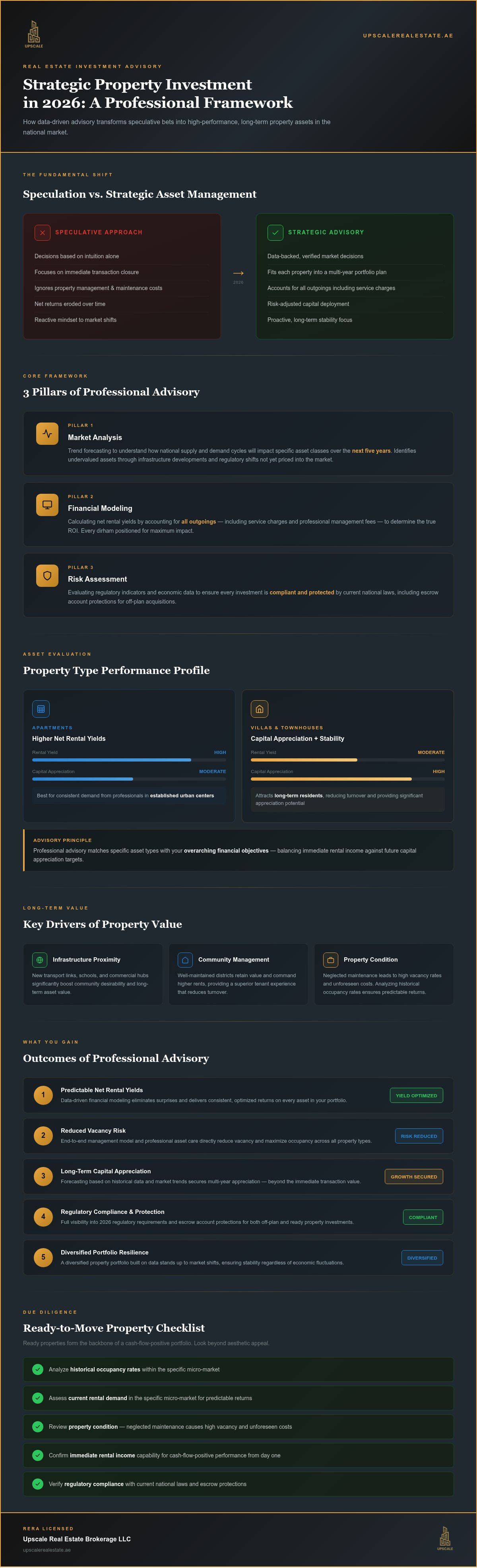
The national property market has moved beyond the era of simple buying and selling. Professional investment advisory now serves as the critical differentiator between a standard purchase and a high-performance asset. While a traditional sales agent focuses on the immediate closure of a transaction, a strategic investment consultant looks at how a single property fits into a broader, multi-year portfolio. This shift is essential in a maturing market where transparency and data-backed decisions have replaced intuition.
In 2026, the complexity of national property regulations and the sheer volume of available assets require a more sophisticated approach. Investors who understand fundamental real estate investment strategies recognize that a property's value isn't just its current price; it's the potential for sustained performance. A strategic consultant provides the visibility needed to identify high-yield assets in a crowded market, ensuring that every acquisition is grounded in professional standards rather than high-pressure sales tactics.
The Shift from Speculation to Strategic Asset Management
Successful investors prioritize long-term portfolio health over short-term market fluctuations. Speculative buying often ignores the underlying mechanics of property management and maintenance costs, which can erode net returns over time. Professional advisory identifies undervalued assets by looking at infrastructure developments and regulatory shifts that aren't yet priced into the market. Real estate investment advisory is a process of risk-adjusted capital deployment. By focusing on asset management from the outset, you ensure that your portfolio remains resilient against economic shifts.
Core Components of a Professional Advisory Service
A structured investment advisory service relies on three primary pillars to secure investor interests:
- Market Analysis: We use trend forecasting to understand how national supply and demand cycles will impact specific asset classes over the next five years.
- Financial Modeling: This involves calculating net rental yields by accounting for all outgoings, including service charges and professional management fees, to find the true ROI.
- Risk Assessment: We evaluate regulatory indicators and economic data to ensure every investment is compliant and protected by current national laws.
This methodical approach provides the clarity required to build a diversified property portfolio. It's about moving from a reactive mindset to a proactive strategy where every dirham is positioned for maximum impact. By utilizing these frameworks, you can secure predictable net rental yields and ensure your assets are managed with the highest level of professional integrity.
Essential Criteria for Evaluating National Property Assets
Success in the national market depends on a granular understanding of asset performance across different categories. Investors typically weigh the benefits of apartments, villas, and townhouses based on their specific yield targets and risk tolerance. Apartments generally offer higher net rental yields in established urban centers due to consistent demand from professionals. Conversely, villas and townhouses often attract long-term residents, providing greater stability and significant potential for capital appreciation. Effective investment advisory services help you navigate these choices by matching specific asset types with your overarching financial objectives.
Infrastructure remains the primary driver of long-term value. Proximity to new transport links, schools, and commercial hubs can significantly boost the desirability of a community. However, the longevity of these gains depends heavily on community management. Assets in well-maintained districts retain their value and command higher rents because they provide a superior living experience for tenants. This reduces turnover and ensures your portfolio remains competitive as the market matures.
Assessing the Viability of Ready-to-Move Properties
Ready properties are the backbone of a cash-flow-positive portfolio, offering immediate rental income. When evaluating these assets, look beyond the aesthetic appeal. Analyze historical occupancy rates and current rental demand within the specific micro-market to ensure predictable returns. A property's condition is equally vital; neglected maintenance can lead to high vacancy rates and unforeseen costs. Reviewing a Landlord Property Maintenance Checklist ensures you're accounting for all operational requirements before finalizing an acquisition.
Strategic Selection of Off-Plan Project Investments
Off-plan investments offer a different risk-reward profile, primarily focused on capital growth. The most critical factor here is the developer's track record and their history of project completion. Verify their adherence to quality standards and timelines to protect your capital. Payment plans serve as a powerful tool for capital leverage, allowing you to secure a high-value asset with a smaller initial outlay while the property appreciates during the construction phase.
Strategic investment advisory involves modeling these payment structures against projected market conditions at the time of handover. This ensures you aren't just buying a unit, but executing a timed entry into a developing market. If you're looking to expand your holdings with stable, family-oriented assets, you might consider browsing a villa for sale that aligns with these strategic criteria.
Regulatory Frameworks and Transparency in Asset Acquisition
National regulatory bodies serve as the foundation of a secure investment environment. They establish the rules that govern every transaction, ensuring that both domestic and international investors operate on a level playing field. A core pillar of this protection is the mandatory use of escrow accounts for off-plan developments. These accounts ensure that investor funds are utilized solely for the construction of the specific project, providing a layer of financial security that minimizes the risk of project stalls or developer insolvency. This structured approach protects your capital and ensures that developers remain accountable to their timelines and quality standards.
Professional investment advisory extends beyond asset selection into the realm of regulatory compliance. It's not enough to find a property with high potential. The acquisition process must be legally sound and fully transparent. Licensed consultants act as intermediaries who verify the status of developers, titles, and project permits before any contracts are signed. This oversight is vital in a maturing market where the legal landscape continues to evolve. By conducting thorough due diligence, advisors help you avoid common pitfalls and ensure your capital is deployed within a secure legal framework.
The Impact of Licensing and Professional Standards
Working with a licensed brokerage, such as Upscale Real Estate (ORN 23084), provides a direct line of accountability. Licensing isn't just a formality; it's a commitment to professional ethics and regulatory adherence. The national market is shifting toward unified standards for property advisors, which helps eliminate the ambiguity often found in less regulated environments. For a deeper look at how these rules are implemented, you can read our guide on Understanding the Dubai Land Department for essential regulatory context.
Transparency as a Tool for Risk Mitigation
Visibility into service charges and administrative costs is crucial for accurate yield modeling. Hidden fees can quickly turn a high-performing asset into a liability. Professional property management plays a key role here by ensuring that all costs are documented and that the building remains compliant with local health and safety protocols. This includes managing sinking funds and ensuring service charge audits are conducted regularly. Transparency builds investor confidence in high-value asset classes by removing the uncertainty associated with hidden costs and unregulated administrative changes. When you have visibility into every aspect of an asset's operation, you can make decisions that are grounded in reality rather than speculation.
Quantitative Analysis: Modeling Yields and Capital Appreciation
Quantitative analysis transforms a property from a physical structure into a sophisticated financial instrument. Successful investors avoid the trap of focusing solely on gross yields, which often mask the true performance of an asset. Instead, professional investment advisory emphasizes the calculation of net rental yields. This meticulous process accounts for all operational outgoings, including service charges, sinking funds, and professional management fees. By stripping away these expenses, you gain a transparent view of the actual cash flow your asset generates, allowing for more grounded financial planning.
Forecasting capital appreciation requires a data-driven look at historical trends and national development cycles. It's not enough to hope for price growth; you must analyze the relationship between asset supply and projected rental demand. In communities where new supply is limited but infrastructure is expanding, capital gains tend to be more resilient. Diversification strategies that balance commercial and residential holdings further mitigate risk. Commercial assets often provide longer lease durations and corporate stability, while residential units offer higher liquidity and a broader tenant pool in shifting markets.
Modeling Total Return on Investment (ROI)
A comprehensive performance metric must integrate both consistent rental income and projected capital gains into a single, cohesive figure. This total ROI approach provides a clearer picture of an asset's long-term value and its place within your broader strategy. One critical variable often overlooked in basic models is the impact of vacancy rates on long-term portfolio performance. Even a high-yielding property can underperform if it remains unoccupied for several weeks each year. For more sophisticated techniques on balancing these variables, explore our guide on Real Estate Portfolio Management.
Yield Comparison Across National Asset Classes
Residential leasing typically offers a consistent tenant base, whereas commercial leasing provides longer lease terms and stable, predictable cash flows. High-demand communities often exhibit lower price volatility, which translates into stable yields even during market corrections. In contrast, emerging districts might offer higher potential yields but come with increased vacancy risks as the community matures. Professional management optimizes these net returns by ensuring high tenant retention and proactive maintenance. This steady hand protects the asset's yield over its entire lifecycle. If you're ready to optimize your holdings, you can start by exploring a professional investment advisory framework today.
Implementing a Professional Investment Strategy with Upscale Real Estate
Upscale Real Estate Brokerage LLC operates on a model that prioritizes long-term partnership over individual transactions. Our investment advisory framework is designed to guide you through every stage of the asset lifecycle. We don't just facilitate a purchase; we build a strategic foundation that accounts for the specific nuances of the national market. This consultative approach ensures that whether you're acquiring a residential villa or a commercial asset, the property aligns with your broader financial trajectory. It's about moving from a reactive mindset to a proactive strategy where data dictates every move.
The national market's maturity in 2026 requires more than just local knowledge. It demands a steady hand that understands how to transition an asset from the point of acquisition to a high-performing rental unit. By positioning ourselves as a strategic consultant rather than a mere middleman, we ensure that your portfolio is built for resilience. Our approach is grounded in transparency, providing you with the visibility needed to manage high-value assets with confidence and precision.
Integrated Portfolio Management Solutions
Transitioning from the acquisition phase to active property management is where many investors face operational friction. Our end-to-end model eliminates this by integrating professional tenant relations and administrative oversight into the advisory process. By maintaining a single point of contact for diverse property holdings, you gain better visibility into your portfolio's performance. This seamless transition is vital for both ready properties and off-plan assets as they reach completion. Professional management ensures that maintenance is proactive and tenant retention remains high, which directly protects your net rental yields and reduces the burden of daily operations.
Securing Your Investment Future in 2026
The landscape of 2026 demands a partner with local mastery and on-the-ground expertise. Integrity and accountability aren't just values at Upscale Real Estate Brokerage LLC; they are the metrics by which we measure our success. As an RERA-licensed brokerage (ORN 23084), we adhere to the highest professional standards to ensure every transaction is transparent and secure. We believe that a grounded, data-backed strategy is the only way to navigate a maturing market effectively. Our team focuses on process over pressure, ensuring your goals remain the priority.
Choosing the right advisor means selecting a partner who values your long-term goals as much as you do. We provide the technical expertise and regulatory knowledge necessary to optimize both commercial and residential portfolios for sustained growth. If you're ready to move beyond speculative buying and implement a high-performance strategy, consult with our Investment Advisory team to optimize your portfolio and secure your position in the national market.
Optimizing Your National Property Portfolio for 2026
Success in the maturing property landscape requires a transition from speculative acquisition to a structured, data-driven strategy. We've explored how identifying high-yield assets depends on rigorous modeling and a deep understanding of national regulatory frameworks. By prioritizing transparency and professional asset management, you can secure predictable net yields and long-term capital appreciation. It's no longer enough to simply buy; you must manage with precision to protect your capital against market shifts.
Upscale Real Estate provides the steady hand needed to navigate these complexities. As a RERA-licensed brokerage (ORN 23084), we offer transparent brokerage fees and comprehensive property management solutions that reduce vacancy risks. Our approach to investment advisory is built on accountability and on-the-ground mastery, ensuring your interests remain the priority throughout the asset lifecycle. You can Partner with Upscale Real Estate for Professional Investment Advisory to begin optimizing your holdings today. We're here to help you build a resilient and high-performing portfolio for the years ahead.
Frequently Asked Questions
What is the primary benefit of hiring a real estate investment advisory firm?
The primary benefit is the transition from speculative buying to strategic asset planning through data-backed modeling. Professional firms provide visibility into long-term performance rather than just facilitating a one-off sale. This approach helps you optimize net rental yields and secure capital appreciation by aligning every acquisition with your broader financial goals. It's about having a steady hand that prioritizes your portfolio's resilience in a complex national market.
How does investment advisory differ from traditional real estate brokerage?
Traditional brokerage focuses on the immediate transaction and closing the sale. In contrast, investment advisory looks at the entire asset lifecycle, including risk assessment and portfolio optimization. While a broker might find you a property, an advisor evaluates how that property fits into a multi-year strategy. This model includes end-to-end services like property management and quantitative modeling to ensure the asset performs consistently after the initial purchase.
Can investment advisory help with both residential and commercial properties?
Yes, professional advisory services cover both residential and commercial asset classes. Advisors help you balance your portfolio by analyzing the different risk-reward profiles of apartments, villas, and commercial units. Residential properties often provide higher liquidity and consistent tenant demand; commercial assets can offer longer lease terms and corporate stability. A strategic consultant ensures that your mix of holdings is diversified to withstand various market cycles and economic shifts.
How are net rental yields calculated in the national property market?
Net rental yields are calculated by subtracting all operational expenses from the annual rental income and dividing that figure by the total property cost. These expenses include service charges, maintenance fees, insurance, and professional property management costs. Unlike gross yields, which only look at the headline rent, net yield modeling provides a transparent view of your actual ROI. This level of granular analysis is essential for making grounded decisions in the national property market.
What are the risks of investing in off-plan projects without professional advisory?
Investing in off-plan projects without professional oversight carries risks such as project delays, developer insolvency, or lower-than-expected quality standards. Advisors mitigate these risks by verifying developer track records and ensuring that all payments are made through regulated escrow accounts. They also analyze whether the projected handover date aligns with market demand cycles. Without this due diligence, investors may find their capital tied up in stalled developments or assets that fail to meet appreciation targets.
How often should a real estate investment portfolio be reviewed for performance?
An investment portfolio should be reviewed at least annually to account for regulatory changes and shifting market trends. These reviews allow you to reassess vacancy rates, maintenance costs, and rental price growth against your original projections. More frequent reviews might be necessary if there are significant infrastructure developments or national policy updates. Consistent monitoring ensures your strategy remains proactive, allowing you to rebalance holdings or adjust management protocols to maintain peak performance levels.
Is investment advisory necessary for experienced property owners?
Experienced property owners often find investment advisory essential for scaling their portfolios and navigating complex regulatory updates. Even if you've managed assets successfully in the past, the maturing national market requires sophisticated data modeling and professional property management to maintain competitive yields. Advisors provide a fresh perspective and on-the-ground mastery that helps identify undervalued assets or optimize existing holdings through more efficient administrative and tenant relation processes.
What regulatory bodies oversee real estate investment consultants in the UAE?
Real estate consultants and brokerages in the UAE are overseen by national and regional regulatory bodies that ensure professional standards and transparency. These entities establish the licensing requirements, such as the RERA license (ORN 23084), which mandates strict adherence to ethical and legal protocols. They also manage escrow account regulations and unified standards for property advisors. Working with a licensed firm ensures that your transactions are secure and that your interests are protected by national law.