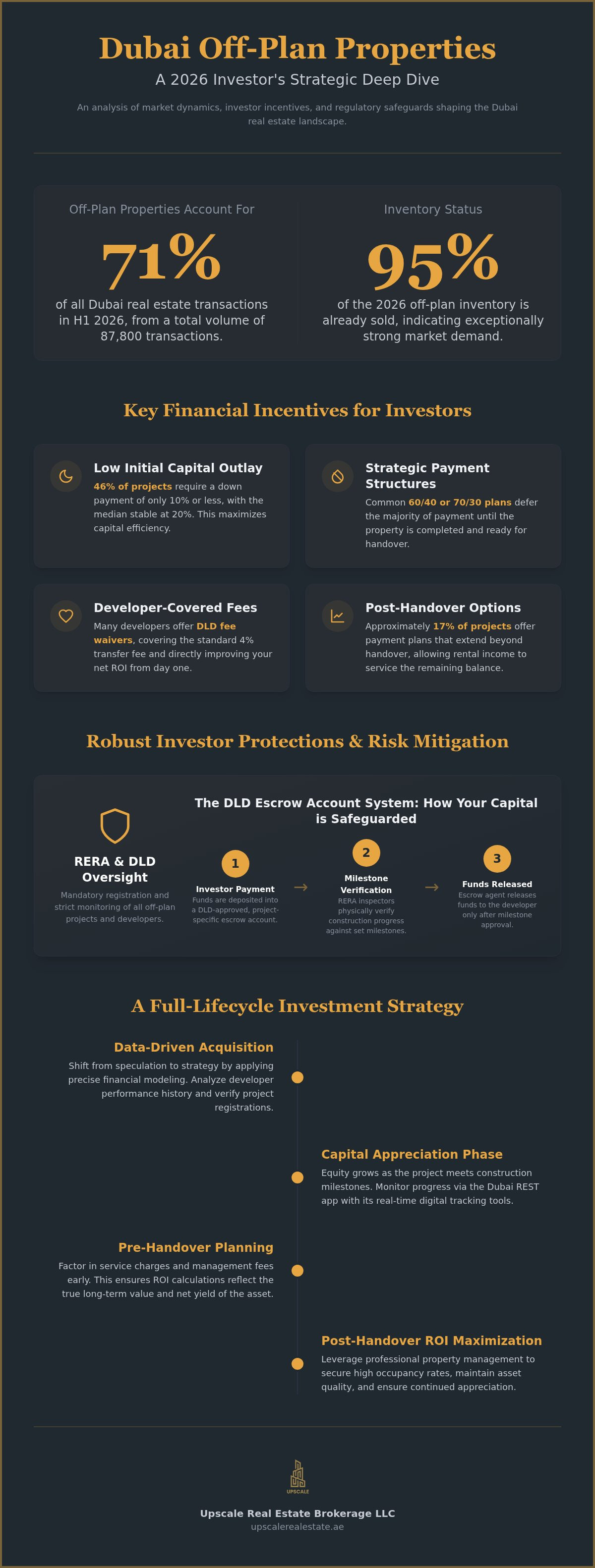
Did you know that off-plan properties accounted for a staggering 71% of all real estate transactions in Dubai during the first half of 2026? While the volume of 87,800 transactions suggests a robust market, you likely feel the weight of the underlying complexity. Investing in off-plan properties Dubai is no longer about speculative betting; it's about navigating a mature ecosystem where nearly 95% of 2026 inventory is already sold. You recognize that the opportunity is vast, but the fear of project delays or shifting regulations can make even the most seasoned investor hesitate.
We're here to replace that uncertainty with data-driven clarity and strategic visibility. This guide provides an expert deep dive into the 2026 off-plan market, moving beyond sales brochures to focus on rigorous financial modeling and risk mitigation. You'll gain a clear understanding of the latest RERA buyer protections and DLD escrow requirements that safeguard your capital. We'll examine how to secure capital appreciation during construction and calculate true net yields to ensure your portfolio remains grounded in long-term value.
Key Takeaways
- Understand the 2026 regulatory landscape, where RERA oversight and digital escrow accounts provide a transparent framework for capital protection.
- Shift from speculative buying to data-driven investing in off-plan properties Dubai by applying precise financial modeling to project net rental yields.
- Mitigate acquisition risks through rigorous due diligence protocols that focus on developer performance history and physical construction milestones.
- Factor in service charges and management fees early to ensure your ROI calculations reflect the true long-term value of the asset.
- Adopt a full-lifecycle investment strategy that leverages professional property management to maintain high occupancy and asset appreciation post-handover.
The Strategic Case for Investing in Off-Plan Properties in Dubai
Dubai's real estate market in 2026 isn't the speculative environment of a decade ago; it's a mature, data-driven landscape. For high-net-worth individuals, investing in off-plan properties Dubai serves as a sophisticated capital growth vehicle. By purchasing a property before it's completed, you're essentially securing an asset at today's market value with the expectation that its worth will increase by the handover date. This approach requires a solid understanding of off-plan properties and their role within a diversified UAE portfolio.
The 2026 market dynamics are particularly compelling. With off-plan properties accounting for 71% of the 87,800 transactions recorded in the first half of the year, the demand is clear. Strategic investors are moving away from "quick flips" and toward long-term asset management. They're targeting emerging districts where infrastructure is still developing, ensuring they capture the highest possible appreciation curve before the area reaches full maturity.
Capital Appreciation vs. Immediate Cash Flow
While ready properties offer immediate rental income, off-plan acquisitions prioritize equity growth during the construction phase. The mechanism is simple: you buy at a lower entry price compared to ready units in the same district. As the project reaches construction milestones, the market value typically rises. By the time you receive the keys, your equity has often grown significantly without the immediate burden of maintenance costs or tenant management. Modeling this growth requires looking at Tier-1 developer track records, where capital appreciation has remained a steady driver of value through 2025 and into 2026.
Entry Incentives and Flexible Payment Plans
One of the primary drivers for investors in 2026 is the structural flexibility of payment plans. These models allow you to leverage your capital more effectively than traditional ready-property purchases.
- Low Initial Capital: As of September 2026, 46% of off-plan projects require a down payment of 10% or less. The median down payment remains stable at 20%.
- Strategic Payment Structures: Many developers utilize 60/40 or 70/30 plans, where the bulk of the payment is due only upon completion.
- Fee Waivers: To stay competitive, developers frequently offer DLD fee waivers, effectively covering the 4% transfer fee and improving your net ROI from day one.
- Post-Handover Options: Roughly 17% of projects currently offer post-handover payment plans, allowing you to settle the balance using the property's own rental yield.
These incentives lower the barrier to entry while maximizing the potential for high rental yields upon handover. When paired with professional property management, these assets transition seamlessly from a construction-phase growth play into a stable, income-generating component of your portfolio.
Navigating the 2026 Regulatory Framework and Investor Protections
The stability of the Dubai real estate market relies on a robust regulatory framework. The Dubai Land Department (DLD) and the Real Estate Regulatory Agency (RERA) act as the primary guardians of investor interests. Effective January 1, 2026, new RERA regulations have enhanced protections for off-plan buyers, specifically through stricter monitoring of developer escrow accounts. When you're investing in off-plan properties Dubai, these safeguards ensure that your capital isn't just a line item in a developer's budget, but a protected asset tied to tangible progress. This regulatory rigour is a key component of the broader construction sector overview in the UAE, which prioritizes transparency and professional standards.
The Escrow Account System Explained
Every off-plan project must have a dedicated escrow account registered with the DLD. Developers can't access your funds for marketing or unrelated administrative costs. Instead, RERA releases capital only when specific construction milestones are verified by on-site inspectors. You can monitor this progress in real-time through the Dubai REST app, which now features AI-powered valuation tools and digital tracking as of 2026. Before committing capital, it's vital to verify that both the developer and the project are officially registered. If you need assistance verifying project status or developer track records, our team at Upscale Real Estate provides the grounded advisory needed to navigate these protocols safely.
Legal Recourse and Dispute Resolution
Investor rights are clearly defined within the Sales and Purchase Agreement (SPA). These contracts include mandatory clauses regarding completion dates, grace periods, and compensation for project delays. If a developer fails to meet their obligations or defaults, the Rental Dispute Center and specialized DLD legal committees provide a formal, efficient path for resolution. The Oqood system is a certificate of ownership for uncompleted units that serves as your interim title deed until handover. Interim registration fees for Oqood typically range from AED 3,000 to AED 5,250. This mandatory registration ensures your rights are recorded in the central DLD database, preventing the same unit from being sold twice and providing total visibility into the legal status of your investment from day one.
Financial Modeling: Analyzing Yields and Appreciation Potential
Successful investing in off-plan properties Dubai requires moving beyond developer marketing materials to build a custom, conservative financial model. You must evaluate an asset's potential based on hard market data rather than optimistic forecasts. This involves analyzing supply pipelines for 2026 through 2029; currently, over 71% of scheduled off-plan properties are already sold. This high absorption rate suggests a competitive future market that could support sustained rental demand and price stability.
Gross Yield vs. Net Yield: The Investor's Reality
Gross yields often look attractive on paper, but the net yield is the only figure that impacts your long-term bottom line. To calculate an accurate net ROI, you must subtract recurring expenses such as service charges, professional property management fees, and maintenance provisions from your projected annual rental income. You also need to factor in the one-time acquisition costs that occur during the initial purchase phase:
- DLD Transfer Fee: 4% of the purchase price.
- Administrative Fees: AED 580 for apartments and offices.
- Trustee Fees: AED 4,200 for properties valued at or above AED 500,000.
- Oqood Registration: Between AED 3,000 and AED 5,250 for interim title registration.
Our strategic guide to Off-Plan vs. Ready Property in Dubai provides a deeper comparison of how these yields fluctuate across different asset classes. Modeling a 5% to 8% vacancy rate for units in new communities is a prudent step to ensure your financial projections remain grounded and realistic.
Predicting Capital Appreciation Milestones
Capital appreciation in the off-plan sector isn't linear; it's triggered by specific project and infrastructure milestones. The "Golden Period" for growth typically occurs between groundbreaking and the 50% construction mark. During this phase, early-stage risk diminishes and the project's physical presence increases market confidence, often leading to price adjustments by the developer. External catalysts are equally important. In 2026, proximity to new Dubai Metro expansions or the Dubai 2040 Urban Master Plan's green corridors significantly boosts the resale value of off-plan units. Strategic Selection minimizes market timing risks by focusing on high-demand corridors where population growth, which reached approximately 121,000 new residents in the first half of 2026, consistently outpaces new supply.
Risk Mitigation Strategies for Off-Plan Acquisitions
Risk management is the cornerstone of successful investing in off-plan properties Dubai. While the regulatory framework provides a safety net for your capital, it doesn't guarantee that every project will meet your specific quality or timeline standards. You must move beyond the marketing suite to evaluate a developer's execution capability. This involves a rigorous assessment of their historical performance and current project density to ensure they have the operational capacity to deliver on their promises.
Developer Due Diligence Checklist
Before signing a Sales and Purchase Agreement, you should conduct a thorough audit of the developer's track record. This isn't just about their brand name; it's about their consistency in the following areas:
- Handover Timelines: Analyze their last five projects to see if they were delivered within the promised grace period.
- Build Quality: Visit their completed developments that are five to ten years old. This reveals how their materials and construction methods withstand the local climate over time.
- Portfolio Health: Ensure the developer isn't overextended. A healthy developer maintains a balanced ratio between active construction and completed assets.
- Management Standards: Evaluate the quality of the Owners Association and property management in their ready projects, as this directly impacts your future resale value.
Location and Infrastructure Analysis
An individual building is only as valuable as the community surrounding it. You should prioritize master-planned communities where infrastructure development is coordinated by a master developer. Identifying high-growth corridors using the Dubai Land Department data allows you to see where the government is concentrating its 2040 Urban Master Plan resources. For instance, proximity to established or expanding economic hubs like Dubai Silicon Oasis or Business Bay ensures a steady pool of corporate tenants upon handover.
Diversification within the off-plan sector also acts as a strategic hedge. While residential apartments are popular, balancing your portfolio with townhouses or commercial units can protect you from shifts in specific market segments. With 71.45% of properties scheduled for delivery between 2026 and 2029 already sold, the window for securing prime units in top-tier communities is narrowing. If you're ready to move from research to acquisition, our team can help you request a developer portfolio audit to ensure your next investment is grounded in data rather than speculation.
Maximizing ROI: The Full-Lifecycle Investment Approach
The strategic journey of investing in off-plan properties Dubai doesn't conclude when you receive the keys. Handover marks the transition from a capital growth play to a yield-generating asset. To maximize your total return on investment, you must adopt a full-lifecycle perspective that treats the property as a managed financial instrument rather than a passive purchase. This phase requires a shift in focus toward operational excellence and market-timed exit strategies.
Integrating Professional Property Management
Once a project is completed, the immediate priority is securing high-caliber tenants to begin recouping capital. A specialized real estate management dubai partner bridges the gap between construction and cash flow. They provide the grounded visibility needed to set competitive rental rates based on current 2026 market data, where average rental valuations are increasingly driven by RERA's AI-powered digital tools.
- Tenant Procurement: Professional managers screen for long-term stability, reducing turnover costs and vacancy periods.
- End-to-End Oversight: From utility connections to DEWA registrations, management services remove the administrative burden from the investor.
- Asset Preservation: Proactive maintenance schedules prevent minor issues from becoming costly repairs, directly protecting the property's future resale value and net yield.
Strategic Portfolio Advisory
Successful investors don't just hold assets; they rebalance their portfolios based on shifting market cycles. As Dubai's population continues to grow, with 121,000 new residents arriving in early 2026, demand for different asset classes evolves. You might choose to "flip" the property shortly after handover to capture peak capital appreciation or hold it for long-term rental income. Data-driven investment advisory helps you decide when to transition from residential units into higher-yielding commercial assets or emerging master communities.
This advisory-led approach ensures your capital remains deployed in the most efficient corridors of the city. Whether you're looking to exit a mature position or diversify into new sectors, having a steady hand to guide your decisions is essential for long-term wealth preservation. To move beyond generic market trends and develop a plan tailored to your specific goals, consult with Upscale Real Estate for a personalized investment strategy and professional property management support.
Building a Resilient Portfolio in the 2026 Dubai Market
The 2026 landscape offers a unique window for those who prioritize data over intuition. Investing in off-plan properties Dubai has evolved into a disciplined strategy where regulatory transparency and meticulous financial modeling are the primary drivers of success. By securing assets within RERA-protected frameworks and planning for the full investment lifecycle, you position yourself to capture both construction-phase appreciation and sustainable rental yields.
Upscale Real Estate provides the steady hand needed in this complex landscape. As a RERA Licensed Brokerage, we combine Strategic Investment Advisory with Comprehensive Portfolio Management to ensure your capital is always working efficiently. We're committed to a partnership grounded in accountability and local mastery, helping you navigate every milestone from groundbreaking to handover.
Secure Your Dubai Investment Future with Upscale Real Estate and take the first step toward a secure, high-yield property portfolio. It's time to ground your investment goals in professional expertise and local market certainty.
Frequently Asked Questions
Is it safe to buy off-plan property in Dubai in 2026?
Buying off-plan is highly secure in 2026 because of the stringent regulatory oversight provided by RERA and the Dubai Land Department. All investor funds are deposited into mandatory escrow accounts, which are only released to developers as construction milestones are verified. These protections, combined with the AI-driven monitoring systems introduced in early 2026, ensure that investing in off-plan properties Dubai remains a transparent and reliable strategy for both local and international investors.
What happens if an off-plan project is delayed?
If a project is delayed beyond the completion date specified in your Sales and Purchase Agreement (SPA), you're protected by mandatory legal clauses. Most contracts include a standard 12-month grace period. If the developer exceeds this without a valid reason, you may be entitled to compensation or contract termination. The Rental Dispute Center and DLD legal committees provide formal channels to resolve these issues, ensuring your capital remains protected throughout the construction cycle.
Can I sell my off-plan property before it is completed?
You can generally sell an off-plan property before completion once you've met the developer's minimum payment threshold, which is typically between 30% and 40% of the total value. This process, often called "flipping," requires a No Objection Certificate (NOC) from the developer. It's a common strategy for investors looking to capture capital appreciation during the construction phase without waiting for the final handover or long-term property management phase.
How do I verify a developer's escrow account?
You can verify a developer's escrow account status directly through the Dubai REST app or the official DLD website. These digital platforms provide real-time visibility into the project's financial health and construction progress. By entering the project's registration number, you can confirm that your payments are being held in a regulated account. This level of transparency is a cornerstone of the 2026 market, allowing you to monitor your investment with total certainty.
What are the typical payment plans for off-plan projects?
Payment plans in 2026 are structured to be flexible, with a median down payment currently at 20%. Popular models include 60/40 or 70/30, where the larger portion is due upon handover. Approximately 17% of projects also offer post-handover payment plans, allowing you to pay the balance over several years. These structures lower the barrier to entry for investing in off-plan properties Dubai, enabling more efficient capital deployment across a diversified real estate portfolio.
Are there any hidden fees when buying off-plan?
While there are no hidden fees, you must account for several mandatory government and administrative charges. These include the 4% DLD transfer fee, a trustee fee of AED 4,200 for properties over AED 500,000, and an administrative fee of AED 580. Additionally, Oqood registration costs between AED 3,000 and AED 5,250. Factoring these into your financial modeling is essential to calculate your true net yield and avoid surprises during the acquisition phase.
What is the difference between Oqood and Title Deed?
Oqood is an interim registration certificate that serves as proof of ownership for uncompleted off-plan units. It ensures your rights are recorded in the central DLD database before the building exists. A Title Deed, conversely, is only issued once the property is completed and handed over. Both documents are legally binding, but Oqood is specifically designed to protect your interests during the construction phase, preventing the developer from selling the same unit twice.
How does the Golden Visa apply to off-plan property investments?
The UAE Golden Visa applies to off-plan investments provided the total value of your property acquisition meets the government's minimum threshold. This ten-year residency program is a key incentive for investors looking to establish a long-term presence in the country. By working with a RERA-licensed firm, you can ensure your documentation is correctly filed to qualify for residency once your investment milestones are met, adding another layer of value to your portfolio.