With Grade A office occupancy reaching a staggering 95% in 2026, the window for casual entry into the market has effectively closed. You likely recognize that while the headline figures for commercial real estate investment Dubai look promising, the lack of transparent data and the complexity of modern lease structures make securing a high-yield asset feel increasingly difficult. Regulatory shifts, including the 2025 agreement allowing free zone companies to own property, have added new layers of opportunity and risk that require a grounded, advisory-led approach.
We understand that institutional-grade results depend on clarity and meticulous planning rather than market intuition. This guide provides the strategic framework you need to navigate the current landscape with the precision of a seasoned investor. You'll gain a clear understanding of the transition from gross to net yield modeling, the nuances of the latest national regulations, and the specific steps required to build a reliable investment advisory partnership. We'll move past the sales-driven hype to focus on the data-driven mechanics of a successful 2026 acquisition. This methodical preview of the market ensures your next move is backed by professional accountability and local mastery.
Key Takeaways
- Learn to navigate the "Flight to Quality" trend to secure high-yield Grade A office spaces in a market currently seeing 95% occupancy.
- Master a data-driven framework for commercial real estate investment Dubai that prioritizes long-term capital appreciation and consistent cash flow.
- Understand the strategic benefits of 3-5 year lease structures and why commercial landlords face lower operational costs than residential owners.
- Follow a professional acquisition roadmap that emphasizes technical and legal due diligence to mitigate risk during the closing process.
- Discover the necessity of active asset management and how expert advisory optimizes the performance of complex corporate portfolios.
Analyzing the 2026 Commercial Real Estate Investment Landscape
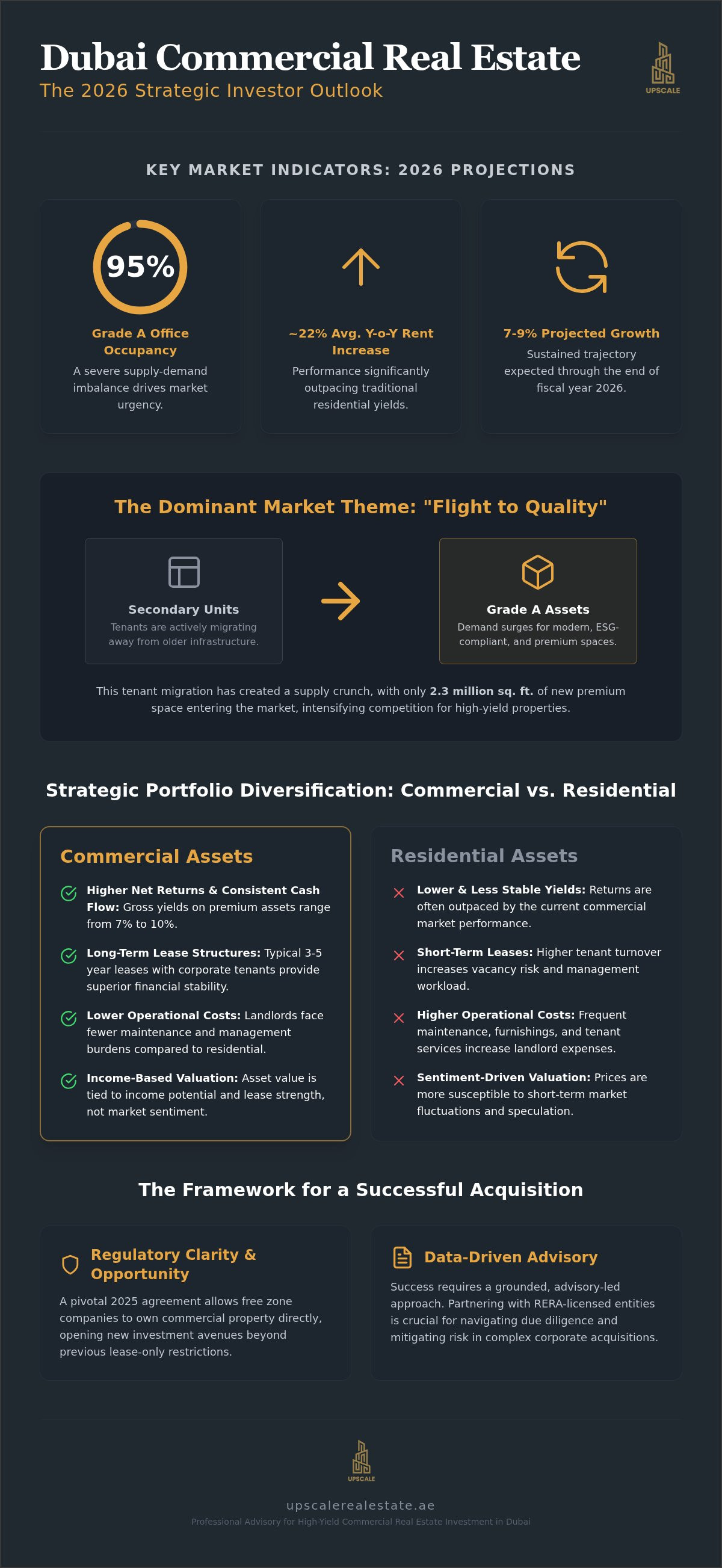
The 2026 market presents a distinct shift in asset preference. While residential portfolios have historically dominated investor attention, the current fiscal year highlights why commercial units are now the preferred vehicle for institutional capital. This transition is driven by a severe supply-demand imbalance. With Grade A office occupancy hovering near 95%, investors are seeing an average year-on-year rent increase of approximately 22%. This performance outpaces traditional residential yields, making commercial real estate investment Dubai a cornerstone of strategic portfolio diversification for those seeking stability and higher net returns.
Economic Drivers and National Market Resilience
Robust GDP growth remains intrinsically linked to commercial occupancy. The maturation of the corporate tax framework has not deterred international firms; instead, it has provided the fiscal clarity needed for long-term leasing commitments. A "Flight to Quality" is now the dominant market theme. Tenants are actively migrating from secondary units to premium spaces that offer modern infrastructure and sustainable certifications. This demand for Grade A assets has created a supply crunch, with only 2.3 million square feet of new premium space entering the market this year. Based on current projections, the commercial sector is expected to maintain a growth trajectory of 7-9% through the end of the 2026 fiscal year.
The 2026 Regulatory Environment for Investors
Transparency is the primary safeguard for capital in 2026. The Dubai Land Department has streamlined data visibility, allowing for more accurate yield modeling and risk assessment. A pivotal development is the 2025 agreement allowing free zone companies to own commercial property directly, a significant departure from previous lease-only restrictions. For a foundational overview of real estate in Dubai and its historical regulatory evolution, the market's trajectory shows a clear move toward institutional standards that protect the landlord's long-term interests.
Success in this environment requires strict adherence to professional protocols. Working with RERA-licensed entities, such as those holding ORN 23084, isn't merely a legal requirement; it's a strategic necessity for complex corporate acquisitions. These entities provide the grounded advisory needed to navigate the latest national standards for commercial brokerage. Accurate visibility into transaction data ensures that your commercial real estate investment Dubai is based on verified benchmarks rather than speculative projections. By prioritizing this level of regulatory alignment, investors can effectively mitigate the operational risks associated with high-value asset management.
Evaluating High-Yield Commercial Asset Classes
Effective commercial real estate investment Dubai requires a clear distinction between asset classes to ensure both capital preservation and yield optimization. Unlike residential assets, which often rely on short-term market sentiment, commercial properties are valued based on their income-generating potential and the strength of their lease covenants. This makes them a superior vehicle for long-term capital appreciation and consistent cash flow. Successful investors in 2026 don't just buy space; they acquire strategic positions in the national economy.
Office Space: Grade A vs. Flexible Solutions
Multinational corporations in 2026 are prioritizing ESG-compliant buildings to meet global sustainability mandates. This has widened the yield gap between Grade A and secondary office units. According to the Dubai Office Market Report Q1 2026, premium assets are seeing gross yields between 7% and 10%. While co-working hubs offer higher flexibility, long-term corporate leases provide the financial modeling stability that institutional investors prefer. If you're looking to acquire specific units, our investment advisory services can help model these returns with precision.
Retail and Mixed-Use Commercial Assets
The retail landscape has evolved from traditional mall dominance toward community-centric, destination-led hubs. These assets focus on experiential services rather than just product sales. The valuation of these units is heavily influenced by anchor tenants, such as major grocery chains or fitness centers, which drive consistent footfall. Modeling vacancy risk in high-street retail requires a grounded approach. High-street locations often face more volatility than established community malls with diverse tenant mixes. Retail assets in 2026 are delivering gross yields in the 7-12% range, provided the tenant mix is resilient.
Industrial and Logistics Portfolios
Industrial assets have become the backbone of the national economy. The e-commerce boom has created a surge in demand for last-mile delivery hubs and specialized cold-storage facilities. These properties offer the highest stability in a volatile market because they are essential infrastructure. With gross yields reaching up to 12%, warehouses in strategic locations are highly sought after. Their low maintenance requirements and long-term occupancy rates make them an ideal choice for investors seeking defensive asset classes. This sector remains a steady hand for those looking to balance a high-growth corporate portfolio with reliable, low-intensity management assets.
Commercial vs. Residential: Strategic Portfolio Diversification
Investors often begin with residential assets due to their perceived simplicity. However, professional commercial real estate investment Dubai offers a level of structural stability that residential portfolios rarely match. The most immediate differentiator is lease duration. While residential contracts typically renew annually, commercial assets are secured by 3-5 year agreements, often with blue-chip corporate tenants. This creates a predictable income stream and significantly reduces the vacancy risk associated with high-turnover residential units.
Operational costs also favor the commercial landlord. In the residential sector, the landlord is responsible for constant upkeep, appliances, and cosmetic wear. In contrast, many commercial units are leased as "shell and core," shifting the fit-out and internal maintenance costs to the tenant. This fundamental shift ensures that a higher percentage of the gross rent is retained as profit. While residential properties might offer faster capital appreciation in speculative cycles, commercial assets provide the defensive qualities required for institutional-grade wealth preservation.
Yield Modeling and Cash Flow Stability
Institutional investors focus on the Net Initial Yield (NIY) rather than just headline gross figures. Commercial leases in 2026 frequently include fixed annual rent escalations, which serve as a built-in hedge against inflation. This modeling ensures that your cash flow maintains its purchasing power over the five-year term. For those weighing their entry point, understanding the lifecycle of these assets is critical. Our analysis of Off-Plan vs. Ready Property in Dubai: A 2026 Strategic Investor’s Guide highlights how timing impacts these long-term yield projections and cash flow entry points.
Operational Differences and Landlord Duties
The choice between "shell and core" and "fitted" units dictates your operational involvement. Fitted units may command higher immediate rents, but shell and core units offer the lowest landlord liability. In most commercial structures, the tenant manages the interior environment, while the landlord focuses on building-wide service charges and structural integrity. This reduces the daily friction of property management.
Service charge transparency is vital for calculating true net returns. These charges vary by building grade but typically range from AED 15 to AED 45 per square foot. Maintaining these standards is non-negotiable for Grade A assets. You can review the necessary protocols in our Landlord Property Maintenance Checklist Dubai. This structured approach to management ensures that the asset remains attractive to premium corporate tenants, preserving both yield and capital appreciation potential through professional accountability.
The Commercial Acquisition Framework: From Due Diligence to Closing
The transition from asset evaluation to capital deployment requires a methodical framework. Successful commercial real estate investment Dubai isn't a single transaction; it's a sequence of strategic checkpoints designed to protect your equity. This process begins with asset selection that aligns with a specific 10-year portfolio goal. Whether you're targeting high-yield retail or stable Grade A office space, the acquisition must be grounded in data rather than market sentiment. A steady hand at this stage prevents the common error of overpaying for speculative future growth.
Critical Due Diligence for Business Assets
Technical and legal due diligence is the most intensive phase of the framework. You must verify the Ejari history of the unit to understand past rental performance and current tenant profiles. Stability depends on the quality of the lease contract. Beyond the paperwork, structural and MEP (Mechanical, Electrical, Plumbing) inspections are mandatory for commercial buildings. These assets often carry heavy electrical loads and complex cooling requirements that residential units don't face. Ensuring the asset complies with the latest national fire and safety regulations is a legal necessity that preserves the building's insurance status and long-term valuation.
Financial Sensitivity and ROI Modeling
Professional investors prioritize the Internal Rate of Return (IRR) over a 10-year hold period. This modeling must account for more than just the purchase price. You need to factor in the 4% Dubai Land Department (DLD) transfer fee and the standard 2% brokerage commission. True sensitivity analysis also accounts for potential vacancy periods and annual building service charges, which can significantly impact net yields. For a granular breakdown of these steps, refer to our Strategic Guide to Dubai Commercial Real Estate Investment. This level of modeling ensures your exit strategy is as robust as your entry point.
The final stages involve navigating RERA protocols and DLD registration. Closing the transaction is merely the beginning of the asset's lifecycle. Once the title deed is issued, you must immediately initiate an active asset management plan. This includes optimizing the tenant mix and ensuring all maintenance protocols are met to preserve Grade A status. If you're ready to begin your acquisition with a RERA-licensed partner (ORN 23084), contact our investment advisory team to discuss your specific portfolio requirements.
Strategic Advisory and Long-Term Asset Management
Acquiring a high-value asset is only the first phase of a successful commercial real estate investment Dubai. Unlike residential units where management is often reactive, commercial properties require a proactive, advisory-led approach to maintain their Grade A status and institutional appeal. The transition from acquisition to operation marks the point where strategic modeling meets real-world execution. We position ourselves as a steady hand for investors, ensuring that every operational decision is grounded in data and strict regulatory compliance. This end-to-end model moves beyond the role of a mere middleman, focusing instead on the long-term health of your corporate portfolio.
The Value of Professional Investment Advisory
Professional advisors provide visibility into "off-market" commercial opportunities that rarely reach public listings. These exclusive transactions often involve entire buildings or bulk units where the yield potential is significantly higher than the market average. A structured advisory partnership allows you to build a portfolio that balances immediate cash flow with long-term capital appreciation. By leveraging local mastery and RERA-licensed expertise (ORN 23084), advisors can structure acquisitions that align with specific institutional goals. For a deeper look at these mechanics, review our guide on Real Estate Portfolio Management in Dubai. This strategic oversight ensures that your capital is deployed in assets with verified growth trajectories.
Optimizing Yields Through Active Management
Corporate tenants are inherently stable due to the high costs of fit-outs and business relocation; however, retention requires active relationship management. Successful commercial real estate investment Dubai depends on structured lease renewals and regular market rent reviews. These reviews ensure your asset remains competitive while capturing the current upward trend in commercial pricing. Active management also involves implementing cost-saving measures in building operations, such as energy-efficient upgrades to MEP systems. These improvements directly enhance your net yield by reducing the building-wide service charges that can otherwise erode profit margins.
Transparency in reporting and data-grounded decision-making are the hallmarks of professional asset management. By maintaining a steady focus on tenant satisfaction and operational efficiency, you protect the asset's valuation for future exit strategies. This methodical approach to high-yield operations ensures that your investment remains a secure, income-generating vehicle regardless of short-term market fluctuations. Our commitment to professional accountability means your portfolio is managed with the same precision used during the initial acquisition phase.
Securing Your Position in the 2026 Commercial Market
The current landscape demands a transition from speculative buying to institutional-grade asset management. With Grade A occupancy rates remaining exceptionally high, success in commercial real estate investment Dubai depends on more than just location. It requires a disciplined acquisition framework grounded in technical due diligence and a sophisticated understanding of net yield modeling. By prioritizing ESG-compliant assets and stable corporate leases, you build a portfolio that's resilient against market volatility.
Our team provides the local mastery needed to navigate these complexities. We offer a comprehensive end-to-end management model backed by RERA-certified advisors and rigorous data-driven yield modeling. This steady approach ensures your capital is protected while maximizing long-term appreciation. Consult with our Strategic Advisory Team for your 2026 Commercial Portfolio and begin building a legacy of stable, high-yield returns. The 2026 market offers significant rewards for those who lead with strategy and professional accountability.
Frequently Asked Questions
Is commercial real estate a good investment in the UAE for 2026?
Commercial assets currently offer a stable environment for institutional capital due to a significant supply-demand imbalance. With Grade A office occupancy reaching 95% in 2026, investors are seeing rental growth that often outpaces the residential sector. This makes commercial real estate investment Dubai a resilient choice for those seeking long-term capital appreciation and predictable cash flow backed by corporate lease agreements rather than short-term residential shifts.
What is the average yield for commercial property compared to residential?
Average gross yields for commercial properties in 2026 range from 7% to 12% depending on the asset class. Office units generally yield 7-10%, while industrial and logistics assets can reach up to 12%. Residential yields typically hover in a lower range when accounting for the higher operational costs and maintenance duties borne by the landlord. Commercial assets often provide a higher net initial yield because tenants frequently handle their own internal fit-outs.
Can foreign investors buy commercial property in the UAE?
Foreign investors can purchase commercial property in designated freehold zones across the country. A significant regulatory shift in 2025 now allows free zone companies to own commercial assets directly, which was previously restricted to leasing. This change has opened new avenues for international firms and individual investors to secure permanent corporate footprints. Working with a RERA-licensed brokerage ensures that all ownership transfers comply with the latest national legal standards.
What are the main risks associated with commercial real estate investment?
The primary risks include longer vacancy periods compared to residential units and the potential impact of economic cycles on corporate tenants. While commercial leases offer 3-5 year stability, finding a replacement tenant for a specialized unit can take several months. Investors must also account for the technical complexity of building-wide MEP systems. Mitigating these risks requires a data-driven approach to tenant selection and a robust financial sensitivity analysis before closing any transaction.
How does the acquisition process differ for commercial units?
The acquisition process involves more intensive technical and legal due diligence than a standard residential purchase. Commercial transactions are subject to a 5% VAT on the sale price of vacant units, and the buyer must verify the Ejari history and current tenant profiles. Technical inspections focus on heavy electrical loads and fire safety compliance. The framework follows a methodical path from strategic asset selection to DLD registration and active management initiation.
What are the typical service charges for commercial buildings?
Service charges for commercial buildings typically range from AED 15 to AED 45 per square foot annually. These fees cover building maintenance, security, and common area cooling. Grade A assets usually command higher service charges to maintain the premium infrastructure required by multinational corporate tenants. It's essential to factor these recurring costs into your net yield modeling to ensure that the asset's performance aligns with your long-term financial objectives.
Do I need a specific license to lease commercial property as an investor?
Individual investors don't require a specific trade license to own and lease out a commercial unit as a landlord. However, if you're operating through a corporate entity, that entity must be properly registered and compliant with local regulations. All commercial lease agreements must be registered through the Ejari system to be legally binding. Professional advisory helps clarify these requirements based on whether you're investing as a private individual or through an institutional investment vehicle.
How does Upscale Real Estate assist with commercial asset management?
Upscale Real Estate provides an end-to-end management and advisory model for commercial property owners. We focus on tenant retention strategies, regular market rent reviews, and implementing cost-saving measures in building operations. Our RERA-licensed team (ORN 23084) uses data-driven yield modeling to optimize your corporate portfolio performance. By taking a proactive rather than reactive approach, we ensure your commercial real estate investment Dubai remains a high-performing asset with institutional-grade transparency and accountability.