

What if the most polished launch presentation isn’t the clearest guide to a property’s long-term value? Buyers exploring new residential projects in dubai often need to look beyond promotional claims and check the details that affect a purchase: the developer’s record, documented construction progress, payment obligations, and whether the home suits its intended use.
That uncertainty is understandable. A compelling location or payment structure can attract attention, but neither confirms that a project fits your budget, timeline, or investment strategy. A sound comparison starts with verifiable information and a clear view of the assumptions behind each option.
This guide offers a practical framework for assessing new residential developments in the UAE. It explains which project documents and milestones to review, what to verify about the developer and contractual terms, and how to compare payment schedules and handover expectations. It also considers how personal use, rental objectives, and holding strategy can shape your decision. The aim is not to predict outcomes, but to help you ask better questions and make a more informed purchase decision based on your priorities.
Key Takeaways
- Assess new residential projects in dubai by separating confirmed project facts from marketing claims, assumptions, and unanswered questions.
- Compare planned, under-construction, and completed properties against your intended use, timeline, and investment objectives.
- Review payment milestones, handover expectations, unit details, and contractual terms rather than assuming they are consistent across projects.
- Use a sequenced due-diligence checklist to verify project status, developer records, construction progress, and cancellation provisions before reserving.
- Choose an adviser who explains their brokerage role clearly and helps you assess project information against your objectives and constraints.
Why new residential projects require more than a launch-day decision
A launch introduces a residential development, but it doesn’t establish whether a property suits your needs, when it will be ready, or what it may be worth later. Buyers in the UAE should assess project evidence, contract terms, and personal priorities rather than treating launch materials as a complete picture. A sound decision depends on verified information and fit, not promotional claims alone.
What counts as a new residential development?
A launch is the marketing and sales stage, which may begin before construction. An under-construction project has progressed into building work, while a completed unit is ready or approaching readiness for handover, subject to its documented status. Each stage brings different timelines and questions. For a general introduction to what off-plan projects are, consider what it means to commit before a home is complete and weigh potential advantages against delivery and market risks.
Check current project documents before relying on availability, construction status, or handover information. A brochure or sales conversation can explain what is being marketed, but it shouldn’t replace reviewing relevant records and contractual terms. Buying a unit is also not the same as securing an investment outcome. A launch claim cannot guarantee future demand, resale options, or value.
Who may consider buying a newly launched property?
For an end-user planning future occupancy, the decision may centre on whether the layout, unit configuration, facilities, and documented handover expectations match household needs. If you have a firm move-in timeline, give construction progress and timing more weight than features that are still proposed.
An investor may instead assess potential demand, expected holding period, ongoing costs, and flexibility if plans change. These are factors to investigate, not promises of yield or appreciation. A project that suits an investor comfortable with a longer timeline may not fit someone who needs easier access to capital or a near-term exit.
Start by defining your objectives, timeline, liquidity needs, and risk tolerance. Then compare each project against those priorities. A structured discussion with a qualified adviser can help clarify assumptions and identify questions to verify, but it doesn’t replace independent review of project documents. The same development can be a strong personal fit for one buyer and a poor strategic fit for another.
How off-plan projects work: agreements, payment milestones, and handover
Buying off-plan means committing to a home before it is complete, so the decision depends on more than the advertised layout or launch presentation. When assessing new residential projects in dubai, treat the purchase as a sequence: review project and unit information, examine the proposed sale documents, confirm payment obligations, track documented progress, and follow the contractual process for completion and handover. The sequence and terms can differ by project.
Which project and sale documents should buyers review?
The sale and purchase agreement (SPA) sets out the terms between buyer and seller. Read it alongside current project information and the unit schedule, rather than relying on verbal explanations. Check that the unit identifier, configuration, area, specifications, included facilities, and any stated completion expectations are consistent across the documents.
Pay close attention to the payment schedule. Identify each amount, due date, and triggering milestone, then confirm what the agreement says about late payment, changes, cancellation, and other obligations. Don’t assume one project’s terms apply to another. Ask for unclear statements or promotional promises to be explained in writing. If contract wording or obligations remain uncertain, seek independent legal or other qualified professional advice.
Also verify which rules and safeguards apply to the specific transaction. Don’t assume escrow arrangements or statutory protections from general descriptions. Confirm applicable requirements through reliable, current sources and relevant project documents before committing.
What do construction updates and handover milestones tell you?
Compare the developer’s stated milestones with dated, project-specific construction updates where available. An update can help you understand what has been completed and what remains, but it isn’t a guarantee of the final delivery date or outcome. Treat projected handover timing as an estimate unless the contract clearly establishes the relevant terms and conditions.
Before signing, identify what the agreement says about completion and handover. Confirm how inspection is arranged, how defects or incomplete items are recorded, what process applies to snagging, and what documents, access, or outstanding obligations are involved in accepting the unit. Clarify how the contract addresses delays or changes.
- Before commitment: Match unit specifications and payment milestones to the SPA.
- During construction: Save dated progress information and compare it with stated milestones.
- Before handover: Confirm inspection, snagging, completion, and acceptance procedures in writing.
A buyer-focused review can help separate documented terms from assumptions and identify questions that need independent verification. If you’re assessing off-plan options, Upscale Real Estate Brokerage LLC's property guidance can help you organize project information around your objectives.
Compare new residential projects using buyer-focused criteria
A useful comparison starts with evidence, not a ranking based on launch appeal. For new residential projects in dubai, record what each project’s documents confirm, what you’re assuming, and what still needs an answer. This makes information gaps visible and prevents an attractive feature or projected return from being mistaken for a verified fact.
Which project fundamentals deserve side-by-side comparison?
Use a simple comparison grid and update it as you receive current documents. Record the developer and project identity, documented construction stage, unit configuration, usable area, facilities, payment terms, and contractual handover information. Compare features against likely use. A facility may matter to an end-user’s routine or a future tenant, but weigh it against any associated ownership obligations.
Mark missing information as unknown rather than filling the gap with a sales estimate. If usable space, facility details, or handover terms aren’t clearly documented for one project, ask for clarification before comparing it with another option.
How should investors evaluate potential returns and risks?
Build scenarios, not promises. For rental analysis, use verified comparable evidence and state your assumptions, including expected rent, vacancy periods, ownership costs, and holding period. Keep gross income separate from estimated net income. Then test how the result changes if rent is lower, the unit stays vacant longer, or costs differ from your estimate.
Consider liquidity and exit flexibility as well. Ask what conditions could affect a resale, whether your intended holding period matches the project timeline, and how you would respond if circumstances changed. A projected appreciation rate or rental yield in marketing materials is a claim, not an assured outcome. Ask for its basis and check whether the evidence is relevant to the specific unit and your strategy.
- For personal use: Prioritize configuration, usable space, facilities, and timing against your needs.
- For investment: Assess demand, costs, holding period, vacancy scenarios, and potential resale constraints.
The stronger option is the one whose documented fundamentals align with your objectives and risk tolerance, not necessarily the one with the most persuasive forecast.
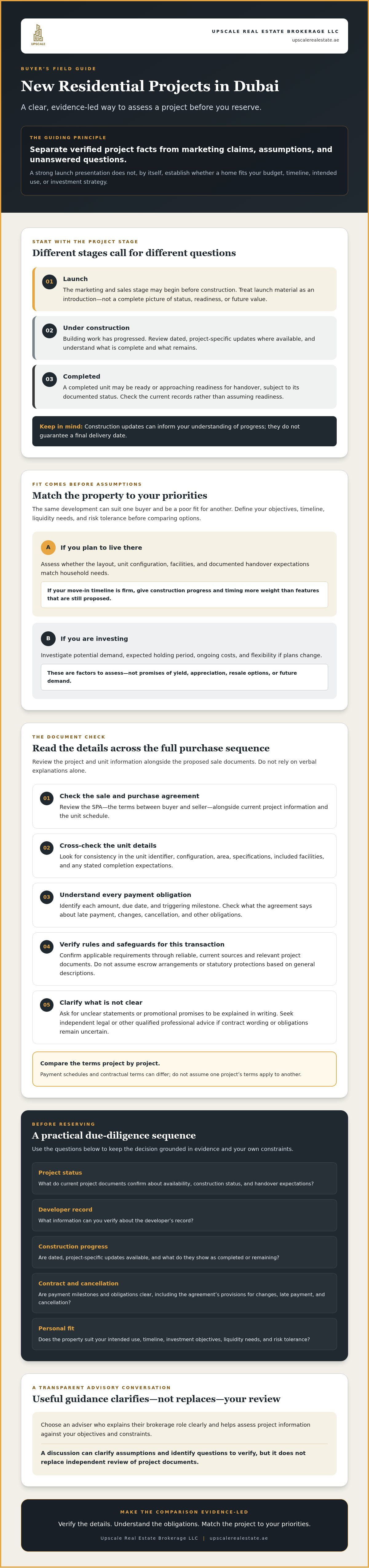
A practical due-diligence checklist before reserving a new property
A reservation is a financial and contractual step, not simply a way to hold a preferred unit. Before paying, follow a consistent sequence: define your intended use and timeline, verify current project and unit information, review the reservation conditions and sale documents, then seek independent advice on unclear terms. For new residential projects in dubai, confirm current regulatory requirements and transaction procedures with qualified professionals rather than inferring them from general guidance.
What should buyers verify before paying a reservation amount?
Confirm who you are contracting with and check the project and unit identifiers against the documents provided. Make sure the stated unit details, reservation amount, payment instructions, and other key terms are consistent across the reservation form and sale documents. If a material term is explained verbally but not recorded in writing, request written clarification.
Read the provisions for refunds, cancellation, transfer, and default before signing or paying. Establish what happens if you change your plans or miss a required payment. If an obligation or clause is unclear, pause and seek independent professional advice. Verify payment instructions through documented channels, especially if they are changed or communicated separately from the formal paperwork.
How can buyers test whether a project fits their plans?
Compare the documented project timeline with your intended occupancy date or ability to hold an investment. If you’re buying for personal use, consider whether a delay would disrupt your housing plans. If you’re investing, test whether you could retain the property longer than expected if resale takes time or market conditions change. Don’t treat a projected handover or exit date as certain unless the relevant terms are supported by the contract.
Use this checklist before proceeding:
- Clarify your objective: Define whether the purchase is for future occupancy, asset diversification, or investment.
- Verify project and unit details: Confirm the project’s current status, unit identification, specifications, and documented terms.
- Review payment obligations: Match each amount and due condition to the applicable written documents.
- Understand exit provisions: Check cancellation, refund, transfer, and default terms before committing.
- Keep an audit trail: Save project documents, written representations, questions, and responses, and note anything still unresolved.
- Confirm requirements: Ask a qualified professional to verify current regulatory and transaction procedures for your situation.
Before reserving, consider whether your plans can withstand changes in timing, costs, or resale expectations. To discuss your objectives and open questions, speak with an advisory-led brokerage.
Choose a transparent adviser and define your next steps
A useful project discussion should begin with your priorities, not a recommendation. Before speaking with an adviser about new residential projects in dubai, prepare a shortlist of intended use, preferred timing, budget constraints, and acceptable risk. Note which project details you need documented and which remain estimates.
What should you expect from a project consultation?
A buyer-led consultation should help organize options around your stated criteria. Ask for clear explanations of project documents, payment terms, and any assumptions behind a recommendation. If information is missing or uncertain, it should be identified as an open question rather than presented as fact.
Ask the adviser to explain their role in the transaction, including whether they represent a brokerage and how that role relates to the project or seller. Verify relevant credentials independently through appropriate official channels. Assess recommendations against your priorities, not urgency, launch messaging, or claims of guaranteed performance.
How can Upscale Real Estate support a considered purchase?
Upscale Real Estate Brokerage LLC supports off-plan project sales and investment advisory. Its advisory-led approach can help buyers clarify project information, compare options against their objectives, and discuss investment assumptions, risks, and intended holding strategy. This support can bring structure to the decision, but it cannot guarantee delivery outcomes, rental demand, appreciation, or returns.
The brokerage is RERA-licensed with ORN 23084. Buyers can verify credentials and should still independently review current project records, developer information, construction updates, and contractual terms before making a commitment. A transparent adviser should distinguish verified details from estimates and explain what needs further confirmation.
- Before the discussion: Note your intended use, timing, constraints, and unresolved questions.
- During the discussion: Ask how each option fits your criteria and which details are verified.
- Before deciding: Check credentials and arrange independent review of documents or terms you don’t understand.
A measured next step is to discuss your priorities and questions without treating the conversation as a commitment to buy. Discuss new residential project options with Upscale Real Estate and use the conversation to identify details that still need verification.
Make your next property decision with clarity
Choosing among new residential projects in dubai starts with matching documented facts to your intended use, timeline, and risk tolerance. Compare unit details, project progress, payment obligations, and contractual terms side by side. Treat projected rental income, appreciation, and handover timing as matters to verify, not outcomes to assume.
A considered purchase also depends on asking clear questions and tracking what remains unconfirmed. An adviser can help organize options and discuss investment assumptions, but project documents and relevant requirements still need careful review.
Upscale Real Estate Brokerage LLC is a RERA-licensed brokerage with ORN 23084, providing off-plan sales and investment advisory. To discuss your objectives and questions about a potential purchase, discuss your project criteria with Upscale Real Estate.
Frequently Asked Questions
What should I check before buying a new residential project?
Check that the project and unit details are supported by current documents, then review the sale terms, payment schedule, construction status, and stated handover information. Confirm that the unit configuration and specifications match what you’re considering. Assess whether the timeline and obligations suit your intended use, liquidity needs, and risk tolerance. Verify applicable UAE transaction requirements with a qualified professional before committing, and keep written records of documents and answers.
Is buying an off-plan residential property risky?
Off-plan purchases involve risks that differ from buying a completed home, including uncertainty around construction progress, timing, market conditions, and eventual resale or rental demand. The level of risk depends on the project, contract terms, and your financial position and plans. Review project-specific documents and applicable safeguards rather than assuming they are identical across developments. Consider whether you could manage a delay or a longer holding period before making a commitment.
How do I compare new residential projects fairly?
Compare documented fundamentals using the same criteria for each option: unit configuration, usable space, facilities, project status, payment obligations, and contractual handover terms. Mark each item as a verified fact, an assumption, or an unanswered question. For investment comparisons, model potential rent and costs using relevant evidence, and state assumptions such as vacancy and holding period. Treat advertised yields and appreciation as claims to verify, not assured results.
Can a developer change the handover date or project specifications?
The answer depends on the sale and purchase agreement and the circumstances it addresses. Review clauses covering handover timing, permitted changes, notice, and remedies, and ask for unclear wording to be explained before signing. Don’t assume a projected date in marketing material has the same status as a contractual term. If a proposed change or delay arises, compare it with the signed documents and seek qualified independent advice on your situation.
What documents should I review before reserving an off-plan unit?
Review the reservation form, sale and purchase agreement, project information, unit schedule, specifications, payment milestones, and any documents describing completion or handover. Confirm the counterparty, project and unit identifiers, and terms for refunds, cancellation, transfer, and default. Check that payment instructions are documented and consistent with the formal paperwork. If a term is missing, unclear, or inconsistent, request written clarification and obtain independent professional advice before paying.
Are projected rental yields or appreciation guaranteed for new projects?
No. Rental yields and appreciation projections are estimates, not assured outcomes. Actual performance can differ because of rental demand, vacancy, ownership costs, market conditions, and the price or timing of a future sale. Ask what evidence supports a projection and whether it relates to the specific unit and a comparable period. For a more grounded assessment, model different scenarios and separate verified inputs from assumptions about income, costs, and resale value.
Should I use a real estate adviser when evaluating a new project?
An adviser can help organize project information, compare options against your objectives, and identify assumptions or unanswered questions. Clarify the brokerage role and verify relevant credentials independently. Upscale Real Estate Brokerage LLC is a RERA-licensed brokerage with ORN 23084 and provides off-plan sales and investment advisory. Advisory input can support your review, but it doesn’t replace examining documents or guarantee construction, rental demand, appreciation, or investment returns.