
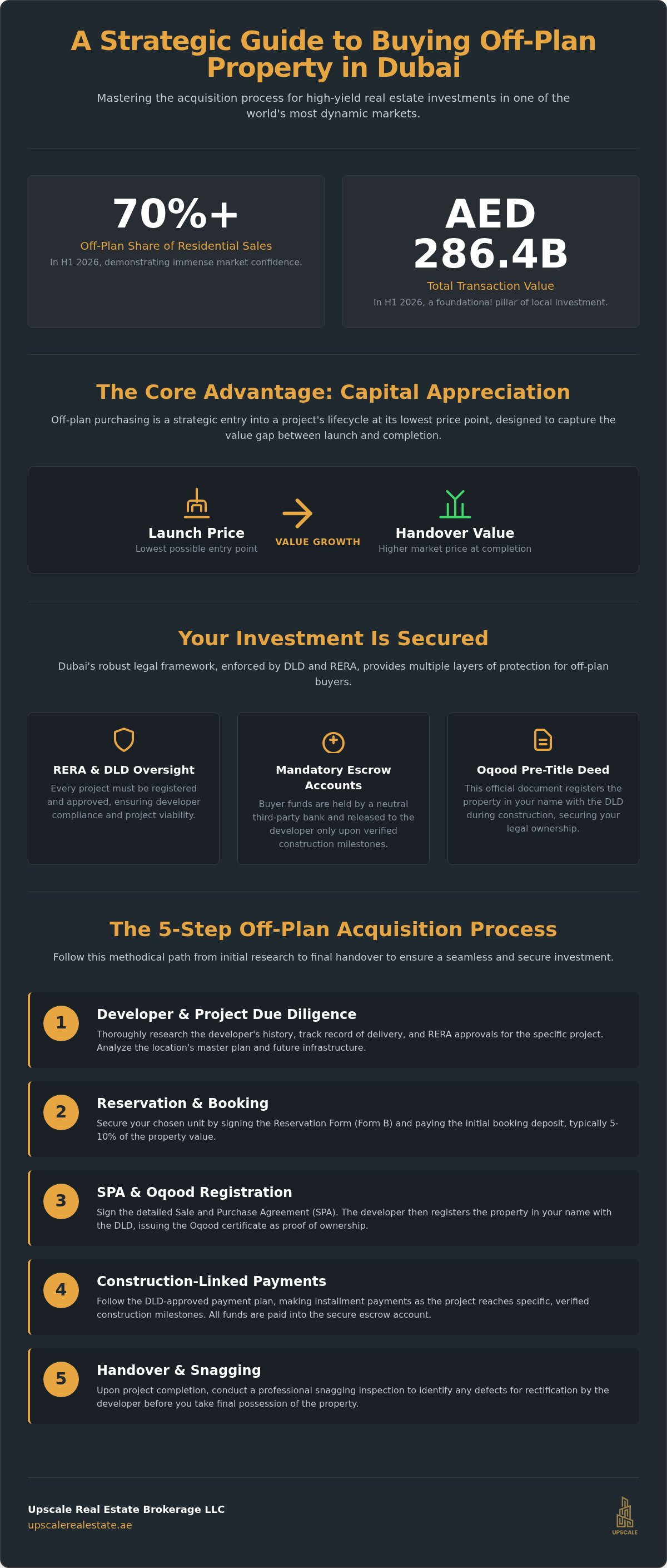
In the first half of 2026, off-plan properties accounted for over 70% of all residential sales in Dubai, representing a staggering AED 286.4 billion in transaction value. While these figures signal immense market confidence, you likely feel a lingering hesitation regarding project delays or the perceived lack of transparency in developer reputations. It's natural to prioritize security when significant capital is at stake; you want to ensure your investment is grounded in more than just a marketing brochure. Learning how to buy off-plan property in Dubai requires a shift from viewing the purchase as a simple transaction to treating it as a strategic financial operation protected by world-class regulatory frameworks.
This guide provides a comprehensive roadmap to mastering the acquisition process with total transparency. We'll explore the legal protections mandated by the Dubai Land Department, including the critical role of RERA-approved escrow accounts and the 2026 compensation laws for project delays. By the end of this analysis, you'll have a clear path from the initial reservation to the final handover, ensuring you secure a high-yield asset at the most competitive entry price. We'll break down the mechanics of modern payment plans and developer due diligence so you can build your portfolio with absolute confidence.
Key Takeaways
- Understand the financial logic of capital appreciation and how entry-level pricing serves as a primary driver for long-term investment yields.
- Identify the critical legal safeguards provided by the Dubai Land Department, including the mandatory use of project-specific escrow accounts.
- Master a methodical five-step process on how to buy off-plan property in Dubai, ensuring each milestone from due diligence to reservation is managed with precision.
- Analyze the strategic advantages of various payment structures, including post-handover plans, to optimize your cash flow and portfolio growth.
- Prepare for a successful handover by implementing professional snagging inspections and developing a clear transition strategy into the rental market.
The Strategic Logic of Buying Off-Plan Property in Dubai
Success in the Dubai market starts with understanding the specific mechanics of an Off-plan property acquisition. At its core, this involves purchasing a residence or commercial space during the planning or construction phase, long before the physical structure is complete. For the sophisticated investor, this isn't merely a purchase; it's a strategic entry into a project’s lifecycle at the lowest possible price point. By securing an asset early, you're positioning yourself to capture the inherent value gap that exists between a project's initial launch and its final handover.
When you evaluate how to buy off-plan property in Dubai, the logic of capital appreciation becomes clear. Developers offer discounted rates during the early stages to incentivise capital inflow. As construction milestones are reached, the perceived risk decreases and the market price typically rises. This creates a built-in ROI that ready properties simply can't match in a short timeframe. Beyond the financial upside, early acquisition grants you the first choice of prime units. Securing a corner villa or a high-floor apartment with unobstructed views ensures your asset remains highly desirable when it eventually hits the secondary market.
Yield Potential and Market Appreciation
The gap between launch pricing and handover value is a primary driver for institutional and private wealth. Historical modeling shows that off-plan assets in Dubai often outpace ready properties during high-growth cycles, particularly in emerging master communities. Strategic selection is vital here. You should focus on projects with high exit liquidity; these are properties in locations where demand consistently exceeds supply. This ensures that once the building is complete, you can either flip the contract for a capital gain or transition into a high-yield rental model with a lower cost-basis than your peers.
The 2026 Market Context
The current landscape reflects a maturing market where off-plan properties accounted for over 70% of residential sales in the first half of 2026. This dominance is driven by a shift in supply-demand dynamics; institutional investors are increasingly moving toward off-plan portfolios to hedge against the rising costs of ready-to-move assets. With total property sales reaching AED 286.4 billion in H1 2026, the data confirms that how to buy off-plan property in Dubai is no longer just a trend, but a foundational pillar of local investment strategy. To better understand the nuances of this choice, you may find our detailed comparison on Off-Plan vs. Ready Property in Dubai: A 2026 Strategic Investor’s Guide useful.
The Legal Framework: Safeguarding Your Investment
The legal landscape of Dubai's real estate market is governed by a robust framework designed to eliminate ambiguity and protect capital. The Dubai Land Department (DLD) and its regulatory arm, the Real Estate Regulatory Agency (RERA), serve as the primary authorities overseeing every transaction. For those exploring how to buy off-plan property in Dubai, understanding these protections is the first step toward a secure acquisition. Every developer must register their project with RERA and establish a dedicated escrow account before a single unit can be sold.
This escrow account is a critical safeguard. Instead of the developer receiving your funds directly, payments are held by a third-party bank. These funds are only released in stages, strictly tied to verified construction milestones. This system provides several layers of protection:
- Capital Security: Your investment is used exclusively for the construction of your specific project.
- Transparency: Progress is audited by RERA before funds are released to the developer.
- Risk Mitigation: If a developer fails to meet milestones, the remaining funds stay protected within the account.
Understanding Escrow and Oqood
The Oqood certificate is your most vital document during the construction phase. It acts as a pre-title deed, officially registering the property in your name within the DLD’s system. This registration provides legal visibility and ensures the property cannot be sold to multiple parties. These laws have simplified how to buy off-plan property in Dubai by creating a predictable environment for international capital. To delve deeper into these administrative structures, you can read our guide on Understanding the Dubai Land Department: A 2026 Investor’s Strategic Overview.
Investor Rights in Case of Delays
Accountability has reached new heights with the 2026 regulatory updates. As of January 1, 2026, developers are legally required to compensate buyers for delays that exceed a six-month grace period. This compensation is set at 1% of the property value for every month of delay. If a project faces cancellation, the Judicial Committee oversees the liquidation of developer assets to ensure investors are prioritised for refunds. We recommend that you always review your Sales and Purchase Agreement (SPA) with a qualified strategic consultant to ensure all delay clauses and payment milestones are transparently documented. This level of due diligence transforms a standard purchase into a secure, high-yield financial operation.
The 5-Step Off-Plan Acquisition Process
Executing a successful acquisition requires a methodical approach that prioritizes data over marketing rhetoric. Understanding how to buy off-plan property in Dubai involves navigating five distinct milestones, each designed to protect your capital and ensure the delivery of a high-quality asset. This process transforms a conceptual project into a registered financial interest, moving from initial selection to a disciplined payment schedule.
Initial Reservation and Due Diligence
Before committing capital, you must verify the project’s legitimacy. Use the Dubai REST app to confirm the project’s registration number and the status of its mandatory escrow account. We recommend a deep track-record analysis of the developer, looking beyond recent launches to their historical handover quality. The process often begins with an Expression of Interest (EOI). This is a refundable deposit that secures your position in the queue for prime units. Once you select a unit, you'll sign a formal reservation agreement and pay an initial down payment, which typically ranges from 10% to 20% of the property value. This step is vital for investors who want to learn how to buy off-plan property in Dubai while securing the best possible floor plans.
Formalising the Purchase
The transition from reservation to ownership involves signing the Sale and Purchase Agreement (SPA). This document is the cornerstone of your investment; it outlines the payment schedule, the anticipated completion date, and specific unit specifications. You should scrutinize clauses related to the mandatory six-month grace period and the 2026 delay compensation protocols. Following the SPA, you're required to pay the Dubai Land Department (DLD) transfer fee, which is 4% of the purchase price. For properties valued above AED 500,000, a trustee registration fee of AED 4,000 plus 5% VAT also applies. These payments trigger the issuance of your Oqood certificate, which serves as your official pre-title deed during the construction phase.
The final stage is adhering to the construction-linked payment plan. Your payments aren't arbitrary; they're tied to verified milestones such as the completion of the foundation or the building's structure. This structure ensures your capital is only deployed as physical value is added to the site. Maintaining discipline with this schedule is essential for protecting your legal standing and ensuring a seamless transition to the final handover and title deed issuance. By following this roadmap, you move from a speculative interest to a secured, high-value real estate asset.
Evaluating Developers and Payment Plan Structures
Choosing the right partner is the most consequential decision in the acquisition lifecycle. When you're determining how to buy off-plan property in Dubai, you must look beyond the glossy renderings and focus on the developer's historical delivery data. The market is broadly divided between Tier 1 established entities and emerging boutique developers. Tier 1 firms offer a high degree of security and a proven track record of maintaining community standards, which often translates to stable long-term yields. Emerging developers, however, can offer more aggressive entry prices and innovative architectural concepts that may yield higher capital appreciation if the project is executed correctly.
Developer Grading and Risk Assessment
A rigorous risk assessment involves analyzing the delta between a developer’s marketing brochures and their finished projects. You should inspect previous handovers to evaluate construction quality, material durability, and the efficiency of their property management. At Upscale, we prioritize transparent developer partnerships, focusing only on entities that demonstrate meticulous adherence to professional standards and local protocols. This advisory-led approach ensures your capital isn't just deployed, but protected. If you're ready to begin your search, our team provides expert investment advisory to help you identify the most secure opportunities in the 2026 market.
Analysing Payment Plan Sustainability
Payment structures are the primary tool for managing your cash flow. Most projects follow a 50/50 or 60/40 model, where a portion is paid during construction and the remainder at handover. A critical distinction is between "completion-linked" and "time-linked" plans. Completion-linked plans are safer; they tie your payments to physical construction milestones verified by RERA. Time-linked plans require payments on specific dates regardless of construction progress, which can increase your financial exposure if the project faces delays. Some developers now offer Post-Handover Payment Plans (PHPP), extending for up to three years after completion. While these ease the initial financial burden, they often come with a slightly higher purchase price, so you must model your net yield carefully.
Don't overlook the secondary costs that impact your initial liquidity. Beyond the 10% to 20% down payment, you'll need to account for the 4% DLD registration fee and the AED 4,000 trustee fee (for properties above AED 500,000). Additionally, once the property is handed over, service charges will apply based on the square footage. Factoring these into your financial modeling is essential for a grounded understanding of how to buy off-plan property in Dubai. By aligning your payment schedule with your long-term liquidity strategy, you transform a property purchase into a sustainable financial asset.
Post-Handover: Portfolio Management and Exit Strategies
The completion of a project marks the transition from a capital-deployment phase to an operational one. While understanding how to buy off-plan property in Dubai involves navigating legal and financial hurdles, the post-handover phase determines your long-term success. The process begins with a formal snagging and inspection. This is a technical audit where you or a professional representative ensure the unit’s finishes, MEP (mechanical, electrical, plumbing) systems, and overall layout strictly adhere to the standards promised in your SPA. Identifying defects early ensures the developer rectifies them under the one-year defect liability period, protecting your asset's value from day one.
Professional Property Management Solutions
For remote investors or those with multi-unit portfolios, professional property management is essential for maintaining high occupancy and optimizing yields. Effective management goes beyond simple rent collection; it encompasses rigorous tenant vetting, proactive maintenance, and strategic rental advisory. By positioning your property correctly within the 2026 market, you can capitalize on the average gross residential rental yield of 6.6%. For a deeper look at optimizing your assets, refer to our guide on Real Estate Portfolio Management in Dubai: The 2026 Investor’s Strategic Guide.
Strategic Exit Planning
Your exit strategy should be as data-driven as your acquisition. Many investors aim for "Peak Appreciation," which typically occurs in the window immediately following handover when the community’s infrastructure is fully realized. However, you can also sell an off-plan property before completion. Most developers require a minimum payment threshold, often between 30% and 40% of the total property value, before they'll issue a No Objection Certificate (NOC) for resale. This ensures the buyer has a significant equity stake in the project before a secondary market transaction occurs.
When deciding whether to flip or hold, consider the current supply-demand dynamics. With villas projected to appreciate by 5% to 7% in 2026, holding for long-term rental income might offer superior total returns compared to a quick liquidation. Mastering how to buy off-plan property in Dubai means having a clear vision for the asset's entire lifecycle, ensuring every move aligns with your broader financial objectives. By treating the handover as a strategic milestone rather than a finish line, you ensure your portfolio remains resilient and high-performing.
Securing Your Future in Dubai's 2026 Real Estate Market
Navigating the complexities of the 2026 market requires a shift from speculative buying to strategic asset management. You've seen that the strength of your investment lies in regulatory transparency, specifically the 2026 delay compensation laws and the security of project-specific escrow accounts. Mastering how to buy off-plan property in Dubai isn't just about selecting a unit; it's about conducting rigorous developer due diligence and aligning payment structures with your long-term liquidity goals. By treating the handover as a transition rather than a finish line, you ensure your portfolio remains resilient and high-performing.
As a RERA-licensed brokerage (ORN 23084), Upscale provides the end-to-end investment advisory you need to move from initial reservation to meticulous portfolio management. We don't just facilitate transactions; we act as your grounded partner in a sophisticated landscape. Consult with Upscale for your off-plan investment strategy to ensure your next acquisition is protected by data and local mastery. Your journey toward a high-yield, secure asset starts with a single, well-informed decision.
Frequently Asked Questions
Can foreigners buy off-plan property in Dubai?
Foreign nationals can purchase off-plan property in Dubai within designated freehold zones, which include major investment hubs like Downtown Dubai and Dubai Marina. This ownership structure grants full title rights to the land and the building. The process is straightforward for international investors; it doesn't require residency status to begin the acquisition. Understanding how to buy off-plan property in Dubai as a non-resident involves providing a passport copy and adhering to the developer's specific payment schedule.
What happens if a developer cancels an off-plan project?
If a developer cancels a project, the Real Estate Regulatory Agency (RERA) oversees the liquidation process to protect investor capital. Funds held in the mandatory escrow account are returned to the buyers. Under the latest 2026 protocols, the Judicial Committee for Cancelled Real Estate Projects manages the distribution of developer assets if the escrow balance is insufficient. This ensures that your financial interests remain a priority and that the refund process is conducted with full regulatory transparency.
How much is the initial down payment for off-plan property?
The initial down payment typically ranges from 10% to 20% of the total purchase price, depending on the developer's specific payment structure. This payment is usually required at the time of signing the reservation agreement or the Sales and Purchase Agreement (SPA). In addition to this down payment, you must budget for the 4% Dubai Land Department (DLD) transfer fee. These initial outlays secure your unit and initiate the official Oqood registration process within the DLD system.
Can I sell my off-plan property before it is finished?
You can sell your off-plan property before construction completion, provided you meet the developer’s minimum payment threshold. Most developers require that 30% to 40% of the property value is paid before they issue the necessary No Objection Certificate (NOC) for resale. This secondary market transaction allows you to realize capital appreciation before the final handover. It's a common strategy for investors learning how to buy off-plan property in Dubai with the intent of exiting at a project's peak appreciation window.
Are there any hidden fees when buying off-plan?
While most costs are transparent, you must account for specific administrative fees beyond the purchase price. These include the 4% DLD transfer fee, a trustee registration fee of AED 4,000 plus 5% VAT for properties above AED 500,000, and a title deed issuance fee of AED 580. Some developers may also charge an administration fee for processing the Oqood. It's also vital to factor in future service charges, which are calculated per square foot once the property is handed over.
What is an Oqood certificate and why do I need it?
An Oqood certificate is a mandatory pre-title deed that registers your off-plan property in the Dubai Land Department’s system during the construction phase. It serves as legal proof of ownership and ensures the developer cannot sell the same unit to multiple parties. This registration is a critical safeguard for your investment; it provides the visibility needed for future resale or financing. Without an Oqood, your interest in the property isn't officially recognized by the local regulatory authorities.
How do I verify if a project has a RERA-approved Escrow account?
You can verify a project's escrow status using the Dubai REST app, which is the official digital platform of the Dubai Land Department. By entering the project's registration number, you can view the escrow account details, the bank name, and the current construction progress percentage. This transparency allows you to confirm that your payments are being managed according to RERA regulations. Checking these details is a fundamental step in conducting proper due diligence before committing any capital to a new development.
Is off-plan property eligible for a UAE Golden Visa?
Off-plan properties are eligible for the UAE Golden Visa, provided the property value meets the minimum threshold of AED 2 million. Investors can apply for this long-term residency once they've paid a specific portion of the property value, as determined by current immigration and DLD policies. This visa offers significant stability for international owners and their families. We recommend consulting with a strategic advisor to ensure your chosen off-plan asset meets all the legal requirements for this specific residency program.